Get Full Government Meeting Transcripts, Videos, & Alerts Forever!
Get email alerts on the Economic Opportunity Collaborative topic
No spam. Unsubscribe anytime.
Consultants pitch ‘opportunity collaborative’ hub to connect Waukegan residents to jobs and services
Summary
Consultants working with the city of Waukegan outlined a plan to create one or more neighborhood “opportunity collaborative” hubs to centralize services, coordinate providers and track outcomes for residents facing concentrated economic distress.
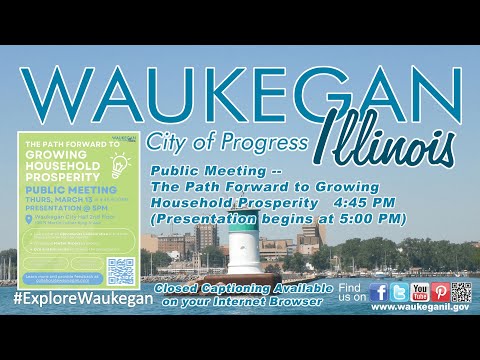
Consultants Mike Higbee and Shelley Moore, engaged by the city of Waukegan, told a public meeting that an “opportunity collaborative” — a small number of local hubs linking residents to job training, health care, childcare and other wraparound services — could help households move out of long-term economic distress.
The consultants and Noelle Kisher Lepper, director of planning, zoning and economic development for the city, presented study findings and asked meeting participants for ideas about locations and partners to operate the hubs. “What if there was a clear place to access opportunity in Waukegan? What if everybody knew where to go?” Mike Higbee asked the room during his presentation.
Why it matters: Consultants said many Waukegan neighborhoods show concentrated, persistent economic distress on commonly used measures — poverty, education attainment and median income — and that existing providers are not organized to scale to local need. A collaborative model would centralize access, coordinate service providers, help match residents to job pipelines and allow the community to track short- and medium-term outcomes rather than waiting multiple years for census updates.
Key points: Higbee and Moore described several features of the proposed model: one or more local hub sites that are walkable or on strong bus routes; a unified intake or “dashboard” of outcome metrics (employment, education, service utilization, housing stability); closer connections between service providers and employers to build career pathways and reduce “failure to stay” in jobs; and wraparound supports such as childcare, transportation and health care that help residents maintain employment and training.
The consultants cited national and local data to frame the need. They said about 20,000 Waukegan residents live in poverty and estimated roughly 15,000 households experience some level of economic distress; in parts of the city fewer than 30% of working-age residents go on to postsecondary education, far below the state norm. Higbee highlighted labor force participation that is “higher than the state norm” but with lower median wages, meaning many residents work in lower-paying jobs despite high participation.
Residents and local providers who spoke at the meeting emphasized transportation, access to high-quality health care, financial literacy, and better referrals/case management as priorities. One attendee said long waiting lines and uncertainty about whether a referral will lead to help undermines trust and prevents people from following up. Another suggested the library, downtown, and areas near transit as likely hub locations.
The consultants described a practical approach: map distressed census tracts (they examined 19 tracts with most land area inside the city), test a one-mile radius around a central tract (census tract 8620) as a potential focal area, and pursue a business plan that combines reorganizing existing resources with seed capital to reach scale. They said hubs should aim to be financially sustainable within three to four years.
What officials and providers asked for: Attendees were asked to identify strong local partners to sit at the collaborative table; suggestions included local nonprofits, community colleges, libraries, workforce centers, health providers and park districts. Providers and residents urged making intake and navigation simple and ensuring that measured outcomes are visible to the public.
Next steps: The team asked participants to submit ideas through the project website, collaboratewaukegan.com, and said they plan follow-up work and another public meeting in roughly one month. The consultants asked the community to provide location suggestions and inform which providers should be “at the table” in an initial leadership group.
Ending: Organizers left a printed summary at the meeting and directed attendees to the project website for the full report and a corrected page of materials. They said outreach and design work will continue between public meetings.