Get Full Government Meeting Transcripts, Videos, & Alerts Forever!
Get email alerts on the Transportation Impact Fees topic
No spam. Unsubscribe anytime.
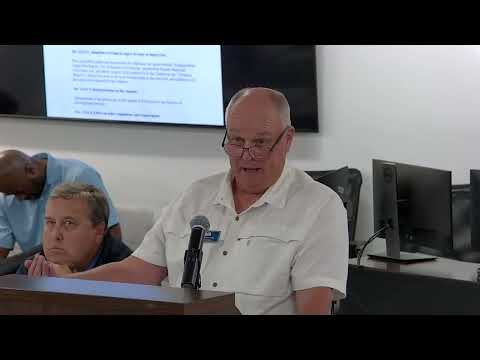
Panama City staff outline transportation impact-fee ordinance changes; builders press for exemptions and delay
Summary
City Manager Jonathan Hayes and planning staff presented a revised transportation impact-fee ordinance and redline changes at a public workshop in Panama City, proposing exemptions for some homes and accessory dwelling units and saying collection would not begin "no sooner than October first of 2025."
City Manager Jonathan Hayes and planning staff presented a revised draft transportation impact-fee ordinance at a public workshop in Panama City, outlining proposed exemptions and credits and saying collection would not begin "no sooner than October first of 2025." The presentation included a redline version of the ordinance and a summary of feedback from earlier meetings.
The proposal would exempt new single-family homes on existing platted lots that are less than 2,400 square feet of heated and cooled space; exempt accessory dwelling units under 1,200 square feet; provide credits for previously existing nonresidential uses on a parcel and for public and municipal facilities; and allow appeals of planning-board decisions on impact fees to circuit court. Vincent Spar of Kimley-Horn, the consultant who prepared the study, and city staff said the draft also contains a credit for development orders, building permits or plats issued before the ordinance's effective date.
Why it matters: city staff argued that transportation impact fees shift the cost of new capacity needed for roads, turn lanes, traffic signals, sidewalks and bike lanes from the general fund to development that generates new trips. "Should the city's general fund pay for any and all types of development?" Hayes asked, saying staff believes the answer is no and that some growth-related capacity should be paid through fees tied to new development.
Builders, developers and commercial brokers pushed back. Kirk (identified in the meeting as a representative of the Bay Building Industries Association) raised wording and timing concerns and asked the city to clarify whether remodeling, change of occupancy and reconstruction rules still trigger fees. Brian Knox of Costa Classic Homes urged the city to extend the smaller-house credit beyond only existing lots of record, saying, "we need that to be across the board for new or existing because we we need more of that product, and we don't need to make that product more expensive." Chase Gruber of Fisher Homes and other builders warned the proposed fees — which the study estimated in many typical cases at several thousand dollars per unit — would raise costs that builders would pass on to buyers.
Commercial developers also criticized specific fee assignments. Jim Everett, a commercial real-estate broker, said the model's high fee for gasoline/convenience stores would make new investment in those uses economically infeasible and urged a commercial roundtable to refine trip assumptions. Staff and the consultant explained that the trip-generation calculations use Institute of Transportation Engineers data and apply pass-by-adjustment factors (for many convenience/gasoline uses only 25% of trips are treated as new) and that the ordinance includes a data-review pathway: developers can submit traffic studies or other evidence, signed and sealed by a professional engineer, to justify a lower fee for a particular project.
Several speakers raised administrative and legal questions. Builders asked how long credits, refunds and appeals will be tracked and who would notify owners eligible for refunds; Michael Hudson and others warned that splitting credits across subdivided lots could create substantial administrative burden. Staff said the city's permitting and records systems can track credits and that the ordinance includes provisions intended to split credits proportionally when platted lots are reconfigured. The draft also allows director-level review in certain cases where a development was in progress when the ordinance took effect.
On policy options staff and attendees discussed possible mitigations. Hayes and staff said a phased implementation is possible (for example, a multi-year ramp-up at partial rates) and noted that the City Commission retains the authority to delay or amend the ordinance later. Multiple industry speakers asked the commission to postpone a projected vote so that stakeholders could continue discussions and explore adjustments to fee levels, timing and credit rules.
No formal action was taken at the workshop; staff said the workshop's purpose was to receive public feedback and finalize wording before the ordinance proceeds to the Planning Board and City Commission for their consideration.
Ending: Staff asked participants to provide additional written comments and data; several industry representatives said they would push the City Commission for a delay and urged additional roundtables on commercial trip assumptions, credit administration and a possible phased-in schedule.