Get Full Government Meeting Transcripts, Videos, & Alerts Forever!
Get email alerts on the Psps Outages topic
No spam. Unsubscribe anytime.
Villa Park residents press Edison on repeated public-safety power shutoffs, company outlines mitigations
Summary
Southern California Edison gave a technical briefing and took questions at a Villa Park town hall after multiple public-safety power shutoffs (PSPS) left parts of the city without electricity for extended periods this winter, but residents said company explanations and recent equipment work have not resolved the problem.
Southern California Edison gave a technical briefing and took questions at a Villa Park town hall after multiple public-safety power shutoffs (PSPS) left parts of the city without electricity for extended periods this winter, but residents said company explanations and recent equipment work have not resolved the problem.
Cynthia Quimby, government relations manager for Southern California Edison, told the meeting the decision to cut power “is not something that we take lightly” and described PSPS as a “tool of last resort” used when weather and vegetation conditions raise the risk of ignitions.
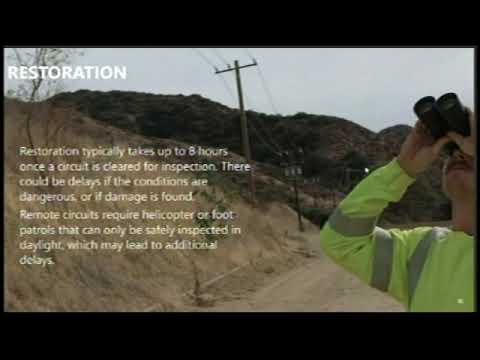
Quimby said Edison bases PSPS choices on a fire potential index, on-the-ground field observations and wind forecasts from company meteorologists and a private weather-station network. She said the company runs incident-management teams during events and that restoration requires field patrols and authorizations that can take “1 hour” to “up to 8 hours.”
Why this matters: residents described repeated outages — one speaker said they were without power for nearly seven days in January and multiple shorter outages earlier — disrupting households, businesses and schools and prompting neighbors to consider whole-house generators. City leaders pressed Edison for clearer timelines and concrete fixes.
Edison presentations and resident exchanges
At the start of the town hall, SCE described the scale of its territory and assets: a service area the company described as about 50,000 square miles with roughly 51,000 miles of overhead lines and about 1.4 million poles and towers; the company said 27% of its territory and 14,000 miles of lines are in CPUC-designated high-fire-threat areas. Quimby and outage-and-communications staff said their meteorologists and fire-science teams combine vegetation dryness sampling with recorded wind thresholds to decide whether to de-energize circuits.
Luis Slade of SCE’s customer engagement/outage-management teams urged customers to keep contact information up to date and described programs aimed at customers with medical needs, including a critical-care backup battery option and loaned batteries during events. Slade said SCE deploys community resource centers and mobile units that offer charging and information during PSPS events.
Chris Clark, district manager for SCE’s Santa Ana district, described grid-inspection and hardening work tied to Villa Park’s Iran circuit. Clark said SCE “installed a little over 3 miles of covered conductor in 2024” in Villa Park and nearby Orange, completed more than 100 maintenance work orders on high-fire circuits in the area, and conducts annual drone inspections on Tier 2/3 overhead structures. Clark said covered conductor reduces the wind thresholds at which the company would consider a PSPS but cautioned that “it’s not going to be 0” and that extremely high winds can still produce outages.
Residents challenged maps, communications and the timing of equipment updates
Multiple residents said SCE’s public-facing outage maps during January were inaccurate and that some parts of Villa Park were shut off while nearby areas stayed powered. One resident asked whether a covered-conductor project finished in December 2024 should have prevented earlier shutdowns; Clark and Quimby said the December work was completed before the January event but that the January storm was unusually severe and that in some prior events the upgraded conductor may have prevented outages. Quimby acknowledged notification problems in January and said the company is evaluating a new notification platform and improvements to the outage map.
Residents pressed the company about vegetation management and property easements along the creek crossing where lines span a canyon. Clark said SCE maintains vegetation near its structures and that routine clearance requirements apply; he said some land in the creek area is owned by outside agencies (for example, water-district land), and that SCE would coordinate with outside owners but could not claim sole responsibility for all adjacent brush. Villa Park Division Chief Kevin Federman explained that Cal Fire’s hazard-mapping (state responsibility area and local hazard maps) is based on state modeling and has not included local-agency input in recent iterations.
Community impacts and requests
Speakers described real-world consequences: lost food, disrupted medical needs, and school closures (a private-school principal said shutoffs cost the school 11 days of instruction). Several residents said repeated outages in the same neighborhoods have prompted homeowners to purchase whole-house generators; others asked whether Edison would subsidize or otherwise offset those costs. Edison representatives did not commit to credits or generator subsidies; they reiterated that undergrounding is costly and often infeasible and that engineering, permitting, easements and community impacts limit some options.
What Edison pledged and what the city will do next
SCE outlined near-term actions and ongoing work: continued grid-hardening projects, engineering studies to better segment circuits, additional inspections and a planned migration to a new notification platform. Quimby said the company will continue dialogue with the city and report technical findings to senior management. The city said it will post the slide deck and video from the town hall and continue to gather resident concerns and technical follow-ups; council members encouraged residents to submit additional questions to City Hall.
Attribution and accuracy
Direct quotations and speaker attributions in this article come from the town hall transcript and are attributed only to speakers recorded speaking at the meeting. No formal votes or ordinances were discussed or adopted at the event.
Ending: The town hall closed with city officials committing to continue talks with Edison and with residents urging faster, visible fixes for neighborhoods that have seen repeated PSPS interruptions.