Get Full Government Meeting Transcripts, Videos, & Alerts Forever!
Get email alerts on the Stormwater Flooding topic
No spam. Unsubscribe anytime.
Punta Gorda seeks engineering study and valve inspections after repeated downtown flooding
Summary
City staff said they will contract an engineering and survey firm to study downtown drainage and help seek grants; divers will inspect tide valves that residents suspect are leaking. No formal council vote was taken at the March 11 workshop.
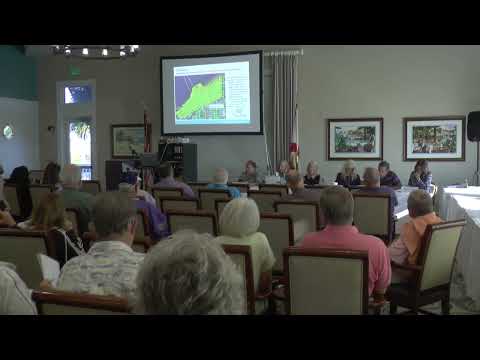
PUNTA GORDA, Fla. — Punta Gorda city staff said Tuesday they have put out a request to hire an engineering and survey firm to study downtown flooding, develop design options and assist with grants and construction procurement, and that separate inspections by divers are planned for the tide valves that residents say let seawater into the storm system.
City Engineer Brian Clements described the scope as a multi‑phase effort to analyze roughly 400–500 acres of downtown drainage — extending from the harbor to the railroad bed, and roughly between Cooper and Berry streets — and to identify upgrades, costs and permit requirements. He said the project would be contracted under a five‑year master agreement and divided into data collection and modeling, design (30/60/90/100%), and construction support and closeout. "I'm the City Engineer. I've been with the city for a little over 4 years," Clements said while outlining the phases.
Why it matters: business owners and residents described repeated "sunny day" and surge flooding in the historic downtown and urged quicker repairs and short‑term measures while the study and larger projects move forward. Speakers said flooding has damaged downtown storefronts and homes and is harming the local economy; staff and outside experts said large projects will likely need federal and state grant funding.
What city staff said they will do - Procure an engineering/survey consultant to compile existing data, survey missing areas, model rainfall and surge scenarios, produce design options, support permitting and assist with grant applications. - Stage the effort in three phases: Phase 1 — data collection and modeling; Phase 2 — construction plans and permitting; Phase 3 — construction assistance, responses to contractor requests and permit close‑out. - Ask divers to inspect the city’s TiteFlex (tide) valves at the 10 outlet locations to determine whether leakage or other faults are contributing to inland flooding, and to prepare bid specifications for repairs if needed.
City manager and procurement timeline City Manager Melissa Reindeer told the workshop the consultant solicitation is on the street and "closes, I believe, on March 24," after which proposers will be evaluated on qualifications. Staff described the procurement as a typical multi‑step process and said their intent is to have critical valve inspections done before the upcoming hurricane season where possible.
Public concerns and technical points raised - Several property and business owners said they have photographic or video evidence of water rising through storm drain grates on high tides with no rain, and asked whether the TiteFlex valves are leaking. Resident and building owner Mark Joffer said he had "photographic evidence of a total sun day ... a video of the water coming out of the storm system." City staff said divers will be used to check valves that are underwater and not otherwise visible. - Ron Adams, public works, described ongoing maintenance: "That Vactor truck is out on the road approximately 60% of the working days of the year, which works out about 3 days a week," meaning city crews regularly clean inlets and pipes but cannot access some underground valves without divers. - Joan Leveau, planning director, said code compliance letters have gone to owners of properties with impervious surfaces downtown and reinspections and enforcement are underway. "Letters have gone out to the owners. Reinspections will be done," she said. - Several speakers urged the city to look beyond gray infrastructure: suggestions included "sponge city" approaches, expanded mangrove and living‑shoreline projects, reclaimed water, and temporary pumping or bladder storage as short‑term mitigation while larger projects proceed.
Outside experts and funding Jennifer Hecker of the Coastal & Heartland National Estuary Partnership (CHNEP) said CHNEP is funding a regional vulnerability assessment and offered technical and grant‑coordination help. She urged staff to model multiple scenarios — including at least the 100‑year rainfall standard used in state vulnerability work — and to coordinate with county, state and federal partners, including the U.S. Army Corps of Engineers and FEMA, both of which have programs relevant to large coastal risk projects.
Staff cautioned that solutions and costs vary by objective: preventing every street from becoming wet during an ordinary rain is a different engineering problem from protecting buildings against a large storm surge. Speakers also noted that some storm drains fall within Florida Department of Transportation (FDOT) or Charlotte County rights‑of‑way, which limits the city's unilateral control over those drains; staff agreed to provide a map of jurisdictional responsibilities.
Short‑term measures and next steps City staff and speakers discussed short‑term options staff can pursue now (more frequent cleaning, marking and exercising valves, temporary pumps in targeted streets) while the consultant models long‑term improvements. Staff said they will: share with council and the public a map identifying drains under city, FDOT and county jurisdiction; proceed with procurement evaluation after March 24; schedule diver inspections for TiteFlex outlets; and include grant‑writing assistance in the consultant scope.
No formal votes No council motions or formal votes were taken at the workshop; the session was structured for information, public input and to set procurement and study direction.
What's next Staff said they will report procurement outcomes and consultant recommendations to council when modeling and options are available, and will continue to work with CHNEP, Charlotte County, FDOT, FEMA and other agencies on funding and implementation.