Get Full Government Meeting Transcripts, Videos, & Alerts Forever!
Get email alerts on the Solid Waste Collection topic
No spam. Unsubscribe anytime.
Republic Services details missed pickups, transload fixes and automation options for Peabody
Summary
Republic Services told the Peabody City Public Services Committee it recorded 46 missed residential pickups since Jan. 1, described a transload workaround with Covanta that costs about $150,000 a year, and urged the city to consider automated carts and vehicles to improve safety, service consistency and recycling diversion.
Republic Services representatives told the Peabody City Public Services Committee on March 13 that the company logged 46 missed residential pickups in the city since Jan. 1 and has taken steps — including a transload agreement with Covanta — to reduce route delays while urging the city to move from manual collection toward automated carts and trucks.
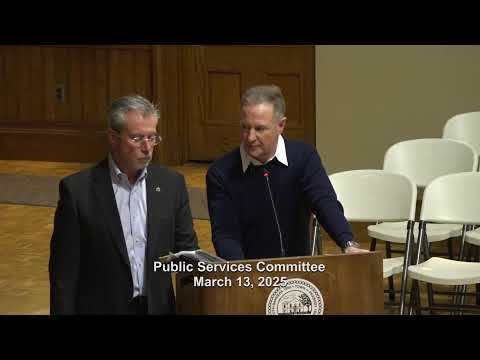
The report came during a presentation by Dan Higgins, area sales manager for municipal sales at Republic Services, and Brian Skene, general manager for Republic's Northeast Massachusetts business unit. Higgins said the company's route records show 242,000 truck drive-bys in Peabody since Jan. 1 and a reported on-schedule completion rate “about 99.9098%.” He added the company typically recovers reported missed pickups the same day or the next day.
The committee was shown a packet of materials that included route and service data; the committee voted to receive the packet as a late communication. The packet, Higgins said, also documented operational challenges Republic faced last year at the region's disposal/energy-from-waste facilities — long wait times at the city's designated incinerator forced crews off routes and created federal-hours-of-service complications for drivers.
To address those delays, Higgins said Republic Services entered a transload agreement with Covanta to dump trucks at a closer facility in Danvers and then move loads to the incinerator at off-peak hours. "To be frank with you, it's costing us about a hundred $50,000 a year to do that," Higgins said, but the arrangement keeps trucks in neighborhoods completing routes.
Republic representatives made repeated pitches for the city to consider automated collection with carts. Higgins and Skene said automation typically reduces labor exposure (from two-person manual crews to one-person truck operation), improves safety, increases recycling diversion and can lower disposal costs.
"Our experience is that towns that go from a manual collection program to automated with carts ... you can increase that diversion by about 10% to 28% potentially," Higgins said, estimating that a similar shift in Peabody could yield roughly $300,000 a year in disposal savings based on current rates cited by the company. Skene and Higgins said carts typically cost $35 to $55 apiece delivered and assembled, depending on size, and that MassDEP and other grant programs can provide per-cart assistance.
Councilors pressed Republic for operational details and short-term fixes. Ward representatives asked whether smaller trucks could be allocated to older, narrow streets to reduce missed pickups caused by parked cars; Skene said the company has two smaller "pop trucks" used as chase trucks and would evaluate dedicating or staging appropriately sized automated trucks if the city moved to automation. Councilors also asked about customer service: company staff said residents should call their local Republic supervisor (identified in the meeting as "Katie") or the Republic call center to report missed pickups; the company said supervisors staff the business unit through evening hours and that an app called Track My Truck (described in the packet) will be implemented this year to allow municipal residents to check truck location and report misses.
Republic said it will renovate its Peabody recycling center (company figure cited: about $25,000,000) to add optical sorters and increase throughput; Higgins said upgrades aim to make recyclables cleaner and more valuable for markets. The company also described pilot and fleet options such as electric vehicles and reiterated that widespread industry trends favor automation; they said few contractors still bid strictly manual-collection contracts.
Committee members and Republic representatives agreed to continue conversations with the mayor's office about contract terms and the practicalities of transitioning to carts and automated equipment before the contract term ends in June 2031 (the packet notes optional extension years). Councilors asked Republic to develop a proposal the mayor could review; Republic said it would pursue that and continue working with city staff.
Committee members repeated constituent complaints about leaf-collection and tote damage. Republic acknowledged this year’s heavy leaf season and described limits on how much yard waste crews can collect per stop, the difficulty of balancing leaf collection with trash and recycling priorities, and routine replacement of damaged totes or lids when appropriate.
Votes at a glance: the committee voted to receive Republic Services’ packet as a late communication; the meeting adjournment motion passed at the end of the session.
The presentation will feed follow-up discussions between Republic, the mayor's office and city staff on whether and how to stage an automated conversion, how to size and place carts, possible funding sources for carts and the implications for the existing contract and annual budget.