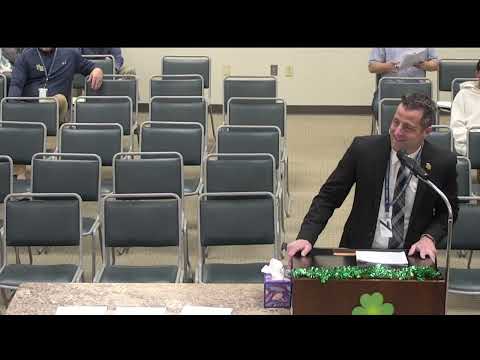
Franklin Regional board hears questions about out-of-district related-services contracts and billing
Loading...
Summary
Public commenters asked whether the district is operating without contracts and how charges for out-of-district occupational and physical therapy are handled; Dr. Rogalski explained legal obligations under federal and state special-education law and described why separate contracts sometimes are needed.
Helen Elliott and other public commenters pressed the Franklin Regional School District on March 10 about a contract listed in the committee packet for occupational and physical therapy services that referenced providers outside the district.
Elliott said she was concerned the contract packet listed a February 13 date and asked whether the district was “operating under a non contract,” why a Latrobe provider was listed and who was paying monthly invoices noted in the documents.
Dr. Rogalski, speaking for district staff, told the board that when a student is identified as needing special-education services the district must provide any related services required by that student’s individualized education program so the student can receive a free and appropriate public education. He said those related services can include nursing, transportation, orientation and mobility, occupational therapy and physical therapy.
“Sometimes we have students who need an out-of-district placement because we’ve tried everything that we can within our setting,” Rogalski said. He added that when an out-of-district placement is required the district may need separate contracts because some providers cannot travel to distant facilities or because the external facility does not itself provide the required service.
Rogalski said the February date on the packet reflected when a contract was drafted after students moved into a facility and that “those services have not been provided yet until it is approved by the school board.” He said Camco (a contracted company) is used to provide services inside school settings and that other vendors (he named Adelphi and Children’s Institute as examples) may be contracted for residential or other out-of-district placements.
On legal authority, Rogalski said service decisions are made by an IEP team that includes parents and staff, guided by federal law (IDEA) and Chapter 14 of the Pennsylvania School Code. He said the district budgets for special-education costs during annual budget planning, but that placements and needs “ebb and flow” as students enter or leave the district.
Public commenters asked whether students in the cited contract live at the facilities or travel there. Rogalski said for the contract in question the students were not residential but that the district does sometimes educate students in residential settings and must contract for services if required.
The comments and staff responses were recorded during the committee of the whole and regular board meeting; no formal vote specifically on this contract was reported in the public record excerpt provided.
The discussion clarified the district’s legal obligation to provide related services and why the district occasionally must use separate contracts for services provided at out-of-district facilities.