Get Full Government Meeting Transcripts, Videos, & Alerts Forever!
Get email alerts on the Land Use Development topic
No spam. Unsubscribe anytime.
Planning commission approves 1-year extension for Pines at Stone Ridge preliminary plat
Summary
On March 13, 2025, the Woodland Park Planning Commission voted unanimously to grant a one-year extension for the Pines at Stone Ridge preliminary plat, preserving previous conditions of approval and aligning the plat’s expiration with the PUD master plan.
The Woodland Park Planning Commission unanimously approved a one-year extension of the Pines at Stone Ridge preliminary plat at its March 13, 2025 meeting, extending the plat’s expiration to April 14, 2026.
The extension preserves an earlier approval that allows 77 total dwelling units on about 9.01 acres southeast of Bridgestone Drive and Research Drive. The project was originally approved as 58 apartment units and 19 patio homes; a subsequent planned-unit-development (PUD) amendment reconfigured the project to 49 townhomes and 20 patio homes. Staff described minimum and average lot sizes for patio homes as 3,581 square feet minimum with an average about 4,672 square feet, and townhome lots at 1,862 square feet minimum and about 2,452 square feet on average. Anticipated building footprints given in the packet were about 2,185 square feet for patio homes and 1,287 square feet for townhomes.
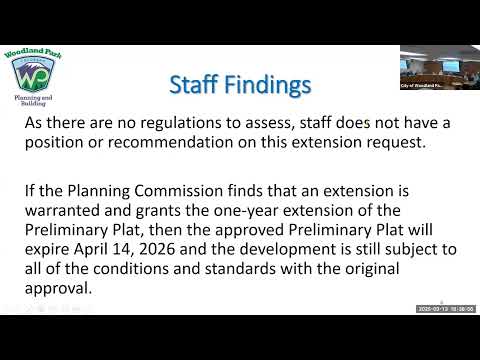
The application is a straight extension request and does not seek changes to prior conditions of approval. Staff told the commission that the preliminary plat and condition number 6 within Resolution 921 (included in the staff report) address earlier utility easement concerns raised by Core Electric. "This application does not seek to change any prior conditions of approval," staff said, and added that, because the packet contains no new regulatory requirement to guide extensions, staff offered no formal recommendation for approval or denial of the extension.
Core Electric submitted a written comment objecting to the extension on the grounds that the submittal did not meet the utility’s easement requirements. Staff and the applicant said that Core raised similar concerns during the initial review in 2022 and that the parties previously resolved those concerns as part of the original approval. Staff told the commission that the previously approved condition addressing minimum driveway length resolves Core’s earlier comment; staff said the applicant will need to work with Core as the project proceeds.
Applicant Craig O'Boyle, representing Go Beyond LLC, told the commission the request is purely to extend the approved preliminary plat and not to amend prior approvals. He said market conditions and contractor availability delayed construction: "It's been a very challenging...three years in this business," O'Boyle said, and added the applicant owns the property outright and recently obtained a new bid for site work from a local contractor.
Staff also noted that existing grading and infrastructure zoning development permits (ZDPs) and approvals remain active but cautioned that if construction does not commence by Jan. 16, 2026, the applicant must renew the approved grading and infrastructure ZDPs. Staff explained two paths to final plat: (1) install the infrastructure and then submit a final plat for recording, or (2) submit a final plat before construction and provide financial security for remaining work through a subdivision improvement agreement recorded with the plat.
A motion to approve the one-year preliminary-plat extension as submitted carried unanimously. The roll call recorded affirmative votes from: Don DeSellum; Ken Hartsfield; Don Hoyne; Ken Kennedy; Jared Newcomb; Chair Brown; and Vice Chair Larson. The approval keeps the previously adopted conditions and standards in force and sets the preliminary plat expiration for April 14, 2026.
With the extension granted, the project remains subject to the conditions and standards from the original approval and to any required coordination with utility providers during final engineering and permitting.