Get Full Government Meeting Transcripts, Videos, & Alerts Forever!
Get email alerts on the Education Educator Workforce topic
No spam. Unsubscribe anytime.
Educator Advancement Council details statewide training, Grow Your Own investments and a missing $25 million in current service-level budget
Summary
The Educator Advancement Council told a legislative subcommittee it has built statewide infrastructure for professional learning and Grow Your Own educator pipelines but flagged a $25 million one-time shift that was omitted from the governor's current service-level budget for 2025–27.
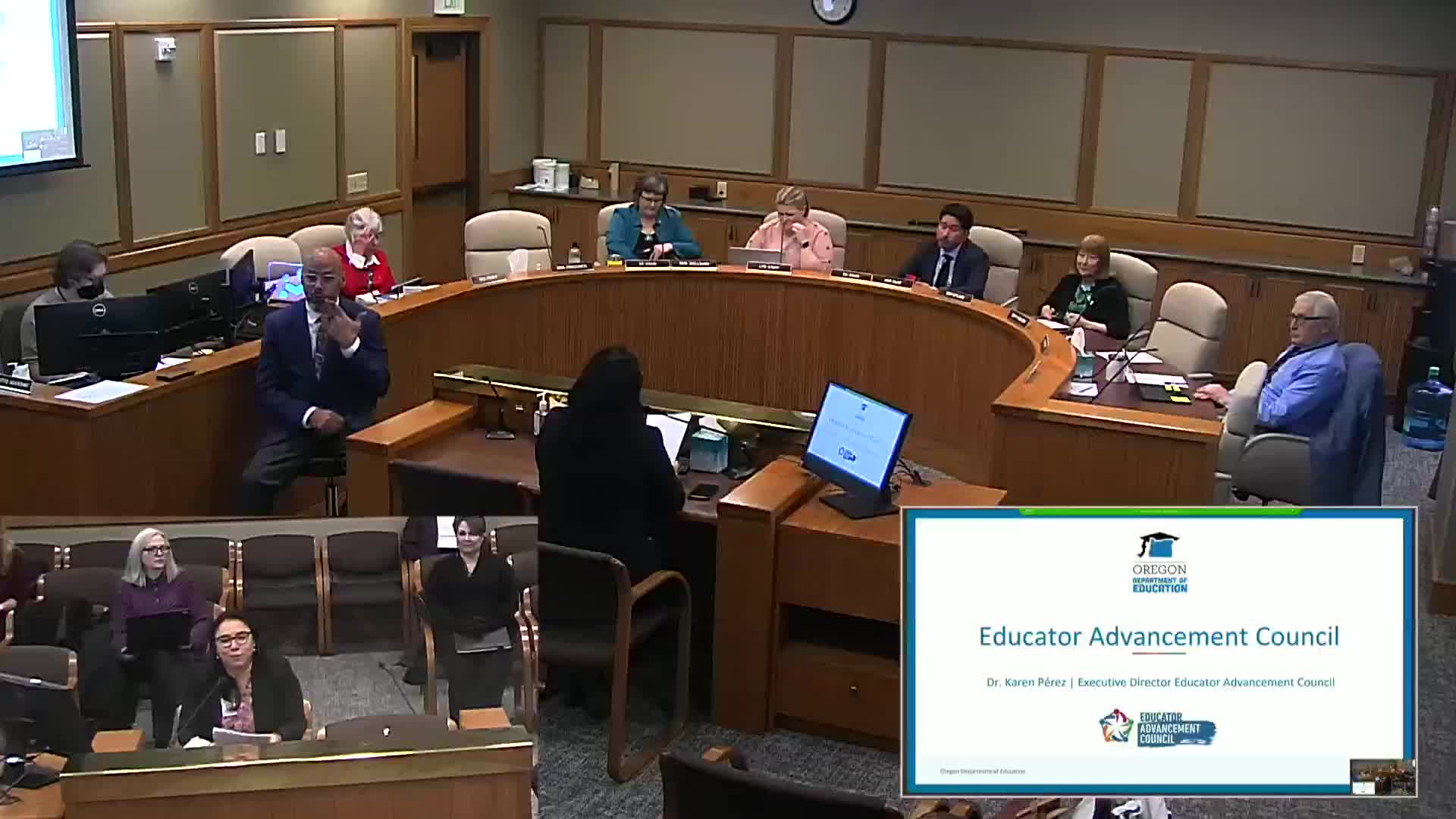
Dr. Karen Perez, executive director of the Educator Advancement Council, told the Joint Committee on Ways and Means Subcommittee on Education on March 13 that the council has established statewide infrastructure — regional education networks, Grow Your Own partnerships and a professional learning platform — to support Oregon’s preK–12 educators and teacher candidates.
The council, Perez said, was established by Senate Bill 182 in 2017 to expand access to culturally responsive professional learning and now oversees grant programs, regional networks and partnerships intended to recruit, prepare and retain educators. She told the committee the EAC has supported more than 13,000 educators and teacher candidates through the regional education networks and Grow Your Own initiatives and that the state-funded networks reach rural districts and districts with high need.
The EAC’s work matters because it aims to supply districts with trained teachers, mentors and coaches aligned to pending accountability and literacy standards. “The infrastructure of our program is now built, and we are aligning, refining, accountability measures, and growing best practices locally and statewide with continuous improvement at the center of our work for Oregon students,” Perez said.
Perez described three main EAC program areas: regional education networks (RENs), Grow Your Own partnerships, and a statewide professional learning platform. RENs, launched in 2019 with a $42 million investment, serve 97 school districts and 19 education service districts and are intended to deliver mentoring, instructional coaching and job-embedded professional learning without a competitive application process. The Grow Your Own portfolio — funded with more than $30 million since 2021, Perez said — includes pre-collegiate high-school pathways, district/ESD career-advancement programs for classified staff and partnerships between districts and educator-preparation providers.
Perez gave data from the current biennium and earlier cycles: more than 500 newly licensed educators were supported in a previous biennium; in 2023–24, EAC partners reported about 230 educator candidates earning licenses or certificates, more than 400 enrolled in licensure programs, and 313 high-school participants completing pre-collegiate Grow Your Own work with 68 enrolling in college programs. Perez said adult Grow Your Own participants number nearly 500 classified staff and that 516 adult participants are employed as licensed educators, with a mix of full teaching licenses, restricted licenses and emergency or substitute credentials.
On funding, Perez said the EAC received $67.9 million in “other funds” for the 2023–25 biennium, $10.4 million from ODE’s grant-in-aid budget for K–12 professional development, and $10 million in one-time grant funds. She also noted a budget issue for 2025–27: a $25 million one-time shift of unspent EAC balance (the Educator Advancement Fund) was omitted from the governor’s current service-level budget and the department is requesting restoration of that amount from the EAF ending fund balance.
Perez described recent statutory and budgetary actions the council implements: the EAC was created by Senate Bill 182 (2017); House Bill 5014 included a one-time budget direction that shifted $25 million of unspent EAF resources to fund Grow Your Own partnerships and related programs; and Senate Bill 283 included one-time funds for a new educator mentor program ($8 million) and a $2 million transfer to the Teacher Standards and Practices Commission for an apprenticeship program.
Committee members asked how RENs and the EAC will support upcoming accountability and literacy requirements. Perez said RENs are “uniquely positioned” to provide mentoring, coaching and technical assistance and that the EAC is developing a professional learning platform, expected to launch in June, to deliver free, standards-aligned courses statewide and to provide records districts can query for staff completion.
Perez and other presenters acknowledged data gaps the council is working to close. Committee members asked for more granular, matched data showing where participants live and work and which districts already teach the science of reading; Perez said the EAC is aligning its participant surveys with ODE data and referenced a study done with a university partner that the council can share.
The presentation emphasized cross-agency collaboration: EAC staff work with the Oregon Department of Education, the Teacher Standards and Practices Commission, the Higher Education Coordinating Commission and the Department of Early Learning and Care on scholarships, licensure reimbursement, multiple-measure assessment options and administrator scholarships.
The session was informational; the presenters did not propose or adopt any formal motions before the subcommittee.
Looking ahead, the EAC requested that legislators restore the $25 million one-time shift to the 2025–27 budget and continue funding for RENs, Grow Your Own partnerships and the statewide professional learning platform so the council can scale regional best practices and align training to forthcoming standards and licensure requirements.