Get Full Government Meeting Transcripts, Videos, & Alerts Forever!
Get email alerts on the Firearm Safety Prevention topic
No spam. Unsubscribe anytime.
Advocates: Oregon’s recent gun laws are saving lives but more action needed
Summary
Advocates told Oregon’s joint Judiciary committees that background checks, a child access prevention law, a ghost‑gun ban and extreme risk protection orders have reduced some harms but that more policies—dealer licensing, waiting periods and bans on rapid‑fire conversion devices—are needed to further cut firearm deaths.
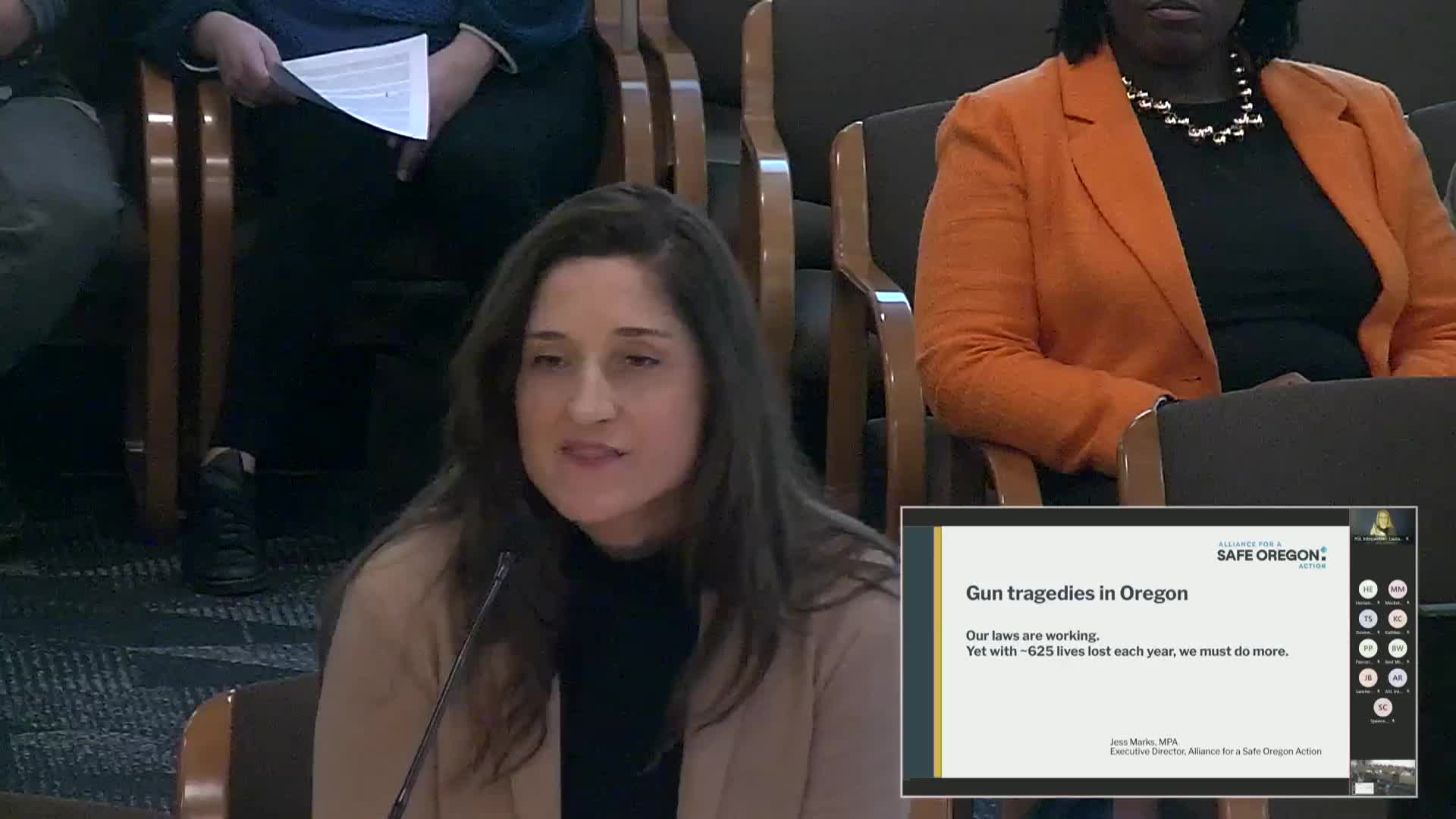
Jess Marks, executive director of the Alliance for a Safe Oregon, told the Senate and House Judiciary Committees that Oregon’s laws passed over the past decade have reduced some firearm harms but that the state must do more.
Marks said approximately 625 Oregonians die each year in gun‑related tragedies and that Oregon’s gun death rate — about 14.4 per 100,000 — remains high. She noted the state has roughly 50% household firearm ownership, higher in rural areas, and said that “these laws are making a big impact on reducing our rates of gun deaths while continuing to respect our tradition of historic firearm ownership.”
Marks listed laws she said are helping: expanded background checks, a ban on so‑called ghost guns, Oregon’s child access prevention storage law and the state’s extreme risk protection order (ERPO) law. She said background checks have prevented more than 10,000 firearm transfers in a recent five‑year period and described early enforcement of the ghost‑gun ban as “promising.”
At the same time, Marks argued that additional state policies could further reduce deaths and injuries. She identified possible next steps that have been raised during the hearing: licensing and oversight for in‑state gun dealers; banning rapid‑fire conversion devices; instituting a waiting period or permit‑to‑purchase system; and limits on certain high‑capacity or rapid‑fire devices. “Oregon can and should become a national leader,” Marks said, urging lawmakers to act with “courage.”
Marks asked legislative staff to ensure written follow‑up to committee questions would be preserved in OLISS, the legislative information system, so that the record is available to members and the public.
The presentation framed current laws as part of an incremental approach: advocates credited the existing statutes with measurable reductions in some harms while urging complementary supply‑side and implementation reforms that, they said, would reduce trafficking and misuse of firearms.
The hearing was informational; presenters noted questions would be answered in writing and that additional follow‑up between staff and presenters was expected.