Get Full Government Meeting Transcripts, Videos, & Alerts Forever!
Get email alerts on the Transportation And Economic Development topic
No spam. Unsubscribe anytime.
Business Oregon presents $1.5 billion infrastructure package, details on loans, grants and port funding
Summary
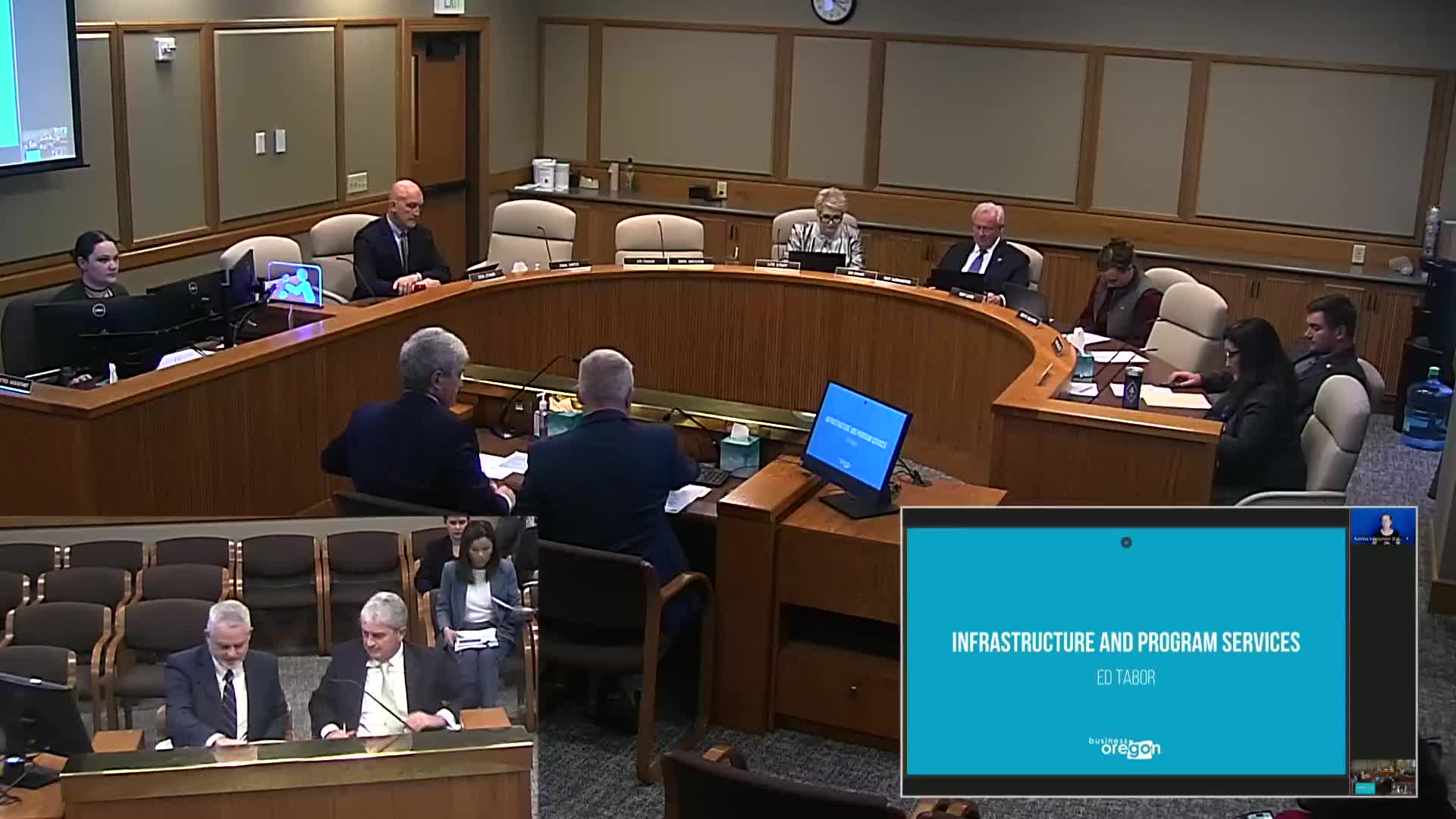
Ed Taber, infrastructure and program services director at Business Oregon, told the subcommittee the governor—s recommended infrastructure package totals $1.5 billion, about 74% of the agency—s $2.1 billion request.
Ed Taber, infrastructure and program services director at Business Oregon, told the Transportation and Economic Development Subcommittee the governor—s recommended infrastructure package totals $1.5 billion and makes up roughly 74% of the agency—s $2.1 billion request.
Taber described 13 key funding programs administered through the Infrastructure Finance Authority (IFA), an independent nine‑member board that provides oversight for IFA capital programs. He said IFA programs provide loans, grants, project management and technical assistance for water and wastewater systems, ports, brownfields remediation and other projects that support economic development.
Nut graf: The briefing included requests to recapitalize several revolving funds and one‑time bond requests to address high demand across the state — particularly in rural communities — and to provide local match for federal dredging and flood‑control projects.
Taber outlined multiple policy option packages and funding requests the department is presenting to the subcommittee:
- Special Public Works Fund (SPWF): The department requested $50,000,000 in one‑time lottery bonds plus lottery funds for debt service and cost of issuance to recapitalize a revolving loan fund that provides flexible financing for public infrastructure projects. Taber said a majority of awards are loans and that repayments average $12 million–$15 million per year, which is insufficient to sustain current pipeline demand.
- Levee (levy) Grant Fund: The department requested one‑time lottery bond funding to support levee repair, accreditation and maintenance for flood risk reduction. Taber said the program makes grants (no repayments) and that demand exceeds available cash balances.
- Brownfields programs: The department requested $10,000,000 (Brownfields Redevelopment Fund) and $5,000,000 (Brownfields Property Revitalization Fund) in one‑time lottery bonds; Taber said brownfields awards target both urban and rural projects and that the funds support loans, forgivable loans and grants to clean and repurpose contaminated properties.
- Ports and marine navigation: Taber described requests tied to dredging and port capital. The department asked for $15,000,000 in lottery bonds to support the Marine Navigation Improvement Fund (to help Port of Portland and other ports with dredging material placement and restoration), and requested $20,000,000 in lottery bonds to establish a Port Capital Improvement Fund (HB 3050) to assist ports that provide active container service. Taber and Deputy Director Chris Cummings clarified the Port of Portland funding commitments and related earlier governor commitments.
- Seismic Rehabilitation Grant Fund: The department requested $150,000,000 in Article XI general obligation bonds to retrofit K‑12 schools, community colleges and emergency services buildings; Taber said nearly every county has received at least one award historically and demand continues to exceed available funds.
Taber gave examples of recent awards: Sherwood received $12,000,000 to open industrial lands; Sweet Home received $2,000,000 for water main, laterals and hydrants; the Port of Toledo was cited as an SPWF beneficiary. He also said SPWF awards disproportionately benefit rural communities (90% of prior biennium awards by count were rural).
Committee members asked several questions about cash flow for lottery bond sales, repayment timing for revolving funds, local match requirements for federal programs, and how the department prioritizes projects across regions. Taber said projects are often reimbursed on a draw schedule, loan terms can be long (30 years for SPWF loans), and the department uses forecasting to manage cash flow.
Ending: Taber concluded his presentation and turned broadband questions to the Oregon Broadband Office director; the subcommittee did not take votes during the hearing.