Get Full Government Meeting Transcripts, Videos, & Alerts Forever!
Get email alerts on the Appropriations topic
No spam. Unsubscribe anytime.
State appropriations chair outlines $133 billion budget, highlights education, human services and transit investments
Summary
Pennsylvania House Appropriations Committee Chair Jordan Harris presented an overview of the governor’s $133 billion budget proposal in a South Philadelphia community briefing and answered residents’ questions about education, human services, transit and housing funding.
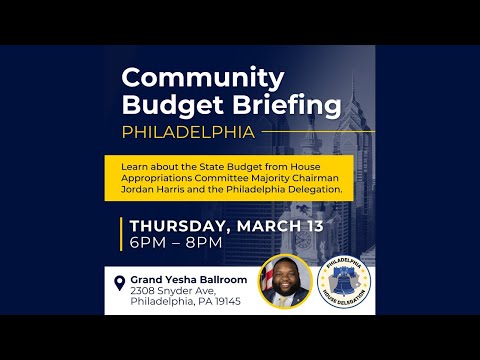
Pennsylvania House Appropriations Committee Chair Jordan Harris, joined by Philadelphia delegation leaders, presented an overview of the governor’s $133 billion budget proposal and answered community questions at a South Philadelphia briefing Thursday evening.
The presentation laid out how the proposal would allocate roughly $51.4 billion in the state’s general fund, about $53.1 billion in federal funds and a series of restricted and other funds. "Pennsylvania's budget is a hundred and $33,000,000,000 — it's so much money that you just can't even conceptualize it," said Courtney Richardson, the Appropriations Committee executive director, as she described the document’s scale and major spending categories.
Why it matters: Committee leaders said the briefing was meant to make technical budget details accessible to neighborhoods that will be affected by funding decisions and to solicit local input before final negotiations in Harrisburg. Delegation members and staff emphasized that the proposal is the governor’s starting point and must still clear the General Assembly and any subsequent negotiations.
Top allocations and proposals
- Education: Committee staff described continued installments aimed at closing Philadelphia’s school funding “adequacy gap,” which the briefing identified as about $1.25 billion. Sean Brandon, the committee’s education analyst, said the proposal includes an annual installment in the range of $136 million toward that gap, plus $440 million for special education and $75 million for basic education increases. The officials said the school district of Philadelphia received about $2.44 billion from the state last year.
- Human services and health: The Department of Human Services (DHS) constitutes the single largest share of the general fund. Committee staff said the governor proposed roughly $2 billion of additional DHS funding over the prior year, and itemized proposed increases including $20 million for county mental-health services, $10 million for the 988 crisis network, $5.8 million for diversion and discharge programs and targeted amounts to support hospitals, neurodegenerative disease research and reentry medical assistance.
- Child care and workforce: The proposal includes $55 million intended for recruitment and retention in early childhood and child-care workforce programs, and $10 million for increased rates for early-intervention providers. A First Up representative at the meeting said, "Child care teachers make on average $15.15 an hour," and urged lawmakers to preserve the proposed funding.
- Transit: Officials described a mechanism that would transfer additional sales-and-use-tax revenue into the public-transportation trust fund. The presentation said SEPTA received $153 million from the Commonwealth in November 2024 and that an increase in the trust fund could provide roughly $167 million more in the upcoming fiscal year; the briefing also recited last year’s Commonwealth support for SEPTA at about $1.06 billion.
- Housing: The executive proposal includes $50 million for a housing-stock restoration program to help homeowners make repairs and $10 million for first-time homebuyer assistance. Chair Harris noted the state sometimes routes funds through local governments or existing local programs when the state does not directly administer a program.
- Public safety and violence prevention: The budget would add funding for violence-intervention grants and a crime-lab contribution to Philadelphia; the briefing cited a $5 million Commonwealth contribution for a city crime lab and noted a proposed $76.5 million package for violence intervention and prevention boosts.
Proposed revenue changes
Officials described a package of revenue measures to help balance the plan, including a proposal to raise the state minimum wage to $15 an hour with a $9/hour tipped-worker rate (effective 1/1/2026), a proposed start of adult-use cannabis sales 1/1/2026 with a 20% wholesale tax and related licensing, and an expansion of the video-gaming-terminal tax to include certain “skill” gaming machines with a proposed 52% tax split between the general fund and the lottery. Staff estimated revenues from adult-use cannabis and skill games in the hundreds of millions in the first fiscal year.
Public questions and community concerns
During a sustained Q&A, community members pressed officials on gaps they said remained in the proposal. A domestic-violence advocate asked why the state crisis-line appropriation had not increased; Mara, the committee’s DHS analyst, replied that the governor’s proposed DHS package did not increase that specific line, and reiterated that the governor’s document is a proposal that the General Assembly can change.
Child-care providers and advocates asked how likely it is that the $55 million workforce investment would survive negotiations; Harris and staff said the delegation intends to defend that line but urged local advocacy across the state because members from other regions must approve final spending.
Seniors and housing advocates asked about whole-home repair programs; committee staff said $50 million for housing stock restoration is included in the proposal but noted execution often depends on local administration and the city’s choices about how to use state funds. A constituent who described making $100 above poverty asked which agencies set eligibility rules; staff responded that many assistance thresholds are federal, while others are state-determined and vary by program.
Higher-education, scholarships and Head Start
Officials said the governor proposes modest increases for state system campuses (PASSHE) and specific line items such as Lincoln University, and a new performance-based component for Penn State, Temple and Pitt that will allocate a competitive pot (approximately $60 million referenced in the briefing) against metrics that are still being finalized. Sean Brandon (education) and other staff said state grant programs administered by PHEAA remain largely need-based and that the proposal aims to maintain the maximum state grant.
Process and next steps
Chair Harris and delegation members reiterated that the governor’s document is a starting point: "This is a proposal," Harris said, adding that the House and Senate can move numbers, add lines or subtract them and that negotiations will continue through the spring budget cycle. Officials urged residents to contact state and federal elected officials about priorities, and they recommended follow-up with staff for case-specific eligibility questions.
No formal votes or committee actions occurred at the briefing; it was an informational outreach and Q&A session. Committee staff encouraged attendees to submit additional feedback and to meet with legislative offices if specific local program details or individual eligibility questions need review.
Audience turnout and context
The briefing drew multiple Philadelphia-area representatives, appropriations staff and a range of community advocates and service providers. The session lasted roughly an hour and a half and focused on explaining the major numbers in the governor’s proposal, programmatic priorities (education and DHS) and the procedural steps for converting a proposal into law.
The meeting closed with a reminder from Harris that while the state will act where possible, the delegation cannot fully replace major federal funding cuts should they occur and asked constituents to contact federal officials about proposed reductions that could affect Medicaid, education and other programs.