Get Full Government Meeting Transcripts, Videos, & Alerts Forever!
Get email alerts on the Epidemiology topic
No spam. Unsubscribe anytime.
Public health experts: firearm suicides drive Oregon’s high gun-fatality rate
Summary
OHSU-PSU researcher Kathleen Carlson told joint Judiciary committees that firearm fatalities in Oregon are driven disproportionately by suicide, with rural residents and veterans especially affected, and urged lethal-means interventions and better state data.
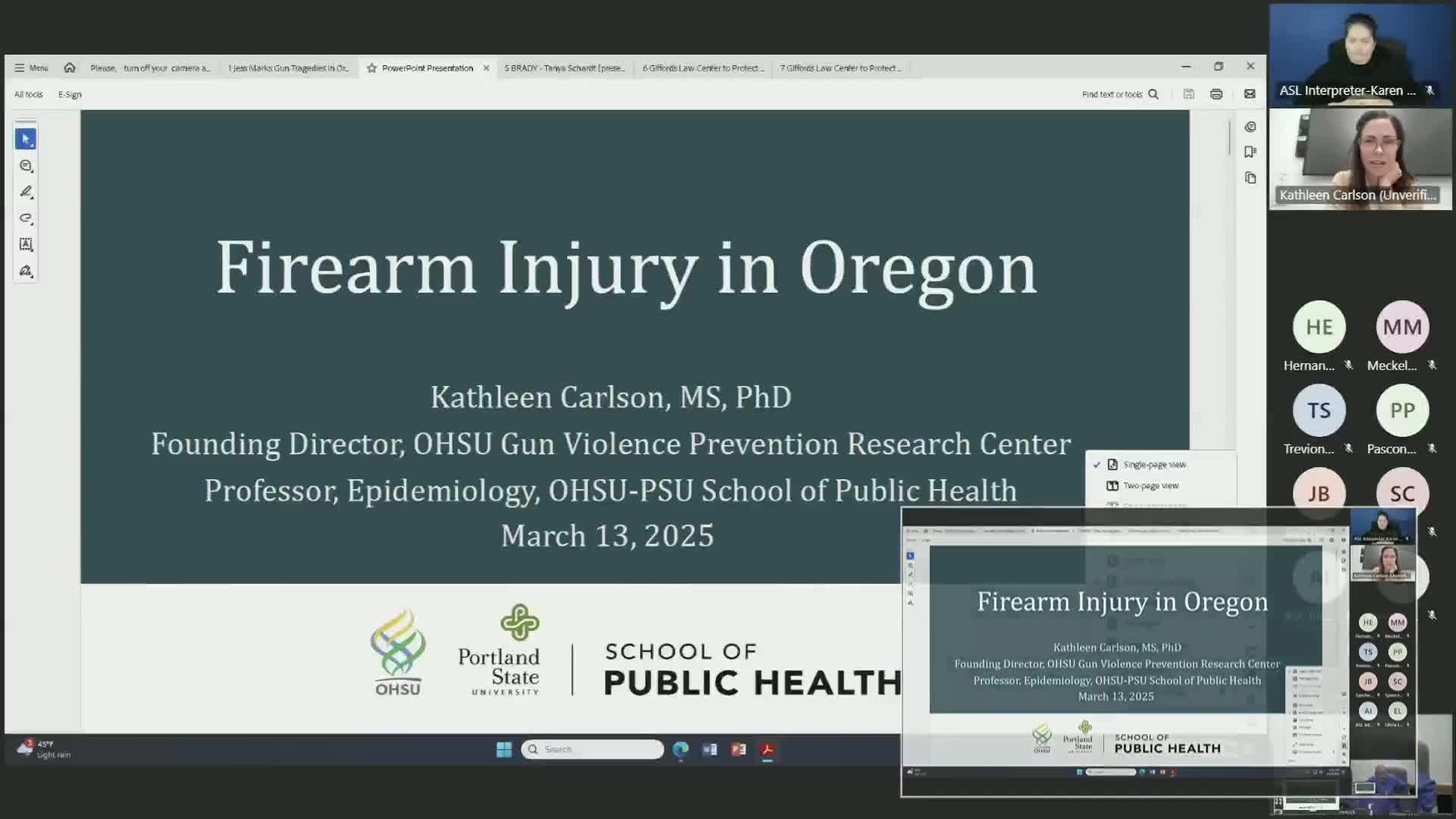
Dr. Kathleen Carlson, injury epidemiologist at the OHSU–PSU School of Public Health, told the joint Senate and House Judiciary committees that firearm deaths in Oregon are higher than U.S. averages and that suicide accounts for most of those fatalities.
"In Oregon, 77 percent of all of our firearm deaths are related to suicide," Carlson said, summarizing state data covering the most recent five years. She reported approximately 3,100 firearm fatalities in Oregon across that five-year window and an annual average near 625 deaths.
Carlson highlighted that, nationally, firearm fatalities average about 45,000 per year and that U.S. rates for both firearm homicide and suicide have increased over the past two decades. In Oregon specifically, she said firearm suicide rates are substantially elevated compared with neighboring states: roughly 22% higher than Washington and 74% higher than California.
She emphasized where the burden falls: rural regions had a 66% higher firearm suicide rate than nonrural regions between 2019 and 2023, and veterans experienced markedly higher suicide rates (a cited example showed a 92% higher rate among veterans for a single year). Carlson also called attention to racial disparities in firearm homicide: rates among Black and African American Oregonians were reported at 25.6 per 100,000 compared with 2.5 per 100,000 among white Oregonians for the period cited.
Carlson urged policies that separate people at heightened risk from lethal means — secure storage, waiting periods and ERPOs — and recommended that the state fund ongoing, Oregon-specific research to evaluate policy impacts.
The testimony stressed nonfatal injuries as well: Oregon had roughly 4,900 emergency department visits for firearm injuries in the 2018–2024 window cited by Carlson. "For every fatal firearm injury, there are about two to three nonfatal injuries," she said.
No committee action was taken during the informational hearing.