Get Full Government Meeting Transcripts, Videos, & Alerts Forever!
Get email alerts on the Gun Laws Overview topic
No spam. Unsubscribe anytime.
Advocates say Oregon's recent gun laws have saved lives but more measures needed
Summary
Speakers at a joint informational hearing told the Senate and House Judiciary committees that Oregon's background checks, child access prevention and extreme risk protection order laws have reduced harm but that gaps remain — notably dealer oversight, rapid-fire conversion devices and broader restrictions other states use.
An informational hearing of the Oregon Senate and House Judiciary Committees heard Thursday that laws passed over the past decade — including background checks, Oregon's child access prevention law and extreme risk protection orders (ERPOs) — have reduced gun deaths but more policy changes are needed to further lower firearm fatalities.
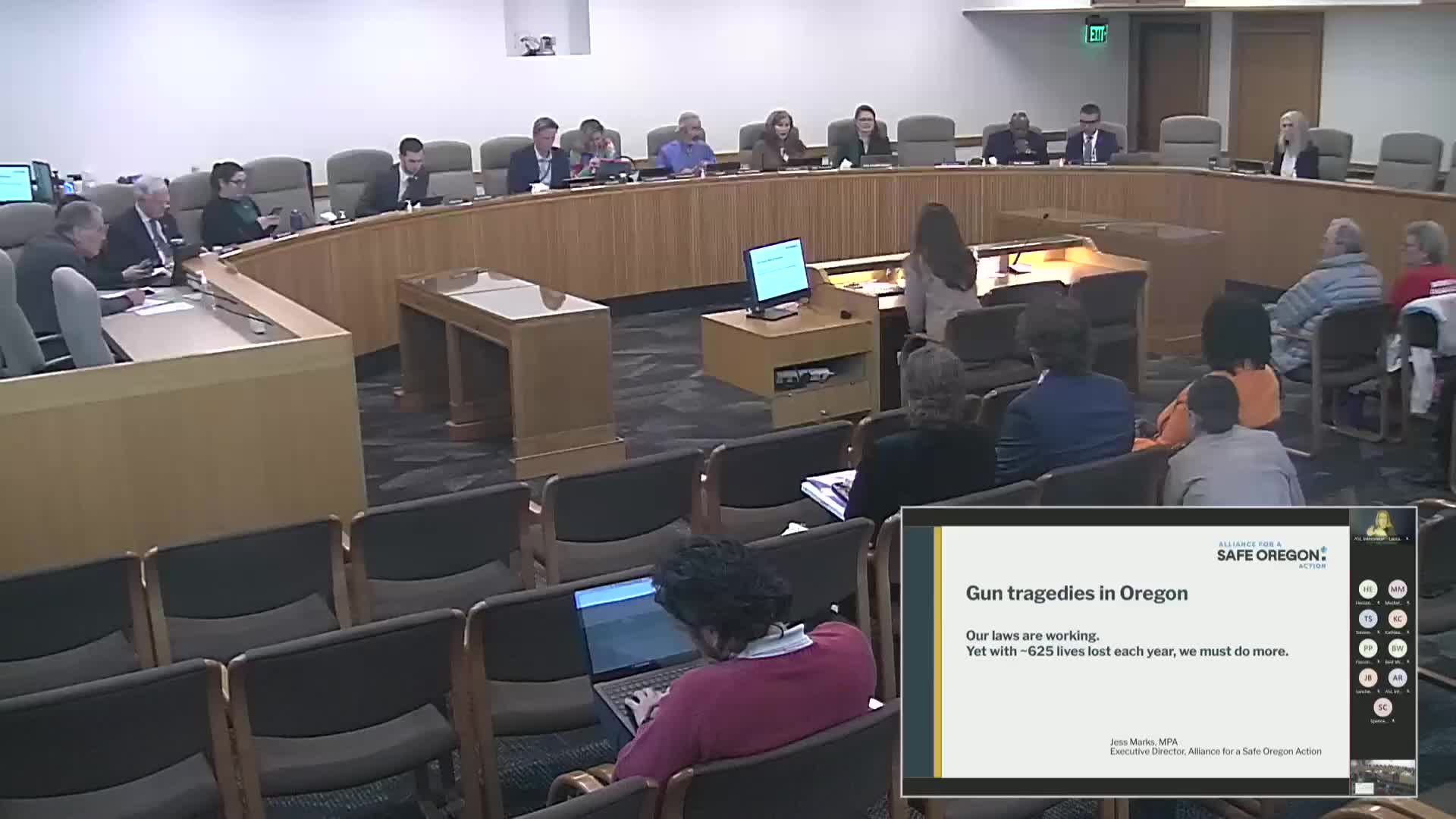
Jess Marks, executive director of the Alliance for a Safe Oregon, told the committees the state currently loses about 625 people each year to firearm-related deaths and that Oregon’s per-capita gun death rate ranks among the higher rates nationally. "These laws are making a big impact on reducing our rates of gun deaths while continuing to respect our tradition of historic firearm ownership," Marks said. She added that Oregon's rate of household gun ownership (about 50% statewide, higher in rural areas) makes tailored policy necessary.
Marks said four categories of law have shown measurable effects: comprehensive background checks, a ban on ghost guns, the state's child access prevention law requiring secure storage, and Oregon's ERPO law to temporarily remove firearms from people judged to be at imminent risk. She cited a 2024 study finding child access prevention laws are associated with about a 25% lower rate of youth firearm suicide. "Our extreme risk protection order law has been used over the past five years over a thousand times," she said, citing published research that estimated lives saved per ERPO issuance.
Panelists cautioned that research and data specific to Oregon remain limited because of long-standing constraints on federal research funding and called for state-funded study. Marks and other presenters urged policymakers to consider additional policies used in neighboring states — including state dealer licensing, waiting periods, and limits on rapid-fire conversion devices — while respecting lawful gun ownership and Heller precedent.
Committee chairs and staff said written questions would be accepted and answers posted to OLISS, the official record, so panelists could follow up with data and citations.
The hearing was informational; no policy votes were taken. Several speakers said stronger dealer oversight and additional enforcement tools are among the highest priorities to stop illegal guns entering communities.