Get email alerts on the Legislation Status topic
No spam. Unsubscribe anytime.
Building Code Council reviews 2025 bill status, flags WUI-code enforceability and permit-streamlining concerns
Summary
At its meeting during week nine of the 2025 legislative session, the Building Code Council reviewed which bills remain alive or are on a "dead list," discussed enforcement gaps in the wildland-urban interface (WUI) code language, and raised concerns about a permit-streamlining bill that could limit local land-use review.
The Building Code Council met virtually during week nine of the 2025 legislative session to review the status of legislative proposals affecting building codes, discuss outstanding issues with wildland-urban interface code language and mapping, and flag problems in a permit-streamlining bill that some members said could expand local obligations and curtail land-use review.
Dustin, a staff member who presented the bills update, said, "So this is the week 9 of the legislative session for 2025. Just as we expected, there's been no new bills added to our list." He then read a list of bills moved to the council's "dead list," including House Bill 1015 (energy labeling), HB 1254 (wildland-urban interface code), HB 1345 (detached ADU limits), HB 1582 (child care centers and buildings), HB 1684 (water recreation facilities), and SB 5514 (clean building standard build). "Without movement on those bills, they've been added to our dead list," Dustin said.
Why it matters: council members said several of the bills — even those currently on the dead list — contain language that affects how the council and local jurisdictions interpret or enforce technical code requirements. That matters for building officials, developers and jurisdictions that must apply the codes and for eventual rulemaking the council may need to undertake.
On the wildland-urban interface issue, Council vice chair Jay Arnold asked whether prior fixes were still needed to avoid an enforceability gap. Jay Arnold: "Wasn't there some fixes that we needed in there that to prevent a gap in enforceable code?" Dustin and other members explained that the legislative language added technical-code provisions that duplicated model WUI-code sections (including provisions similar to the most restrictive Class 3 ignition-resistant construction). That duplication created two possible compliance paths — either comply with the legislative language or the model code — which has produced confusion for enforcement, particularly around defensible-space requirements.
Council members said they are watching mapping work closely. A speaker identified as Michael (role not specified) said the mapping work group has met and the mapping development is expected to be completed around mid to late next year; he added that if no new legislation is enacted in the short session, RCW 19.27.560 will take effect as written and that timeline would affect when a Washington-specific WUI code could be adopted and coordinated with the maps.
The council also discussed Senate Bill 5729 (permit streamlining), including a Stryker amendment. Several members said the amendment contains contradictory language about when an application is "deemed complete" and about whether cities or counties could be required to approve permits that do not comply with applicable development regulations. One member warned the text could remove land-use review for specific project types and allow development beyond critical-area buffers in some circumstances.
Council members agreed the permit-streamlining bill still has significant flaws and recommended continuing to monitor it and to coordinate with cities, counties and building officials. Several members offered to work offline with stakeholders to refine specific language in the bill.
Other active bills the council is monitoring include SB 5552 (child-care related rulemaking obligations), SB 5156 (elevator standards; staff noted the current draft shifts most implementation to the Department of Labor and Industries) and several hearings the council is watching over the coming days, including bills on accessory dwelling unit self-certification (HB 1353), modifications for existing residential buildings (HB 1757), minimum parking requirements (SB 5184/HB 5184), and child-care centers in existing buildings (SB 5655). Dustin summarized the council's schedule priorities and said the list was current as of the previous evening.
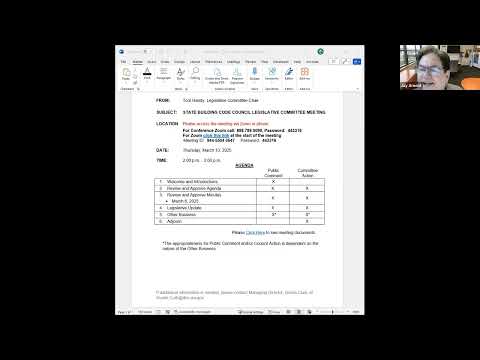
Procedural votes at the meeting were limited to adopting the published agenda and approving minutes from the March 6 meeting. The agenda and minutes motions were moved, seconded and recorded as approved by the council members present.
The meeting closed with members discussing whether to form ad hoc work groups or use existing technical advisory tags to prepare for likely legislative activity in the interim. Several members said working with legislators earlier in the process and coordinating with the Department of Commerce-mandated work groups (for topics such as embodied carbon) would improve code-development outcomes.
Looking ahead, the council will continue to track mapping progress, follow short-session bill introductions, and coordinate with municipalities and stakeholder groups on problematic language in bills the council views as having enforceability or scope implications.
AI generated
The text on this page is AI generated. Summaries, highlights, analysis, and video transcripts are all produced from the original source material.
AI can make mistakes, so if you spot one, and we will fix it for everyone.
Note: the source content is unaltered by us. Any content source we link to, be it a video, an audio recording, or a document, is presented exactly as its publisher released it. That publisher is usually a government body, sometimes an individual official or another organisation.