Get Full Government Meeting Transcripts, Videos, & Alerts Forever!
Get email alerts on the Energy Code Updates topic
No spam. Unsubscribe anytime.
Building Code Council commercial energy tag advances lighting and circulation rules, postpones several water‑heating items; restaurant-equipment rule approved w
Summary
The Building Code Council commercial energy code tag met March 14 and approved a set of lighting and circulation changes while postponing several complex service‑water‑heating and pipe‑sizing proposals to a work group.
The Building Code Council commercial energy code tag met March 14 and approved multiple updates to the commercial energy code while sending several complex service‑water‑heating and pipe‑sizing proposals to a work group for further drafting. Members advanced several lighting changes recommended by PNNL and others; approved clarified rules on hot‑water recirculation insulation and maximum pipe sizing methods; disapproved one proposed change to mixing‑valve language; and approved a new minimum efficiency requirement for a set of commercial kitchen appliances while adding an exception for reused or refurbished equipment.
The meeting matters because the tag is preparing bundles of changes that will feed into the full Building Code Council rulemaking. Several of the matters debated — indoor lighting power allowances, daylight controls, pump and circulation insulation requirements, and how the code treats service‑water heating exceptions — affect building energy use and owner cost. The tag approved some items today and postponed others when members asked for technical work or coordination with ongoing proposals.
The tag approved a cluster of lighting proposals derived from recent national model‑code activity and PNNL drafting: occupancy sensor timer settings were shortened (many 20‑minute timeouts changed to 15 minutes for interior occupancy controls); several PNNL proposals updating interior and exterior lighting power densities (LPDs) and retail lighting allowances were approved after small editorial edits; and horticultural lighting thresholds were revised to apply to greenhouses and controlled plant‑growth environments while clarifying separate limits for decorative plant lighting. Kevin Rose (Northwest Energy Efficiency Alliance, representing PNNL proposals) framed the lighting package as alignment with emerging 90.1/IECC updates and said the technical work shows LED technology now supports the tighter requirements without widespread availability problems.
On plumbing and service water heating, the tag moved several complex items to a work group to give members time to reconcile competing proposals rather than finalize policy today. Proposals that were postponed included multiple submissions that would change exceptions and calculation methods for service‑water‑heating systems (including proposals 277 and 268 and related items). Tag members repeatedly asked for a joint work group with proponents (including the author of the larger “Johnny 279” package) so technical language and equation references could be aligned before the tag takes final votes.
The tag did approve targeted plumbing changes it considered largely noncontroversial or already in local practice: a clarification to use the water‑demand calculator (Appendix M) for sizing R‑2 dwelling units was approved, and a revised insulation/maximum‑pipe‑length table for recirculation and runout piping was adopted and will be folded into the integrated draft. Dwayne Johnlin (tag member) explained the table consolidates requirements that were previously scattered through code text; Dave Price (assistant chief plumbing inspector, Public Health — Seattle & King County) and other plumbing officials supported the change while noting coordination with the Uniform Plumbing Code on allowable pipe sizes.
The tag also debated wording about circulation pumps. A proposal to require variable‑speed circulation pumps was approved, but members asked for clearer language about acceptable technologies (for example, ECM motors versus variable speed with drives) and asked staff and proponents to return with refined language. Larry Andrews (tag member) urged the tag to prefer electronically commutated‑motor (ECM) driven pumps where feasible because of measured energy benefits; other members noted larger pump installations are commonly controlled with drives.
On valves and controls, the tag voted to disapprove a proposal that would have replaced the term “thermostatic mixing valve” with a general “mixing valve” phrase. Plumbers and health officials said thermostatic or electronic valves that actively sense outlet temperature and compensate for inlet fluctuations are essential for scald and legionella control; the tag voted to disapprove the submitted wording and asked the proponent to return with language that explicitly covers electronic thermistor‑based valves and thermostatic valves as functionally equivalent.
Commercial kitchen equipment: the tag approved new mandatory efficiency requirements for a short list of commercial cooking and warewashing equipment (fryers, steamers, holding cabinets and commercial dishwashers) tied to Energy Star performance or equivalent program requirements. Members debated how to treat used/refurbished equipment and small operators who rely on second‑hand gear. The tag approved the requirement but added an exception permitting reused or refurbished equipment that has been in commercial use for more than one year; the tag asked staff to craft clearer language and to check cost and market‑availability data before the next steps.
Actions taken were a mix of approvals, disapprovals, and postponements. Where technical disputes remained (notably service water heating and some detailed piping calculations), the tag formed a work group to produce consolidated language and recommended numerical values. Several PNNL lighting proposals and the revised recirculation/insulation table were among the items approved today.
Members emphasized the distinction between discussion, staff direction and a formal decision. Where the tag chose to postpone, members explicitly directed staff and volunteers to form small work groups and return with revised language or consolidated proposals in the coming weeks. For items approved today, the tag recorded motions and votes and asked staff to publish updated drafts for public comment.
Looking ahead, the tag will bundle approved and consolidated proposals into packages to carry to the Building Code Council (and into CR‑102 rulemaking) but left technical, equation‑level changes to targeted work groups so the final language will reflect cross‑proposal coordination. The tag also signaled several items for third‑party modeling (lighting credits and energy modeling implications) before final Council deliberations.
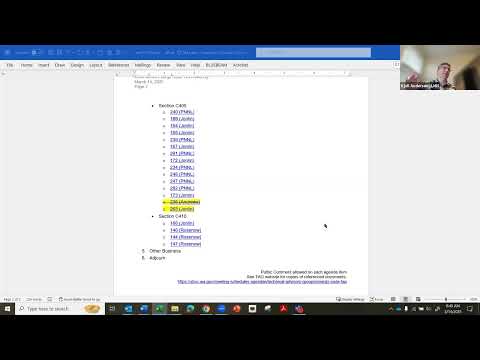
Votes at a glance (selected substantive outcomes) - Motion to approve exception clarifying laboratory sinks as “process equipment” (C404 exception): approved (voice vote). - Proposals 277 (service water‑heating exceptions) and related submissions: postponed to a work group for revision and coordination (motion carried). - Proposal 268 (heat‑pump water‑heater sizing and related exceptions): postponed to the work group (motion carried). - Proposal 253 (related exceptions language): postponed (motion carried). - Proposal 254 (change removing the term “thermostatic” from mixing‑valve language): disapproved (motion carried; tag asked proponent to return with language covering thermostatic and electronic thermistor valves). - Proposal 236 (maximum pipe length / small‑diameter runouts): postponed to work group (motion carried). - Proposal 174 (use Appendix M water‑demand calculator for R‑2 sizing): approved (motion carried). - Proposal 269 (revised recirculation/insulation table and table consolidation): approved (motion carried). - Proposal 278 (variable‑speed/ECM pump requirement for recirculation): approved with direction to refine language and clarify acceptable technologies (motion carried). - Lighting package (several PNNL proposals: occupancy sensor timers reduced from 20 to 15 minutes; updates to interior and exterior LPD tables; retail lighting allowances; horticultural lighting thresholds scoped to greenhouses and controlled plant‑growth environments): approved with minor editorial edits and alignment notes (motions carried). - Proposal 173 (commercial food‑service equipment efficiency tied to Energy Star or equivalent): originally debated and nearly defeated, but ultimately approved as modified with an exception permitting reused or refurbished commercial equipment that has been in commercial service for more than one year (motion carried after amendment).
What the tag asked staff and volunteers to do next - Convene a work group (members and stakeholders volunteered during the meeting) to reconcile service‑water‑heating exceptions and equation cross‑references and return recommended consolidated language before the next tag meeting. - Refine pump language to clarify acceptable variable‑speed/ECM implementations for circulating pumps and to avoid unintended exclusion of common equipment sizes or control approaches. - Clarify the mixing‑valve language so thermostatic and electronic thermistor valves are treated as acceptable, function‑equivalent alternatives and return a revised proposal. - Update public‑facing drafts to include the lighting edits approved today and commission third‑party modeling for credit and LPD package impacts where requested.
Ending: The tag concluded with a list of volunteers for the new work groups and asked staff to post consolidated drafts and minutes. Members emphasized they intend to return detailed, numerically consistent language to the council packages after the work‑group review; several items will reappear in subsequent meetings for final votes or for CR‑102 rulemaking.