Get Full Government Meeting Transcripts, Videos, & Alerts Forever!
Get email alerts on the Accounting Discrepancy topic
No spam. Unsubscribe anytime.
Alex Partners: $1.8 billion in Fund 30350993 came from conversion transfers; responsibility shared
Summary
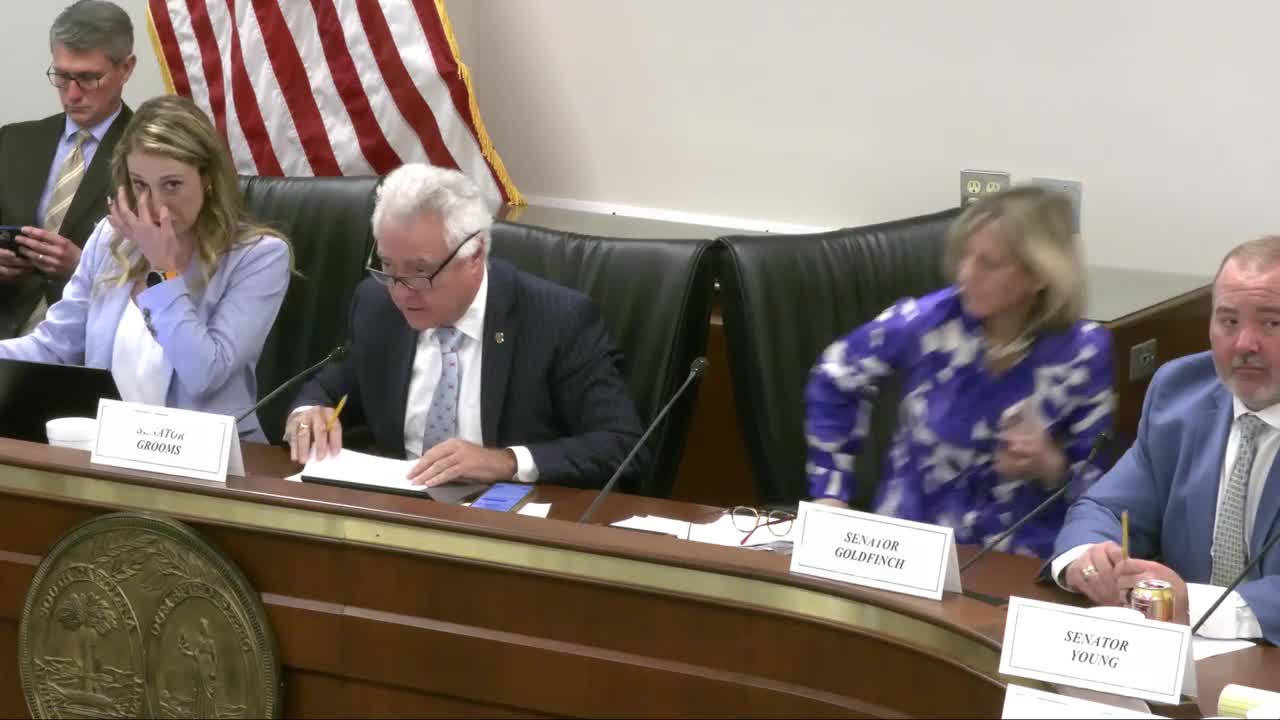
Alex Partners consultants told the Senate Finance Constitutional Subcommittee that $1.8 billion appearing in Fund 30350993 resulted from transfers made during a financial-system conversion, and that responsibility for the incorrect fund balance was shared between the Office of the State Treasurer and the Comptroller General’s Office.
Susan Merkel and David Bly of Alex Partners told the South Carolina Senate Finance Constitutional Subcommittee that $1.8 billion recorded in fund 30350993 arose when balances were transferred during a systems conversion and not because of a single office’s unilateral error.
"We believe that it was joint responsibility," Alex Partners consultant Susan Merkel said during testimony to the panel, summarizing the firm’s finding that both the State Treasurer’s Office and the Comptroller General’s Office were involved in the entries and transfer activity that produced the large balance.
The consultants described the mechanics this way: the Comptroller General’s Office originally created certain ACFRA business-area entries used in the conversion process; the problematic result occurred when those balances were moved into Fund 30350993. From Alex Partners’ review of journal activity, four usernames posted the transfers: Catherine Kipp, Martin Taylor, Doug Cooper and a system-assisted BATCH entry. Merkel and Bly told the committee the overwhelming majority of the postings were performed by staff assigned to the State Treasurer’s Office (STO), with involvement or awareness by Comptroller General Office (CGO) personnel in many cases.
Bly told senators the discrepancy became visible at the fund level because reconciliations had been done only at the account level. "If you only reconcile at the account level ... you would not see the components by fund," he said, adding that Alex Partners recommended reconciling at both account and fund levels.
Committee members asked when STO personnel first recognized a problem. Alex Partners said auditors began raising reconciliation issues in early November 2017, and conversion entries on Nov. 2 and Nov. 7 (years described in the testimony) contributed to subsequent balances that reached $1.56 billion and later $1.8 billion. Merkel said a March 2018 proposal from a Treasurer’s Office employee described the remaining balance as a "prior period adjustment," and that the CGO and external auditors counseled recording the amounts as a liability instead of a write-off.
Merkel and Bly declined to provide an opinion about whether cash and investments were properly managed by the Treasurer’s Office because that was outside Alex Partners’ scope. "It was not part of our scope to go in and determine how they managed their cash and investments," Bly said. However, both consultants told members that the presence of the $1.8 billion balance in a fund that should have netted to zero represented an accounting problem.
Alex Partners also told the committee it did not find that the Comptroller General’s Office alone was responsible. Bly said: "That is not reflected in our report nor is our opinion that it was solely the responsibility ... of the Comptroller General’s Office." Merkel added that Alex Partners had access to CGO crosswalks for fiscal 2022 and 2023 and that certain documents Alex Partners reviewed were found in CGO shared folders, not supplied by the CGO to Alex Partners.
Senators pressed whether officials had a duty to notify the General Assembly when reconciliation problems first appeared. Members repeatedly raised concerns that auditors and agency staff saw reconciliation shortfalls across multiple years but that the legislature was not alerted earlier. Alex Partners responded that staff appeared to have believed they were correcting problems at the time and that the entries were not understood to be erroneous in a way that triggered external notification.
The committee members and Alex Partners also discussed the provenance of some documents and the limits of the review. Merkel said Alex Partners did not evaluate the Treasurer’s Office cash-management practices and corrected several factual statements in a Treasurer-issued Feb. 26 briefing that Alex Partners found misleading or inaccurate.
The subcommittee did not take formal action on Alex Partners’ recommendations at that meeting, but senators indicated they would continue follow-up, including legislative and oversight options.
Ending: Alex Partners recommended greater fund-level reconciliation and additional audit transparency; senators pressed for answers about why the discrepancy persisted across years and whether earlier notice to the General Assembly should have been required.