Get Full Government Meeting Transcripts, Videos, & Alerts Forever!
Get email alerts on the Juvenile Sentencing topic
No spam. Unsubscribe anytime.
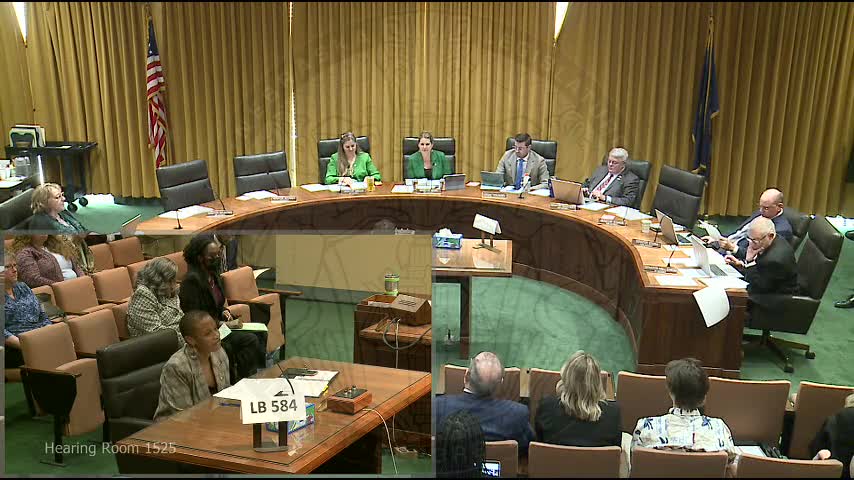
Nebraska hearing spotlights bill to reduce adult-style penalties for juveniles charged as adults
Summary
Sen. Ashley Spivey urged the Judiciary Committee to advance LB584, a bill that would lower sentencing ranges for youths charged as adults so fewer receive effectively life-long terms; supporters cited brain science and low recidivism among resentenced juvenile lifers while county attorneys warned of inconsistent sentencing and victims' interests.
Lincoln — Sen. Ashley Spivey (D–District 13) told the Judiciary Committee on March 12 that LB584 would moderate criminal penalties for children charged as adults, arguing the change would stop juveniles from receiving de facto life sentences and align Nebraska law with constitutional and scientific precedent.
Spivey said the bill narrows sentencing ranges for serious felonies when the defendant was under 18 at the time of the offense, and she read an email from an incarcerated person who said the proposed limits could give juveniles a chance at rehabilitation. "We don't need to throw them away," Spivey said.
Supporters said the bill responds to Miller v. Alabama (2012), in which the U.S. Supreme Court held mandatory life without parole for juveniles unconstitutional, and to later state and national reforms that recognize adolescents' distinct development. Jennifer Holden, chief deputy of the juvenile division in the Lancaster County Public Defender's Office, told the committee the proposal "synthesizes principles" from the courts and gives judges ranges suited to minors. Juliet Summers, executive director of Voices for Children in Nebraska, and Jason Witmer of ACLU Nebraska backed the bill, citing developmental neuroscience and national trends that have reduced or eliminated juvenile life-without-parole in many states.
Proponents pointed to data they said show low recidivism among people resentenced after juvenile life terms and to Nebraska figures supporters cited for people serving virtual life sentences: "the latest number we were able to find is 59," Summers said during questioning.
Opponents included Meghan Bucher of the Nebraska County Attorneys Association, who said existing statutory sentencing ranges reflect the severity of offenses and noted juvenile court already offers transfer and placement mechanisms. Bucher warned the bill would create inconsistency in sentencing simply because of a defendant's age and said victims and community safety could be harmed if ranges were reduced. County attorneys also pointed to statutory transfer and preliminary hearing mechanics that they said still need to be considered if prosecution practices change.
Committee members questioned implementation details: whether the bill affects consecutive sentences or mandatory minimums (Holden said it preserves consecutive sentencing discretion and converts statutory mandatory minimum language in some lower felony classes to ordinary minimums that allow good time). Holden and others emphasized the change targets "de facto life" outcomes created when decades stack across multiple counts.
Context and outlook: The committee heard more than a dozen in-person proponents and several opponents. The committee clerk later reported 24 proponent written comments and five opponent written comments on LB584. Senators asked whether the bill would leave judges adequate tools for very serious cases; proponents replied the measure preserves broad sentencing ranges while explicitly curbing sentences that functionally amount to life imprisonment for conduct committed as minors.
Ending: Spivey said the bill is focused on sentencing proportionality and urged the committee to advance it so judges and communities would have clearer statutory guidance for cases involving young defendants.