Get Full Government Meeting Transcripts, Videos, & Alerts Forever!
Get email alerts on the Tax Policy Sales Services topic
No spam. Unsubscribe anytime.
Senator Brandt proposes broad sales-tax expansion, higher cigarette and alcohol levies; businesses and nonprofits warn of costs
Summary
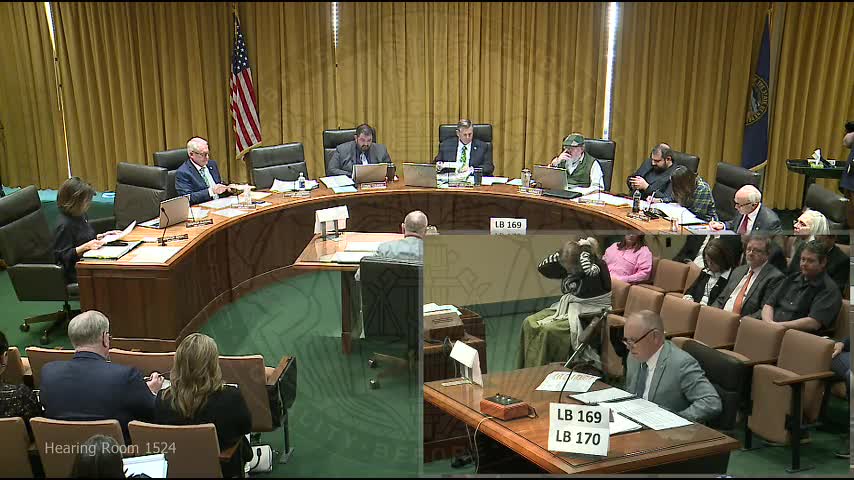
Sen. Tom Brandt introduced a two-bill package to broaden Nebraska's sales-tax base and raise cigarette and alcohol levies, saying the measures would help cover the state's budget shortfall and support property-tax relief.
Sen. Tom Brandt introduced a two-bill package to expand Nebraska's sales-tax base and increase excise taxes on cigarettes and alcohol, saying the measures would raise revenue to help cover the state's budget shortfall and to fund property-tax relief.
Brandt told the Revenue Committee that LB169 would "impose a sales tax on numerous items and services that are currently exempt," and that a white-copy amendment (AM589) narrows the list after industry feedback. He described LB170 as a separate measure that would add a 72¢ increase to the cigarette excise (from 64¢ to $1.36 per pack) and raise certain alcohol excise rates (including a proposed $4.50 per gallon of pure alcohol for large producers), subject to Commerce Clause review, and estimated the pair could generate roughly $120 million in new revenue in a full year.
Why it matters: Senators and advocates framed the bills as one way to stabilize the state's finances without immediate cuts to services, and to create a revenue stream that could be dedicated to property-tax relief. Opponents warned the proposals could be regressive, difficult and costly for small businesses to implement, could tax business inputs (risking "pyramiding" of tax on both inputs and outputs), and could produce unintended consequences such as driving customers to out-of-state sellers and expanding an underground market for unregulated services.
What supporters said
Bruce Bureker of Nebraska Farm Bureau and the Ag Leaders Working Group said groups who pay sales, income and property taxes support broadening the base to rebalance Nebraska's tax structure. Mary Bagalgalis, representing Philip Morris International, supported the tobacco provisions that would recognize heated tobacco products and establish a different excise approach for them.
What opponents said
A wide range of businesses and organizations testified against parts of the package. Small-business owners and trade groups argued that taxing services such as tattooing, body art, professional instruction, interior design, golf lessons, and certain personal-care services would add administrative burdens and be regressive. Licensed cosmetologists and estheticians warned that carving out only some salon services while taxing others could force pricing and bookkeeping changes for small salons. Movie-theater owners said language in the bill could impose a tax on film rental fees — a business input that would amount to "double taxation" because theaters already collect sales tax on ticketed sales and concessions. Zoo and aquarium representatives said removing exemptions on admissions would undermine access and tourism that already produces state revenue.
Regulatory and constitutional concerns
Hobert Rupp, executive director of the Nebraska Liquor Commission, told the committee that AM603's proposed two-tiered alcohol excise (treating sellers differently based on production volume) raised Commerce Clause concerns and could invite litigation; he recommended caution before adopting a differential tax structure. Several trade groups asked that marketing and telemarketing services be left out because taxing marketing could reduce local advertising revenue and harm local broadcasters.
Revenue estimates and specifics
Brandt said the amended LB169 lists roughly 21 categories (including pet grooming, dry cleaning, nonmedical massage, nonmedical skin care, tattooing, interior design and decorating, sightseeing by ground vehicle, telemarketing, limousine/luxury vehicle services, and admissions to zoos and museums) and that Legislative Research estimated the package would generate roughly $37 million from the services list. He said LB170's pop-and-candy changes would raise about $40 million and the cigarette and alcohol changes about $44.5 million combined in a full year, subject to amendment and constitutional limits.
Questions and next steps
Committee members asked for clarification on several items: whether dry-cleaning revenues are business inputs or consumer purchases, how the bills would treat medical services (Brandt pointed to AM589 language to carve out medically necessary services), whether film rentals would be taxed (several theater owners said they understood the bill could be read that way and urged clarification), and how the cigarette increase's proceeds would be distributed between special funds and the general fund.
No formal votes were taken during the hearing. Committee members and bill sponsors signaled further follow-up with stakeholders and agencies (Department of Revenue, Liquor Commission, and Legislative Research) to tighten definitions, resolve carve-outs for medical services and 501(c)(3) exemptions, and to review constitutional risk on bifurcated excise proposals.
Ending
The joint hearing produced detailed, sometimes conflicting testimony about who would be affected and how. Supporters say the measures are a pragmatic way to broaden Nebraska's tax base to support property-tax relief; opponents say they would create administrative burdens, tax business inputs or essential services, and disproportionately affect small businesses and low- and middle-income consumers. Committee members asked for more clarifications and legal analysis before advancing either bill.