Get Full Government Meeting Transcripts, Videos, & Alerts Forever!
Get email alerts on the School Budget topic
No spam. Unsubscribe anytime.
Curriculum office seeks $61,000 net increase for K–4 world language and IB exploration; literacy pilot options remain costly
Summary
Assistant Superintendent Adam Pease presented the Curriculum & Instruction budget March 12, proposing a $61,000 increase primarily to support world language in elementary grades (FLES) and initial International Baccalaureate contractual costs; literacy adoption full K–4 implementation could cost hundreds of thousands and would be phased.
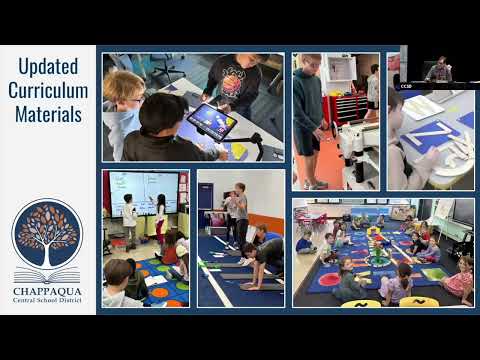
Assistant Superintendent Adam Pease told the Chappaqua Central School District Board of Education on March 12 that his curriculum budget for 2025–26 is essentially a rollover but includes two targeted increases: roughly $16,000 in contractual services to support a world-language-in-elementary (FLES) rollout and about $61,000 total variance to also add an "IB contractual" line as the district explores International Baccalaureate for K–8.
"That increase is really allocated mostly towards the world language in the elementary school," Pease said. The contractual funds would pay consultants, curriculum-writing time and professional development, and the district aims to pilot or begin implementation in the fall. Pease also described an "IB contractual" line to pay conference attendance, consultants and fees as the district evaluates the IB approach for K–10 and whether it should eventually expand to upper grades.
Pease highlighted other curriculum priorities that are funded in the budget including K–2 literacy unit implementation, classroom-library updates, handwriting curriculum and professional development fellowships (science-of-reading, equity and strategic-plan fellowships). He said the curriculum office supports new-teacher mentoring and a variety of conferences and in-service training; most lines are level-funded.
Board members pressed about federal Title grant risk and how the district would insulate programs should some federal money be withheld. Pease said Title allocations (Title I, IIA, III, IVA and UPK) have been relatively small for the district and that budget planning assumes conservative access to those funds. Business office staff (Josh) and district leaders said they are already shifting some positions out of federal grants into the general fund to reduce exposure.
On literacy adoption, Pease said the district has narrowed vendors to a handful of finalists and noted a full K–4 implementation quote for one provider approached $470,000 — an amount the district would not be able to cover in a single year. "We would have to phase that in over a couple of years, which would be the right thing to do anyway," Pease said. He recommended piloting smaller scale implementations next year and using professional development funding to support rollout planning.
Pease also described supports for fellowships, authors visits, and early-career teacher mentoring; federal Title allocations were shown historically on a slide to illustrate that the district budgets conservatively and places some federal money into fund balance when prudent. The board did not vote on any curricular adoptions at the March 12 meeting; members asked for follow-ups on literacy-cost scenarios and on the K–4 language posting and eventual middle-school alignment.