Get Full Government Meeting Transcripts, Videos, & Alerts Forever!
Get email alerts on the Water And Wastewater Infrastructure topic
No spam. Unsubscribe anytime.
Plymouth Village Water & Sewer district approves multi-million-dollar infrastructure package; rates could rise as projects proceed
Summary
Plymouth Village Water and Sewer District voters on March 13 approved a slate of warrant articles authorizing bond and grant-backed spending for water and wastewater projects, including $6.3 million for water-main work, a $7 million replacement of a low‑service water storage tank and multi‑million upgrades at the wastewater treatment plant.
Plymouth Village Water and Sewer District voters on March 13 approved a slate of warrant articles authorizing bond and grant-backed spending for water and wastewater projects, including $6.3 million for water-main work, a $7 million replacement of a low‑service water storage tank and multi‑million upgrades at the wastewater treatment plant.
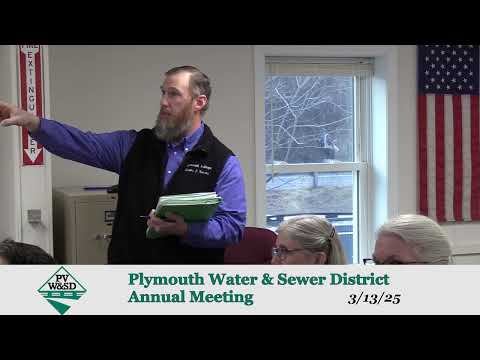
District Director of Operations Jason Randall told the meeting the projects target chronically failing cast‑iron mains, an aging 1972 concrete tank and obsolete plant equipment. “This tank was built in 1972,” Randall said in describing the reservoir structure; on aging mains he said the district has “15 water main breaks” on one corridor and has found “potential for lead service connections” on others. Randall outlined funding mixes that rely on state revolving funds (SRF), loans, grants including American Rescue Plan Act (ARPA) funds and federal programs such as the Northern Borders Regional Commission and Homeland Security grant opportunities.
Why it matters: Commissioners and staff said the work is intended to reduce emergency breaks, restore reliable firefighting capacity and bring aging infrastructure into current standards. The district serves about 1,100 service connections and maintains roughly 27 miles of distribution mains, Randall said, and some projects coordinate with the Town of Plymouth’s roadway work to avoid repeated digs.
Key votes and funding details - Article 2 — Water main and street work (Highland Street, Reservoir Road, Emerson Street): voters authorized raising and appropriating $6,300,000 and issuance of bonds or notes in accordance with the Municipal Finance Act, RSA 33; the appropriation includes authority to accept unanticipated state or federal money under RSA 31:95‑b. The article was presented as the district’s request for an additional $6.3 million because construction costs have roughly doubled since earlier estimates; ARPA funding of $1,400,000 would be at risk if work does not proceed before a June 1, 2026 deadline. Vote: yes 23, no 2 (paper ballot). - Article 3 — Low service‑zone water tank replacement (Reservoir Road): authorized $7,000,000 and related bond authority under RSA 33; Randall said the existing concrete tank shows interior concrete spalling and corrosion and that replacement or redundant tanks are being evaluated. The district reported expected funding applications to the Drinking Water SRF, a potential BRIC/Homeland Security grant and Northern Borders funding; the projected mix at the time of presentation was roughly 50/50 loans and grants if awarded. Vote: yes 23, no 2 (paper ballot). - Article 4 — Foster Street well replacement: authorized $1,000,000 to replace a primary well constructed in 1951; Randall described the well as the community’s “workhorse” and said it pumps about 500–600 gallons per minute. Funding assumed a mix of an emerging contaminant SRF loan with principal forgiveness plus local cash. Vote: not specified in transcript (paper ballot procedure announced). - Article 5 — Wastewater master plan (treatment plant update and inflow & infiltration study): authorized $315,000 to develop a multi‑phase wastewater master plan and evaluate inflow and infiltration. Randall said the plan will guide plant upgrades and compliance with evolving permit monitoring requirements such as PFAS and nutrients. Vote: not specified in transcript (paper ballot procedure announced). - Article 6 — Wastewater facility electrical and HVAC improvements: authorized $3,500,000 for electrical switchgear replacement and HVAC upgrades to address obsolete equipment, code nonconformance and a recent electrical fire at the plant. Randall said the district has been forced to source obsolete parts for decades‑old gear. Vote reported later in the meeting: yes 24, no 1 (paper ballot). - Article 7 — Solids handling improvements (wastewater): authorized $7,000,000 to add drying/solids‑handling capacity so the district can reduce solids volumes and increase options for biosolids recycling. Randall said current processes produce a 30% “cake” and newer technology can reach closer to 90% solids, which reduces disposal costs and provides more beneficial reuse options; the project also anticipates future PFAS-related regulatory risk. Vote: yes 23, no 2 (paper ballot). - Article 8 — Headworks and influent pump station upgrades: authorized $7,000,000 for improved screening, grit removal and a reconfigured influent wet well to reduce pump failures and protect downstream plant equipment from wipes, fats, oils and greases and other non‑flushable materials. Randall described frequent clogging and hazardous manual cleanup tasks that the upgrades would address. Vote: not specified in transcript; chair declared Article 8 passed later in the meeting (paper ballot). - Articles 9 & 10 — Two capital reserve discontinuances (Leatherman construction/reconstruction and acquisition/exploration capital reserve accounts): both items were presented as housekeeping to close accounts with zero balances and to transfer remaining (zero) balances to the water general fund; both passed by voice vote. Vote: not specified (voice vote). - Article 11 — 2025 water and sewer operating budget ($4,054,512): commissioners recommended the appropriation; staff answered questions about staffing and the change in where executive/financial wages are budgeted. Article 11 passed by voice vote; a specific ballot tally was not recorded in the transcript.
Rate implications and contingencies Several residents asked about the effect on customer rates. Resident Michael Renkert asked, “What's the impact to the rate for this project?” Randall said the board engaged a rate consultant and a 2023 rate study anticipates roughly “a 5% increase per year for about the next 5 years” for water rates to accommodate capital investments and loan paybacks, though he and commissioners said projects would not automatically proceed if grant funding does not materialize.
Other discussion and next steps Commissioners and staff repeatedly emphasized that passing warrant articles authorizes the district to seek and accept loans and grants and to bid projects; actual construction and borrowing remain contingent on further approvals, final engineering and grant awards. Randall and commissioners said they will continue to apply for SRF loans, USDA and federal grants and that some project timelines depend on coordination with town road projects.
The meeting also included the swearing‑in of newly elected Commissioner Stephanie Halter and several public comments about a separate subdivision dedication review; commissioners said they will review developer-submitted as‑built and engineering materials and hold any dedication to the district’s standard requirements.
Ending After tabulation of the paper ballots and procedural housekeeping, the chair declared the passed articles and closed the meeting.