Get Full Government Meeting Transcripts, Videos, & Alerts Forever!
Get email alerts on the Comprehensive Plan topic
No spam. Unsubscribe anytime.
Evanston Land Use Commission hears wide-ranging public comment on Envision Evanston comprehensive plan; hearing continued to March 19
Summary
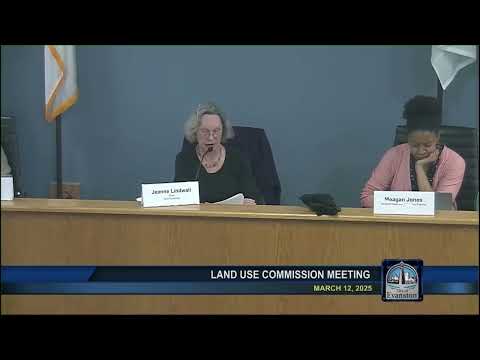
Evanston Land Use Commission members heard nearly three hours of public testimony on the revised draft of Envision Evanston 2045 on March 12, with commenters sharply divided over proposals to increase housing density and the data used to justify policy choices. The commission voted to continue the public hearing to March 19 and asked the public and boards to submit written comments by April 4.
Evanston Land Use Commission members heard nearly three hours of public testimony on the revised draft of Envision Evanston 2045 on March 12, with commenters sharply divided over proposals to increase housing density and the data used to justify policy choices. The commission voted to continue the public hearing to March 19 and asked the public and boards to submit written comments by April 4.
The hearing assembled repeated themes: supporters urged stronger emphasis on housing affordability and tools to produce more housing, while opponents said the draft leans on assumptions that denser housing will lower costs and lacks neighborhood-specific data. Speakers also asked for clearer linkage between plan recommendations and the zoning changes that would follow, and for better presentation of the public engagement record that produced the draft.
Advocates for low-income residents and service providers said the plan should be more explicit about the city’s housing shortfalls and the populations most affected. Betty Bogg, chief executive of Connections for the Homeless, told the commission the plan’s recommendations “will support the two primary actions we are looking for from the city: first, to remove the barriers that the current zoning code creates for development of new affordable and missing-middle housing; second, to fund and implement programs.” Several speakers including Christine Loftus, a Sixth Ward homeowner, described the gap between local wages and rents: “In Evanston the average price for a studio apartment is $1,648…a two‑bedroom is currently $2,213 per month,” Loftus said, and noted a local nursing assistant’s typical yearly pay of about $40,000.
Other residents pressed for more and clearer data. Melissa Applet of Interfaith Action of Evanston suggested the plan should better document local housing need rather than rely on “personal narratives,” and cited a statistical point that surprised many: “this measure of income inequality…has determined that Evanston has the tenth highest of any city in the country,” she said, referring to the Gini coefficient cited in the draft. Speakers also pointed to points of local data they say the plan should use more directly: one commenter cited a working figure of roughly 3,200 vacant units in the city as a factor for how much new construction is needed; another described 6,375 households under $50,000 that pay more than 30% of income on housing.
Design, neighborhood character and downtown vitality were recurring concerns. Several commenters and a written submission from Design Evanston pressed for an Urban Design Commission to review aesthetics and ensure development aligns with community character. Others, including business and transportation advocates, urged stronger policy language connecting land use to transit and pedestrian improvements. Robert Keating of the Evanston Transit Alliance supported the plan’s transportation direction and urged adding funding mechanisms for active‑transportation projects, including a transportation impact fee for new development.
Multiple speakers described the process and outreach as uneven. Several residents and online commenters said the first draft and the consultant process produced outcomes perceived as predetermined; others asked staff to reorganize the plan’s “what we heard” chapter so that major themes—rather than the methods used to collect input—are front‑and‑center.
Commissioners and staff repeatedly reminded the public that the comprehensive plan is a high‑level policy document distinct from the zoning code: the plan sets vision, goals and programmatic priorities; zoning changes would come later in a separate, more detailed process. Still, many commenters asked the commission to identify where increased density would be focused, pointing to corridors, transit‑oriented areas or commercial nodes rather than blanket citywide changes.
The commission asked staff to compile public and commission comments and return with proposed revisions. Commissioners set an April 4 deadline for written comments from boards, commissions and the public and formally continued the hearing to March 19. A motion to continue the hearing passed by voice vote. The commission also noted that staff will prepare a consolidated packet of redlined language and proposed alternatives for future meetings.
What happens next: staff will collect and summarize submitted comments, prepare suggested alternate language for the Land Use Commission’s review, and return with a calendar for the next steps in the comprehensive plan process. Written public comments are due April 4; the commission’s next hearing on the plan is scheduled for March 19.