Get Full Government Meeting Transcripts, Videos, & Alerts Forever!
Get email alerts on the Superintendent Hiring topic
No spam. Unsubscribe anytime.
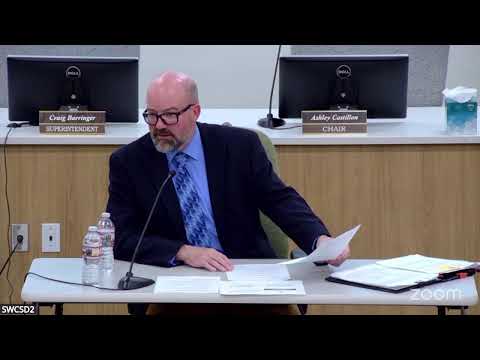
Superintendent candidate tells Sweetwater County School District #2 panel they would lead visibly, expand career-technical programs and protect electives amid预算
Summary
Superintendent candidate told an interview panel for Sweetwater County School District #2 that they favor a collaborative, highly visible leadership style and would prioritize ensuring “every student to graduate with a purpose.”
Superintendent candidate told an interview panel for Sweetwater County School District #2 that they favor a collaborative, highly visible leadership style and would prioritize ensuring “every student to graduate with a purpose.” The candidate outlined past work building career-technical education programs, a live-streaming instruction network for rural schools and plans to protect elective programming while managing likely state-related budget constraints.
The candidate said, “My leadership style is very collaborative and supportive. You're gonna see me. I'm very visible,” and later said the district’s aim should be that “every student to graduate with a purpose.” They told the panel they expect to be involved in classroom observations and to model instructional leadership for principals while keeping an “open door” for staff and community input.
The candidate highlighted two district-level initiatives they said they helped create at Colorado River BOCES: EPIC (Educational Pathways to Innovative Careers), a career-technical expansion effort, and CC Live (cclive.org), a live-streamed instruction program. “We raised over $4,000,000 in 4 years to build out these career tech ed programs,” the candidate said, describing purchases that included mobile learning labs for construction, aviation and small engines. On CC Live, they said live-streamed classes are supported by an in-room paraprofessional and have produced what the candidate described as outcomes “double digits above any other traditional classrooms” where the program is implemented.
On budget priorities, the candidate said they would place student impact first and seek to protect electives such as arts programs. They recommended starting budget discussions at the school level through school advisory committees (SACs) and aggregating that input to a district accountability committee (DAC) to inform districtwide decisions. The candidate described enrollment and state funding adjustments as a likely constraint and estimated current average daily attendance at “91 something or maybe 92%,” saying raising that rate a few percentage points could materially affect district revenue.
On curriculum and instruction, the candidate noted the district’s recent K–8 adoption of Houghton Mifflin literacy and math materials and emphasized providing professional development and implementation supports rather than “page-turner police” fidelity checks. They said walk-throughs and observable continuity across classrooms should accompany curriculum adoption while preserving teacher creativity.
The candidate described approaches to staffing and retention that include using stipends and leadership opportunities (mentor teachers, professional-development leaders), and — where necessary — reassigning staff who are not functioning well in a given building. They suggested exploring partnerships with local employers to create work-based learning and internship opportunities for students to improve post-graduation readiness.
Relating a past challenge, the candidate said that after winning a Colorado BEST (Building Excellent Schools Today) grant and community bond funding for a campus rebuild in Dolores, they discovered the site sat in a 100-year flood plain and that project costs rose; through litigation with the original architects and insurance recoveries the district adjusted plans and raised the build site by about four feet to meet floodplain requirements. The candidate said the experience required modifying original plans, heavy community engagement, and ultimately allowed the district to continue the project.
The candidate provided a preliminary 90-day entry plan: visit the district in spring to meet staff and community, review curriculum, budgets, safety and operations, and be highly visible during the first weeks of the school year. They told the panel they wanted one-on-one meetings with board members to understand motivations and to discuss the strategic plan already posted online.
No hiring decision or vote was recorded in the interview transcript. The panel’s questions and the candidate’s answers focused on leadership style, curriculum alignment, career-technical expansion, budget strategy and community engagement.