Get Full Government Meeting Transcripts, Videos, & Alerts Forever!
Get email alerts on the Candidate Interview topic
No spam. Unsubscribe anytime.
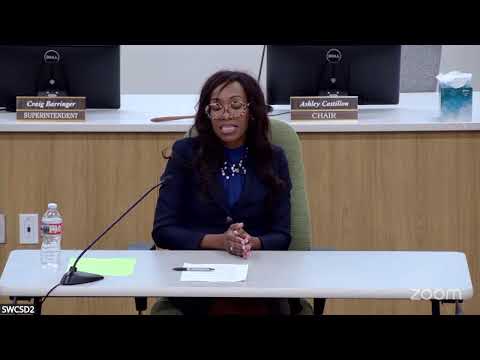
Annette Walters, candidate for district leadership, emphasizes servant leadership, staff support and communication
Summary
In an interview with district representatives, Annette Walters described a servant-leadership approach, prioritized staff recognition, data-driven instruction and community outreach, and addressed budget cuts, staffing and school safety concerns for Sweetwater County School District #2.
Annette Walters, a candidate for a leadership position with Sweetwater County School District #2, told district interviewers she practices "servant leadership" and would prioritize supporting staff, improving communication and using data to guide instruction.
Walters said those priorities matter because the district is balancing performance with funding and staffing challenges. "As a servant leader, I believe that it's my duty to not only support students but to also support staff," she said during the interview. She framed staff recognition, targeted professional development and strengthened parent outreach as central tools to retain teachers and sustain student outcomes.
Walters described specific program approaches she has used previously. She said she implemented a before-school program that provided breakfast, games and focused academic work, and a summer "boost" program for general-education students that included reading and math blocks. "No additional cost to the district," she said of the summer program; teachers were paid from unspecified funding sources she described as "somewhat hidden." Walters also said she had pursued PLC (professional learning community) grant funding in the past to support staff development.
On curriculum and assessment, Walters emphasized coordinating instruction, assessment and professional development through PLCs and a "backwards approach" that defines end goals and maps the instructional steps to reach them. "Assessment practices using both formal and informal assessments... you actually live it," she said, describing how teachers' daily observations complement state tests.
Budget constraints and staffing came up repeatedly. Walters described efforts she led in another district to make budgets transparent and hold department leaders responsible for spending. She said the district she described previously cut about $674,000 from its budget and eliminated roughly "5, 6" positions; she later said she returned to the board to ask to hire one additional position because remaining staff were stretched thin. On balancing cuts and needs, she said, "What if we went to 0.75 versus a 1? What if we went to a 0.5? ... All of those things is on the table when we're looking at staffing cuts to see what we can do."
Walters told interviewers she would "sell" the district to families by being visible at community events, promoting programs and ensuring parents know what schools offer — citing the high school's Olympic-sized pool and other nontraditional programs as examples to highlight. She also referenced recent legislative changes related to school vouchers as a reason to engage and inform families about local options.
School safety was raised as a concern she heard directly from high school students. Walters said students had mentioned locations where it was not easy to control entry and that safety was on students' minds. She called continued attention to safety protocols a priority alongside professional development and support for staff.
Walters described experience resolving personnel conflicts and conducting investigations when required by policy. She recounted an investigation of a superintendent in a prior district over a social-media incident and a separate situation in which a staff member was observed playing video games at work; in the latter case she said she addressed the behavior, sought accountability and then worked to repair staff trust and morale.
On emerging trends, Walters said she researches topics such as artificial intelligence and plans to bring conference learning and research back to staff through PLCs and professional development. She described recruitment and retention as linked challenges for rural districts and noted community pride and contributions — including support from the local mining sector — as advantages to leverage when recruiting.
The interview concluded with Walters reiterating a focus on students and staff: "Student first, student last, student always," she said. No formal decision or vote was recorded during the session; the meeting was an interview process for the district's candidate pool.