Get Full Government Meeting Transcripts, Videos, & Alerts Forever!
Get email alerts on the School Bullying Prevention topic
No spam. Unsubscribe anytime.
Pacific Grove Middle holds third anti-bullying workshop; staff review rights, reporting and consequences
Summary
Pacific Grove Middle School hosted the third session in a four-part anti-bullying series covering California law, student privacy, reporting tools and school interventions, with staff urging early reporting and restorative responses.
Pacific Grove Middle School hosted the third session in a four-part anti-bullying series that reviewed student rights, parent responsibilities, reporting tools and possible school and legal consequences for bullying.
The hourlong presentation, led by school staff and the Rainbow Connection team from Harmony at Home, explained California law on bias-based bullying, student privacy protections and district procedures for reporting and responding to incidents. Presenters described tiered school supports, anonymous reporting options and both school- and civil-level consequences that can follow when bullying escalates.
The session was introduced by Sean Roach, principal of Pacific Grove Middle School, and featured Julie, program manager for the Bullying Prevention Program at Harmony at Home, and Denise Adezza, Rainbow Connection bullying-prevention specialist. Roach said the workshop is part three of a four-part series and that the district will post the session recording for families.
Why it matters: presenters said clear reporting and early intervention reduce harm to targeted students and allow staff to provide supports to both victims and students exhibiting bullying behavior. The school emphasized that many protections extend to incidents that begin or spread online and that parents and staff must document and escalate concerns through the established chain of command.
Key points from presenters
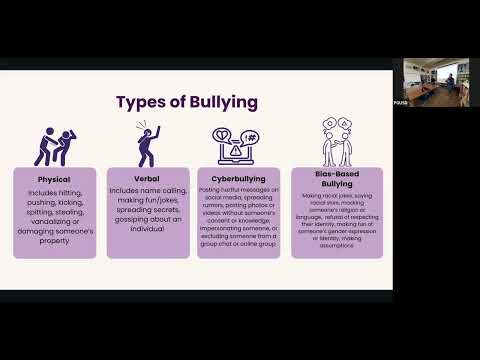
- Definition of bullying: Denise Adezza told attendees that bullying is “a repetitive act” involving an unequal power balance and can be physical, verbal, social or cyberbullying. She emphasized the difference between a one-time mean incident and repeated harmful behavior.
- Legal and policy frameworks: presenters cited Seth’s Law (commonly known as AB 9), multiple California Education Code provisions, the federal Family Educational Rights and Privacy Act (FERPA), Title IX protections, the Ralph Civil Rights Act, and the School Success and Opportunity Act (AB 1266) as laws that shape school responses and privacy rules. They stressed that schools can act when out-of-school conduct (including social-media posts) makes a student feel unsafe at school.
- Student privacy: staff reiterated that FERPA and other privacy rules limit which details schools can share about disciplinary outcomes; they reminded parents that privacy protections can apply both to victims and to students alleged to have engaged in bullying.
- School responses and supports: the presenters described a menu of possible school actions that ranges from restorative interventions and counseling to suspension, expulsion or transfer in extreme cases. The district uses tiered supports (Tier 1 prevention, Tier 2 small-group interventions and Tier 3 individualized services). Roach and other staff highlighted restorative justice as an approach that seeks to identify root causes and reduce recurrence.
- Reporting tools: Pacific Grove Middle maintains a 24/7 anonymous reporting system accessible by QR code posted around campus and a school “green I want to see” form that students use to identify trusted adults. Roach said multiple administrators and counselors are notified when a serious report is filed so the school can act quickly.
- Examples and consequences: presenters walked through two scenarios — one in which a student with a disability was physically shoved and a video of the incident was posted online, and a second where online harassment led to a target’s hospitalization. Staff said incidents that target protected characteristics can prompt bias-based investigations, possible law-enforcement involvement and civil claims; the presenters told families that, in some cases, parents or guardians can face civil liability and fines if they fail to intervene. The presenters cited a range of possible financial penalties mentioned in the workshop, noting figures discussed by staff of up to $25,000.
Parent guidance and next steps
Presenters urged parents to remain calm when a child reports bullying, to document and screenshot online evidence, and to follow the district’s escalation steps (teacher, administration, then district contacts as needed). They urged families to work with the school on interventions and to ensure each student has at least one trusted adult on campus.
The series will conclude with a fourth session; presenters said the next workshop, led by Casey Rodenbush, will cover supporting LGBTQ and neurodiverse students on April 8.
Quotes
“Bullying, again, is the keyword on here is repetitive. It's a repetitive act,” Denise Adezza said when defining bullying.
Sean Roach said the school offers multiple reporting channels and that the district expects staff to act: “We are a…see something, say something district” and the anonymous system is “24 hour a day, 7 day a week, 365 days a year.”
Ending
Presenters stressed prevention, early intervention and documentation as the most reliable ways to reduce harm. The district said it will post the recorded workshop for families and share materials from the session.