Get Full Government Meeting Transcripts, Videos, & Alerts Forever!
Get email alerts on the Big Darby Conservation topic
No spam. Unsubscribe anytime.
Commission discusses Big Darby Accord update, conservation zoning, stream restoration and sewer tap allocation
Summary
Planning staff and commissioners reviewed the Big Darby Accord master plan and Hilliard’s conservation/zoning approach, highlighting map/text inconsistencies, incentive limits for stream restoration, and how newly allocated Columbus sewer taps could affect future development west of Alton Darby Road.
Planning staff and commissioners spent the latter portion of the March 13 meeting reviewing the Big Darby Accord Watershed Master Plan, recent Hilliard conservation zoning changes, completed stream restoration projects, and the implications of newly available Columbus sewer taps for land west of Alton Darby Road.
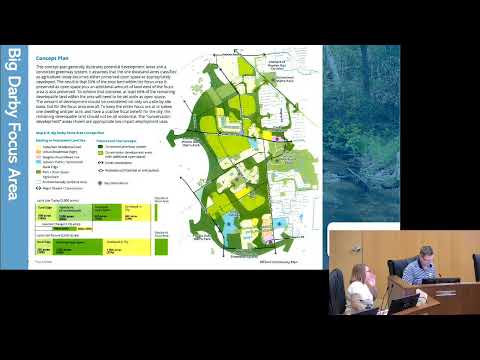
Staff presented the comprehensive-plan and Darby-area land-use maps, noting a mismatch between the plan text and the map: the text describes two conservation development categories — one at 1 dwelling unit per acre and another at 0.2 units per acre (the latter reflecting a 5-acre minimum typical of township rules) — but the displayed map does not match those density descriptions. Staff warned that the inconsistency complicates reviews before the Darby Accord panel and can create uncertainty for applicants and panel members.
Commissioners and staff discussed incentives and density bonuses in the Darby manual. The manual provides an example in which 60% open space could yield a 15% density bonus, but staff said the manual’s bonus formula and crediting for stream restoration are unclear and can discourage developers from doing the most beneficial stream work. Staff and commissioners cited a recent case where a developer conserved 22 acres and performed stream restoration; panel advice questioned whether that credit should apply to the developer’s project. As a result, staff said there is uncertainty about when conservation actions off a developer’s parcel can be counted toward density or other incentives.
Staff outlined local actions already completed: Hilliard has spent about $1.7 million on stream-restoration work within the city’s portion of the watershed and the transcript references more than three miles of restored or created channel across the planning area. Staff provided an example where individual line items in a chart were about $818,000 and $930,000; the record shows Hilliard’s total stream-restoration spending in the plan area at about $1,700,000. The commission also reviewed acreage figures: staff said the area west of Alton Darby that lies inside Hilliard’s service/annexation boundary contains a little over 2,700 acres; the Darby document had referenced a target of about 2,000 sewer “taps” for the Hilliard area, while staff also noted a recently communicated figure of 1,331 additional sewer taps available for the Hilliard area. Commissioners flagged the arithmetic mismatch: 2,700 acres at a ratio of 1 unit per acre is not consistent with a 2,000-tap allocation.
Commissioners discussed limits on municipal annexation and the city’s water/sewer contract boundary with Columbus, first established in the 1990s. Staff explained that the contract boundary constrains where Hilliard can extend service west of Walker Road and that the city cannot unilaterally change those service limits without negotiation. Commissioners and staff also discussed transfer-of-development-rights concepts: while an internal transfer within Hilliard can be used to move density, statutory limitations prevent simple transfers across municipal boundaries in Ohio; the Darby manual contemplates a “de facto” transfer mechanism in some cases, but its application remains complicated.
The panel discussed parkland and open-space definitions. The Big Darby Accord’s definition emphasizes natural conservation open space that protects watershed processes; that standard excludes typical active recreation like soccer fields and mowed parkland in some places. Commissioners said the document’s conservation-only wording has made it difficult for the city to plan for neighborhood athletic fields even as the plan elsewhere recommends additional active recreation. Several commissioners and staff said they expect the planned update to clarify these conflicts.
Staff said Columbus is leading a Darby Accord update this year and has engaged a consultant (MKSK) to manage stakeholder outreach; staff reported a schedule that aims for an updated document by the end of the year. Commissioners urged more consistent monitoring and data sharing; several speakers referenced an Ohio Department of Natural Resources (ODNR) or similar water-quality monitoring program and encouraged an agreed monitoring network so jurisdictions can compare water-quality metrics across the watershed.
Commissioners asked for clearer, consolidated documentation of past and ongoing conservation investments across jurisdictions. Staff said they will compile a unified map and table showing completed projects, stream-restoration lengths and documented expenditures before the next round of Darby Accord updates so panel members and local officials have a shared record.
The commission did not take formal action on policy changes during the meeting; staff framed the discussion as background for forthcoming updates and potential policy refinements the commission may review in the current update cycle.
Key quantitative details discussed in the meeting: the Darby manual’s example (60% open space could yield a 15% density bonus); a past conservation/stream-restoration donation of 22 acres credited to Columbus Parks; Hilliard’s reported stream-restoration spending of about $1.7 million in the city’s planning area; a chart referenced by staff showing line items near $818,000 and $930,000; “over three miles” of restored or created stream channel cited in the presentation; a reported 1,331 additional sewer taps available for Hilliard; and the roughly 2,700 acres of developable land west of Alton Darby considered in Hilliard’s portion of the plan area.