Get Full Government Meeting Transcripts, Videos, & Alerts Forever!
Get email alerts on the Energy Storage topic
No spam. Unsubscribe anytime.
Residents press supervisors for moratorium and transparency after Moss Landing battery fire; county hears repeated calls
Summary
Multiple residents urged the Board of Supervisors to enact an emergency moratorium on large‑scale lithium battery energy storage systems (BESS) and to support state AB 303 to restore local permitting control after the Moss Landing fire. The board heard detailed public testimony but took no immediate formal action on a moratorium.
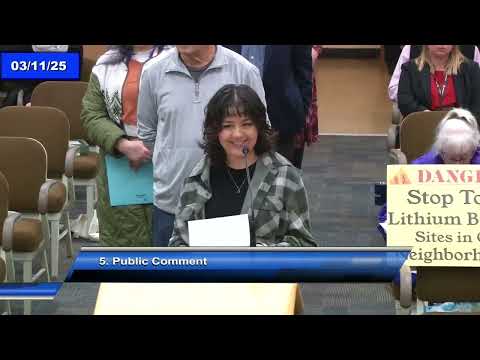
Dozens of residents and stakeholders used the public‑comment period to press the Santa Cruz County Board of Supervisors for immediate action after the Moss Landing battery energy storage system (BESS) fire and to oppose proposed local BESS sites.
Speakers described health concerns, soil contamination, and visibility of smoke from the Vistra/Moss Landing fire and urged an emergency ordinance or moratorium on proposed lithium‑ion battery storage facilities. Tracy Murphy of Watsonville said she was “deeply concerned about the contaminants yet to be determined in our small vineyard soil” and asked the board to slow approvals and convene town halls. Becky Steinbruner called for more public follow‑up and a letter of support for Assembly Bill 303, which commenters described as seeking to restore more local control over permitting of energy storage systems.
Several speakers requested scientific panels without conflicts of interest, expanded soil and nanoparticle testing, and tighter oversight of applicants. Others urged the board to declare Santa Cruz County a BESS‑free zone and to support AB 303 in Sacramento. Some residents asked the board to consider a moratorium until independent safety standards, monitoring plans and community evacuation plans are in place.
Supervisors acknowledged the concerns but did not adopt an emergency moratorium at the meeting. Supervisor Cummings said he appreciated the comments and hoped probation and other departments would continue community engagement on related topics; Supervisor Martinez said she had contacted state officials and would press for more community engagement. The board accepted public testimony and indicated staff would continue to coordinate outreach and gather technical information; no formal directive to enact a moratorium was taken during the session.
The public record shows a high level of local concern about health, emergency response, and transparency; activists signposted upcoming community meetings and asked the board to prioritize independent testing, town halls and closer coordination with state agencies and regulatory partners.