Get Full Government Meeting Transcripts, Videos, & Alerts Forever!
Get email alerts on the Water Rights Columbia Basin topic
No spam. Unsubscribe anytime.
Conservancy board warns Pasco transfers and Ecology's 50814 handling could reshape local water rights
Summary
Franklin County Water Conservancy Board members told commissioners March 12 that recent municipal water-right transfers to Pasco, rising denials from the Department of Ecology and planned changes to Columbia River operations could have large economic effects on local irrigators and county water users.
FRANKLIN COUNTY, Wash.
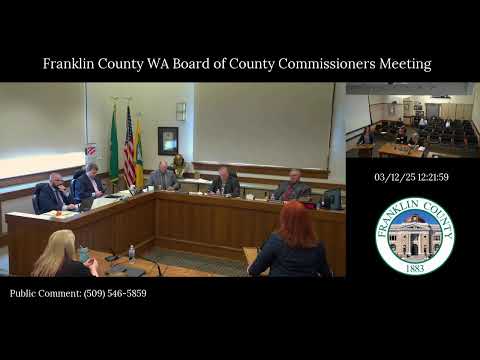
At a March 12 workshop the Franklin County Water Conservancy Board and invited guests briefed the county commissioners on a suite of water-right and river-operation issues they said could affect farms, municipalities and county planning.
Mark Nielsen, treasurer of the Franklin County Water Conservancy Board, and Lynn Hall, the board chair, reviewed recent transfers of irrigation water to municipal use, noting that Pasco submitted dozens of applications in recent years and that the transfers have economic consequences both where water is used and where it is reallocated. Dr. Daryl Olsen, chair of the Benton County Water Conservancy Board, joined the briefing and described parallel regional issues.
Nielsen said the board approved and transmitted roughly three dozen Pasco-area applications for changes and transfers in the past two years; roughly two-thirds of the transfers moved water from agricultural to municipal use. Board members warned that conversion of irrigation permits connected to the Columbia Basin project (commonly discussed in the briefing as the "50814" issue) could shift some existing users from permit status to Bureau of Reclamation-held rights, potentially subject to per-acre fees. That change, the board said, could have substantial fiscal consequences for water users and for the local economy.
The conservancy board also described a perceived rise in Department of Ecology denials on more recent transfer applications. Board members said Ecology's evolving technical interpretations, especially around groundwater-surface-water connectivity and hydraulic conductivity, have increased review times and produced more contested outcomes than in earlier decades.
Nielsen and Olsen urged the commissioners to help convene a multi-county meeting of affected conservancy boards and county officials to press Ecology to enter formal rule-making on key technical standards and to coordinate a regional response. County commissioners agreed to pursue organizing a meeting of Columbia-river-bordering counties and to work with county staff on logistics and invitations.
The briefing also flagged recent Corps of Engineers interim procedures for Columbia River operations. Conservancy-board speakers said the Corps' interim operation curves could lead to larger, more frequent drawdowns at John Day Pool and that drawdowns of several feet could affect irrigation pumping and river-dependent infrastructure; the board scheduled a focused briefing on April 3, and urged elected officials and irrigators to attend.
Why it matters: water-right transfers from agricultural to municipal uses reshape land values, available irrigation acreage and long-term farming operations; technical rule changes or reinterpretations by Ecology could change who pays for water and under what conditions. The conservancy board asked county leadership to help coordinate multi-county outreach to clarify technical standards and encourage public rule-making.