
Decatur board backs DDA plan for mixed‑use redevelopment at 750 Commerce Drive
Get AI-powered insights, summaries, and transcripts
Sign Up Free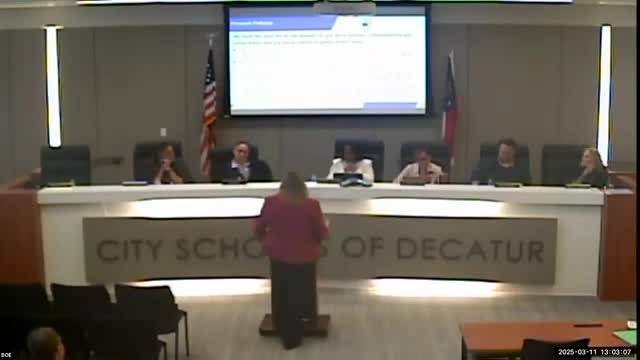
Summary
The City Schools of Decatur Board of Education voted unanimously to support the Downtown Development Authority’s plan to finance a 361‑unit mixed‑use redevelopment at 750 Commerce Drive that includes 36 income‑restricted apartments and a grocery anchor.
The City Schools of Decatur Board of Education on Tuesday voted unanimously to approve a resolution of support requested by the Downtown Development Authority (DDA) so the DDA can move forward with financing a mixed‑use redevelopment at 750 Commerce Drive.
The redevelopment proposed by AMLI/Prime Property Fund would combine the vacant former Kroger site and adjacent land to build 361 residential units, about 13,000 square feet of grocery space, roughly 12,000 square feet of additional street‑front retail and a parking deck. The project includes 36 units set aside at no more than 80% of area median income and a requirement that those inclusionary units be offered first, for six months, to City Schools of Decatur and City of Decatur employees.
Why it matters: Board members said the project would return a long‑vacant grocery anchor to walkable downtown Decatur and add new housing and retail. The city/DDA proposal uses a development‑authority bond structure in which the DDA temporarily owns the land and improvements and leases them back to the developer; the developer makes scheduled payments in lieu of taxes (PILOTs). Over the 10‑year PILOT schedule the developer will pay a reduced tax stream compared with full assessed taxes; the agreement and DDA documents require community benefits (public realm improvements, parking, Paseo, multi‑use path, grocery lease) equal to the value of the incentive.
What the board approved: The Board passed a resolution of support so the DDA may finalize an economic development agreement and proceed toward bond validation. The DDA and city commission have already approved parallel resolutions; the DDA will consider final bond documents later in the week before seeking Superior Court validation.
Key fiscal highlights presented to the board: - Projected total developer construction cost: about $140 million (roughly $415k per unit). - Taxes if fully on the rolls (no incentive) were shown as approximately $28.5 million over 10 years; under the proposed PILOT the developer would pay about $14.5 million over 10 years. - Incremental tax revenue to the city/county over the 10‑year incentive vs leaving the property vacant was presented as a material positive; the analysis projected continued larger tax receipts in years 11–20 once the incentive ends and the property is on the tax rolls. - The presentation included an estimate that a development at this density would add roughly 44 K–12 students to the system (about a 12% yield based on comparable recent multifamily projects), with taxes per added student rising as the project matures.
Conditions and controls included in the economic development agreement: a definition of a “qualified grocery” (a national chain with at least ~200 outlets), requirement of a 10‑year grocery lease before incentives begin, developer reporting and inspection rights for the DDA, clawbacks and monetary penalties if the grocery fails to open or remains closed beyond short allowable periods, and restrictions on assignment or change of control without DDA approval.
Board action and next steps: The board’s motion to approve the resolution of support carried unanimously. The DDA will consider final bond documents on its next agenda, seek Superior Court validation of the bond issuance, and only after required conditions — including evidence of a grocery lease and completion milestones — will the bond closing and construction proceed.
Discussion vs. decision: The board’s vote was a statement of support permitting the DDA to proceed with financing and validation steps; it was not a development permit or final tax abatement beyond the DDA process. The agreement contains multiple performance milestones and termination/clawback provisions the DDA and city must enforce if conditions are not met.
Ending: The board and city emphasized the project’s downtown grocery anchor and public‑realm improvements as primary benefits; board members asked administration to track anticipated pupil yield and tax receipts and to report any material changes as the project moves through validation and permitting.