Get Full Government Meeting Transcripts, Videos, & Alerts Forever!
Get email alerts on the Juvenile Justice Adolescent Brain topic
No spam. Unsubscribe anytime.
UCLA researcher tells Alaska senators adolescent brain plasticity offers window for rehabilitation
Summary
Dr. Adriana Galvin told a joint meeting of the Alaska State Senate Judiciary and Education committees that brain plasticity in adolescence creates opportunities for rehabilitation, and she outlined evidence linking sleep, school start times, and community supports to better outcomes for justice‑involved youth.
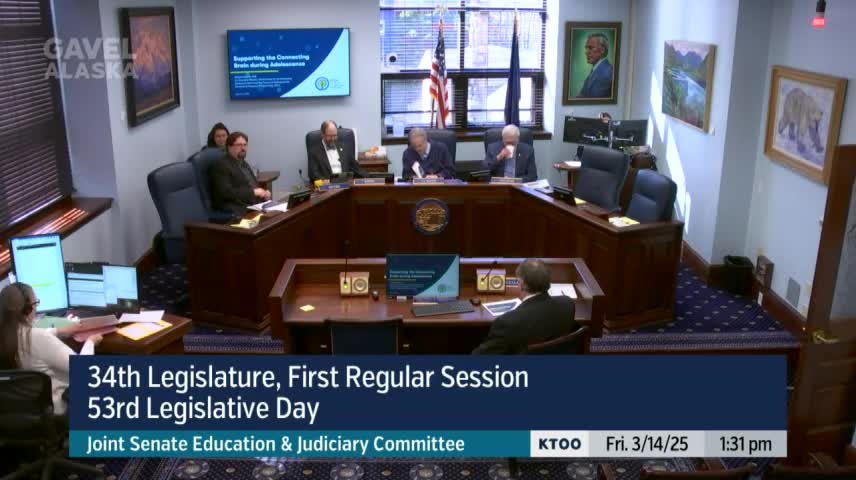
Dr. Adriana Galvin, co-executive director of the UCLA Center for the Developing Adolescent, told a joint meeting of the Alaska State Senate Judiciary Committee and Senate Education Committee on March 14 that adolescence is a distinct developmental period with heightened brain plasticity that creates opportunities for intervention and rehabilitation.
In a 35-minute presentation and Q&A, Dr. Galvin summarized neuroscience research showing that adolescence typically begins with puberty (around ages 10–12) and extends into the early to mid-20s, a period when the brain refines neural connections and shows increased responsiveness to rewards. "Plasticity equals possibility," she said, arguing that interventions during this window can redirect developmental trajectories.
The presentation was placed before senators because of concerns about how juvenile confinement and other adverse experiences affect development. Dr. Galvin told the committee that neurons can gain or lose roughly 25 percent of their synaptic connections during puberty (falling to about 10 percent in adulthood), and that the striatum — a brain region tied to motivation and reward — is particularly active in adolescents, helping them learn quickly but also making them more reward-seeking.
Dr. Galvin highlighted several developmentally important needs for adolescents: opportunities to explore and practice decision-making; chances to form values, goals and identities; continued support from caring adults and mentors; respect from peers and adults; and adequate sleep. She said research links later high‑school start times to improved outcomes — lower crash rates and higher standardized-test scores — and noted that districts that delayed start times, including Seattle, reported benefits.
Committee members asked how to identify adolescents who experienced early adversity and whether schools can help. Dr. Galvin said schools are often the first line for spotting withdrawal or disengagement that can signal earlier trauma. She also endorsed allowing older teens to access mental health care without parental consent: "No one knows our own mental health better than ourselves, and 16 and 17 year olds are aware enough to know whether they need the support," she said.
Senators pressed on juvenile‑justice implications. Dr. Galvin cited work by a colleague at UC Irvine showing lower recidivism among youth who were not given harsher formal sentences and stressed the importance of reentry supports and facility climate. She said youth who reported more positive perceptions of their confinement — including access to education, skills training and a constructive climate — were less likely to be rearrested.
During the exchange, senators raised COVID‑era social isolation and asked whether adolescents can "catch up" after early adversity. Dr. Galvin said the brain's plasticity makes early intervention effective: in her longitudinal research on childhood anxiety, earlier treatment predicted better outcomes.
The joint committee did not take legislative action at the meeting; the session consisted of Dr. Galvin's presentation and a question-and-answer period. Senators present included Senator Klayman (chairing the session), Senator Myers, Senator Stevens, and Senator Akhil; Senator Bjorkman was noted as absent. The Judiciary Committee said it will not meet on March 17; its next meeting is scheduled for March 19 at 1:30 p.m.
The presentation and the committee's questions linked neuroscience findings to several policy topics under discussion in state legislatures nationwide (school start times, consent for mental‑health services for older teens, juvenile confinement practices and reentry supports), but no specific Alaska bill or motion was put forward or voted on during this meeting.