Get Full Government Meeting Transcripts, Videos, & Alerts Forever!
Get email alerts on the Confirmations topic
No spam. Unsubscribe anytime.
House Judiciary Committee holds confirmation hearings for governor's appointees to policing, judicial and civil-rights panels
Summary
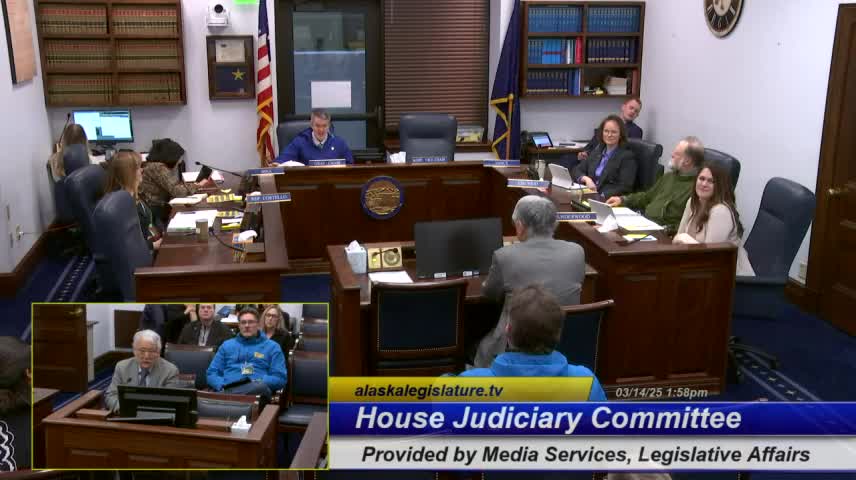
The Alaska House Judiciary Committee on March 14, 2025, held confirmation hearings and public testimony for the governor’s nominees to several state boards and commissions, including the Alaska Police Standards Council, the Commission on Judicial Conduct, the State Commission for Human Rights, the Alaska Bar Association board and the Violent Crimes Compensation Board.
The Alaska House Judiciary Committee on March 14, 2025, held confirmation hearings and public testimony for the governor’s nominees to several state boards and commissions, including the Alaska Police Standards Council, the Commission on Judicial Conduct, the State Commission for Human Rights, the Alaska Bar Association board and the Violent Crimes Compensation Board. The meeting was held in the Gruenberg Room (Capitol Room 120) in Juneau and was chaired by Rep. Tara Gray.
The session matters because the nominees will sit on panels that set standards for police certification and training, review judicial conduct complaints, handle civil-rights claims, regulate the legal profession and authorize payments to victims of violent crime.
David Ross, the police chief for the City of Kenai, told the committee he has served at the Kenai Police Department for about 24 years, including nearly nine years as chief, and has been a member of the Police Standards Council for three years. “I look forward to my role on the council as an opportunity to continue to help address the need for a very professional and well trained law enforcement workforce in Alaska,” Ross said. Committee members asked about the council’s recent regulatory work; Ross described prior proposals on in‑service training, corrections‑officer age limits and the creation of supervisory and management certificates for law enforcement.
Daniel (Dan) Carruthers, a retired corrections professional with 28 years of experience in roles from correctional officer to deputy commissioner, said his background prepares him to represent corrections perspectives on the council. He told the committee he authored the state’s first Criminal Justice Planning Agency (CJPA) grant for an offender counseling program and described practical tools he developed for supervising populations in rural regions.
Timothy Collins, a sergeant with the Alaska State Troopers and the nominee for a police‑officer seat on the council, described nearly 13 years in law enforcement, including patrol and investigative work in Delaware and Alaska and supervisory duties in Kodiak. “If confirmed, I will work diligently to uphold the highest standards of law enforcement in Alaska, ensuring that our officers are equipped with the training, resources, and support they need,” Collins said; committee members pressed him on priorities such as accountability and supervisor training for newly promoted managers.
The committee also heard from Bill Satterberg, the governor’s nominee to the Commission on Judicial Conduct and a longtime Fairbanks lawyer. Satterberg said personal conflicts could require recusal and described three scenarios that would prompt him to step aside: close personal friendship, an active case before a judge, or being the complainant. During public testimony, Ed Martin Jr., an Alaska resident, urged the committee to delay appointments to the Judicial Conduct Commission until “a full investigation of that commission and its actions over the course of several years,” saying he had submitted documents to the committee. Satterberg said he had taken a phone call from Martin after his selection and described the call as an attempt to lobby; he also told the committee that the commission’s meetings include public comment periods followed by closed sessions when complaint investigations require confidentiality.
Doreen Lorenz and Jessie Ruffridge appeared as nominees to the State Commission for Human Rights. Lorenz, a media professional and fourth‑generation Alaskan, told the panel the commission is seeking statutory changes, including renaming the agency from the Commission for Human Rights to the Alaska Commission for Civil Rights to clarify jurisdiction, shifting the annual report timetable to align with the fiscal year, and adding statutory due‑process protections for commissioners. “We would like to change our name. We are currently the Commission for Human Rights,” Lorenz said, noting confusion between human‑rights and civil‑rights matters can misdirect complaints. Jessie Ruffridge, an incumbent commissioner, described outreach work and programs she helped build to support vulnerable residents and teen parents, and said she was proud of recent commission outreach and casework.
Jedediah Cox spoke on behalf of the Alaska Bar Association board appointment. Cox highlighted the bar’s recent work: expanding continuing legal education (CLE) offerings, increasing pathways to licensure and managing the Bar’s finances including paying off the K Street building. He said the bar is pursuing measures to improve access to justice and increase diversity in the legal profession.
Dr. Robert Arata, who serves on the Violent Crimes Compensation Board, described four years on the panel and said the board provides payments for needs such as home repairs and mental‑health care for victims and families. He told the committee the current statutory maximum award is $40,000 and said future budget constraints and federal reimbursement levels are a concern for the board’s ability to help all claimants. Laurel Shoop, speaking as a private citizen though identified as a Department of Public Safety liaison, offered public support for Arata’s reappointment.
Committee members asked routine background questions of nominees and opened, then closed, public testimony for each appointment. The committee did not take formal confirmation votes during the hearing; staff were directed to complete paperwork related to the hearing record. At the conclusion, Rep. Gray previewed upcoming committee business, including hearings and bill amendments scheduled for March 17–21.
No formal confirmation votes or final committee recommendations were recorded on the hearing transcript.
The committee will sign the hearing paperwork; according to the chair’s remarks a signature on the report does not indicate how any member will vote on confirmation in future sessions.