Get Full Government Meeting Transcripts, Videos, & Alerts Forever!
Get email alerts on the Healthcare Scope Of Practice topic
No spam. Unsubscribe anytime.
Senate committee hears bill to allow experienced physician assistants independent licensure
Summary
The Senate Labor and Commerce Committee heard testimony on Senate Bill 89, which would allow physician assistants who meet postgraduate-hour requirements to practice without a written collaborative agreement; the committee set the bill aside for future consideration.
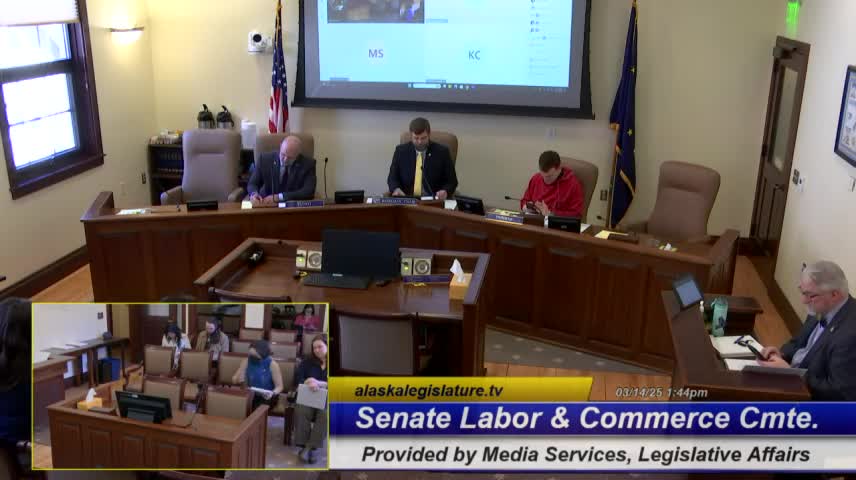
Senate lawmakers on March 14 heard testimony on Senate Bill 89, which would create a pathway for experienced physician assistants (PAs) in Alaska to obtain independent licensure and practice without a written collaborating agreement once they meet specified postgraduate clinical-hour thresholds.
The bill matters because proponents say it could increase access to primary and specialty care in rural and underserved communities where physician shortages are long-standing. Sponsors and health-care representatives told the Senate Labor and Commerce Committee that written collaborating agreements have become an administrative barrier to hiring and retaining PAs in Alaska.
Senator Lukey Tobin, sponsor of SB 89 and senator for District I, told the committee the bill “simply asked to allow Alaska's physician assistants to provide care within the maximum scope of their practice” and that it would allow experienced PAs to pursue independent licensure. Mackenzie Pope, staff to Senator Tobin, provided a sectional analysis describing how the bill would amend multiple licensing statutes, direct the State Medical Board to adopt regulations, and require PAs to attest to postgraduate clinical hours before applying for independent licensure.
Provisions described in the sectional analysis include a requirement that PAs with fewer than 4,000 postgraduate clinical hours continue to practice under a written collaborating agreement; a prohibition on unsupervised surgery; a statutory attestation process for postgraduate hours; inclusion of PAs in existing disciplinary, licensing-recognition, temporary-licensure and reporting statutes; and a clause preventing insurance policies from imposing rules more restrictive than the statute’s practice and collaboration provisions. The sponsor and staff said the State Medical Board would define “surgery” in regulation and could set specialty-specific additional requirements up to the 4,000-hour cap.
Two invited witnesses representing health-care providers backed the bill. Mary Swain, CEO of Shumai Community Health Center in Bristol Bay Borough, said rural clinics face chronic physician vacancies—often averaging 12 months—and that independent practice for experienced PAs would “help mitigate these gaps” by using trained providers already in communities. Swain said her clinic currently pays more than $55,000 to maintain a collaborating agreement with physicians who do not live in the community and that the time to approve such agreements can be months.
Megan Hall, a physician assistant in Anchorage and president of the Alaska Academy of Physician Assistants, described the evolution of the PA profession and told the committee the paperwork and cost of formal collaborating agreements have become hiring barriers. “These collaborative agreements that once allowed a new profession to flourish have now become barriers to hiring PAs,” Hall said, adding that existing statutory and regulatory guardrails—licensure, continuing education, board oversight, privileging, and peer review—would remain in place under the bill.
Committee members asked how the bill would define surgery, who sits on the State Medical Board, and what local or institutional safeguards would remain. Mackenzie Pope said the medical board would create a regulatory definition of surgery and noted the regulatory process allows for public comment. Senator Tobin said, to her recollection, the medical board includes three physicians and one physician assistant, and staff later confirmed the bill text indicates five physicians and one PA on the board.
Committee Chair Senator Bjorkman announced that the committee would set SB 89 aside for further consideration at a future meeting; no formal vote on the bill occurred during the hearing.
The committee hearing included discussion of alternatives such as continued institutional privileging, peer review requirements in federally qualified health centers, and the possibility of specialty-specific postgraduate requirements determined by the medical board. Supporters emphasized the bill does not seek to relabel PAs as physicians and stressed continuing education and board oversight as the primary safety mechanisms.
The committee did not take final action; the sponsor and witnesses said the board-regulation process and institutional privileging would shape how the bill functions if enacted.