Get Full Government Meeting Transcripts, Videos, & Alerts Forever!
Get email alerts on the State Budget topic
No spam. Unsubscribe anytime.
Commerce Department seeks $240 million for FY26; highlights broadband, energy, seafood and insurance items
Summary
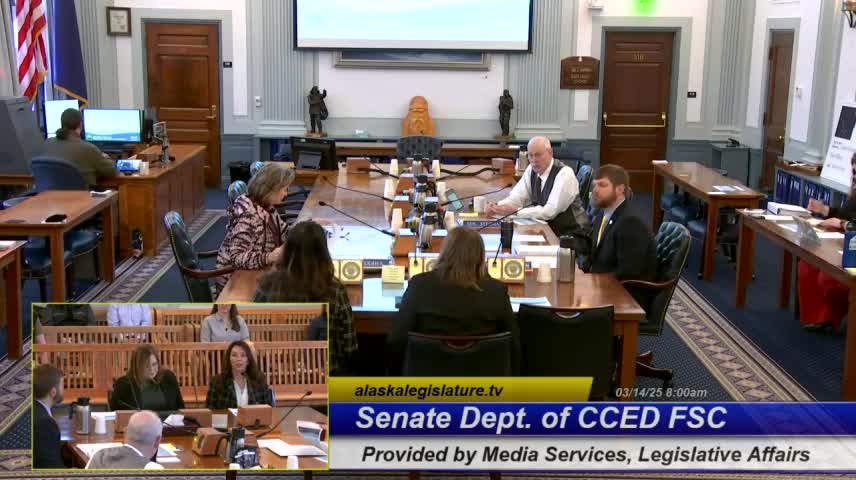
The Alaska Department of Commerce, Community and Economic Development told a Senate Finance subcommittee on March 14 that it is seeking $240,000,000 in total authority for fiscal year 2026 and outlined budget changes across broadband, energy, licensing and seafood marketing programs.
The Alaska Department of Commerce, Community and Economic Development told a Senate Finance subcommittee on March 14 that it is seeking $240,000,000 in total authority for fiscal year 2026 and outlined budget changes across broadband, energy, licensing and seafood marketing programs.
“My name is Julie Sande. I’m the Commissioner of Commerce, Community and Economic Development,” Commissioner Julie Sande said as she opened the department’s overview. “Our team works very hard to help promote a strong economy and healthy communities in Alaska while protecting consumers.”
The administration framed the request as largely supported by dedicated receipts rather than state general fund. “We also deposited over $118,000,000 into the general fund” in fiscal 2024, Administrative Services Director Hannah Lager told the committee, noting that most department revenue comes from fees, assessments and investment earnings rather than unrestricted state general fund.
Why it matters: the department manages a wide portfolio — from the Alaska Broadband Office and the Alaska Energy Authority to licensing divisions, the Alaska Seafood Marketing Institute and regulatory commissions — so shifts in its funding or fee structures can ripple through licensing, consumer services and grant programs.
Key items presented
- Alaska Broadband Office: Lager said the office will establish an indirect cost allocation plan to bill federal awards for administrative costs and that the department is requesting a small amount of general fund in FY26 to bridge administrative expenses while that plan is negotiated. “There is a de minimis rate that the federal program allows us to charge. That’s 10% for this program,” Lager said, describing the temporary nature of the GF support.
- Alaska Energy Authority and AIDEA: Committee materials and staff described technical budget transfers after HB307 allowed AEA to house its own employees. The department plans to replace declining federal support for three circuit‑rider positions by drawing from Power Cost Equalization (PCE) fund receipts. AEA Executive Director Curtis Thayer said the circuit rider program employs four core staff whose “primary focus is to keep the lights on in rural Alaska,” and that the team logged roughly 2,000 calls and responded to about 20 emergencies over the last two years. The department said it will also use existing fund balances for scanning and digitization of energy program records and is adding modest authority for building rent tied to separate fiduciary responsibilities between AIDEA and AEA.
- Alaska Seafood Marketing Institute (ASMI): The department proposed a $10,000,000 general‑fund multi‑year appropriation to implement a three‑year comprehensive marketing plan and reduce ASMI’s reliance on first‑sale seafood assessment receipts, which have fallen with lower fish prices. The submission also reduces statutory designated funds in FY26 to reflect expected assessment revenue declines.
- Alaska Oil & Gas Conservation Commission (AOGCC) carbon storage program: Department officials said primacy for a federal Class VI carbon storage program has not yet been obtained from the U.S. Environmental Protection Agency. The department does not expect receipts from that program in FY26 and is planning for potential receipts in FY27, contingent on EPA primacy and project applications.
- Alcohol & Marijuana Control Office (AMCO): Lager said the department is revising carry‑forward language so that marijuana and alcohol license fee receipts will carry forward to the program year and will no longer be returned to the general fund, reflecting the program’s repayment of earlier one‑time GF investments.
- Division of Insurance and consumer services: Lager told senators the division will add one position in consumer services after a 25% increase in consumer inquiries and a 31% rise in health care appeals in the unit; the division funds the position from associated licensing receipts. Lager also said actuarial contracting costs range “anywhere between $500,000 and a million dollars in actuarial costs in any given fiscal year.”
Revenue contributions and fund flows
Lager identified large flows of department revenue into the general fund: she said the division of insurance contributed about $72,000,000 — primarily from insurance premium taxes with a smaller contribution from licensing fees (roughly $6–7 million) — and that the division of banking and securities contributed about $18,000,000 in 2024 from licensing receipts. Lager said the department is the smallest consumer of unrestricted state general funds among state agencies, but that it also periodically requests limited GF authority for specific items.
Questions from senators
Senators pressed department leaders on indirect costs, interagency receipts, federal funding timelines and board oversight. On carbon storage revenues, Commissioner Greg Wilson said the department expects revenue only after EPA primacy and a subsequent project application, and that timing depends on both project development and primacy. Commissioner Sande, who said she serves on the Alaska Gasline Development Corporation board, told senators she receives regular updates from AGDC’s executive director during active negotiations but acknowledged that rapid developments can outpace formal board meeting schedules.
What’s next: Department staff said they will provide written follow‑ups to several committee questions about indirect cost plans and building rent allocations. The subcommittee did not take formal votes during the hearing; staff will notify members about future subcommittee meetings.
Ending
The department’s presentation covered technical budget realignments, temporary general‑fund bridging for administrative costs, targeted staffing for rising consumer needs and a multi‑year marketing request for ASMI. Committee members asked for follow‑up details on indirect cost plans, interagency charging and timelines for federally dependent programs.