Get Full Government Meeting Transcripts, Videos, & Alerts Forever!
Get email alerts on the Appropriations Committee Actions topic
No spam. Unsubscribe anytime.
HR appropriations subcommittee issues do-pass recommendations on multiple agency budgets, amends retirement office incentive rules
Summary
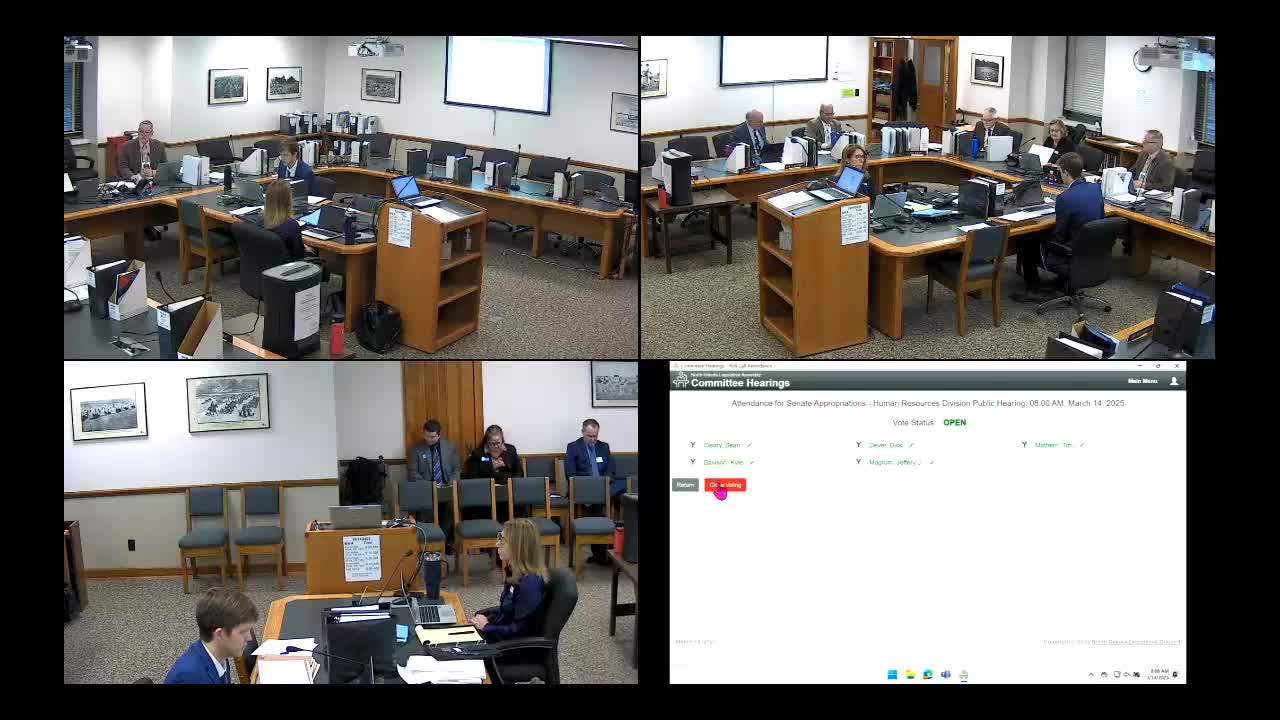
The Senate Appropriations Committee’s Human Resources Division on Thursday recommended passage of three House appropriation bills affecting the Department of Labor and Human Rights, the Protection & Advocacy Project and the Retirement and Investment Office, and it adopted amendments narrowing incentive pay and adding reporting requirements for the retirement office’s new bonus program.
The Senate Appropriations Committee’s Human Resources Division on Thursday recommended passage of multiple agency spending bills and adopted amendments to the bill concerning the Retirement and Investment Office.
The committee approved a do-pass recommendation for House Bill 1007, the appropriation defraying expenses of the Department of Labor and Human Rights; granted a do-pass recommendation for House Bill 1014, which covers expenses for the Protection & Advocacy Project; and amended and passed House Bill 1022, the appropriation for the Retirement and Investment Office, with several changes that limit incentive pay and require reporting to the Appropriations Committee.
Why it matters: The committee’s actions set final language and funding priorities that will go to the full Appropriations Committee and, where required, to conference committee with the House. The changes to the Retirement and Investment Office (RIO) alter the scope and oversight of a new incentive program that state lawmakers authorized recently, and add transparency provisions about plans to move investment work in-house.
The committee first took up House Bill 1007, which the chair described as a straightforward bill reflecting the executive recommendation for the Department of Labor and Human Rights. Senator Davison moved a do-pass recommendation and Senator Mather seconded. The clerk called the roll and the motion carried; the committee recorded that the bill will not go to conference committee and will be carried by Senator Mather to the next stage.
On House Bill 1014 (Protection & Advocacy Project), committee members discussed an FTE request. Committee debate centered on whether to preserve the single FTE contained in both the governor’s recommendation and the House version, while acknowledging that the agency had requested two positions. Senator Cleary moved that the subcommittee adopt the House recommendation (one FTE) and seek a do-pass; Senator Davidson seconded. The roll-call vote was 4 to 1 in favor (Senator Magrum/Magro recorded a no). The motion carried and Senator Cleary volunteered to carry the bill forward; no conference committee was requested for that item.
Most discussion and the largest set of amendments focused on House Bill 1022, the Retirement and Investment Office budget. Senator Cleary offered two related amendments that were adopted. The first amendment narrows the incentive-pay program so it applies only to investment staff positions, caps incentive pay at 75 percent of base annual pay for eligible positions, and requires a report to the Appropriations Committee on the incentive program. The second adopted amendment adds a reporting requirement directed to the State Investment Board asking for a plan to internally manage 50 percent of investments under the board’s control; the amendment requires the board to report its plan to the Appropriations Committee (the transcript records committee discussion that additional statutory changes would be necessary for the board to increase its in-house managed percentage).
Senator Cleary also moved to add $25,000 in special funds for retirement-education outreach related to the Teachers’ Fund for Retirement (TFFR); that motion was adopted. Several other budget items tied to the bill were discussed and a motion by Senator Davison to enter conference negotiations on three budget items (removing an internal audit position, reducing IT hosting fees from $751,334 to $600,000, and reducing IT consulting from $250,000 to $200,000) passed, and the bill as amended was sent on with a do-pass recommendation.
Votes at a glance - House Bill 1007 (Department of Labor and Human Rights): Motion for do pass adopted; no amendment; committee carried the bill to the full committee. (Motion by Senator Davison; second Senator Mather.) - House Bill 1014 (Protection & Advocacy Project): Do-pass motion adopted, 4–1 (one recorded no vote). Motion carried. (Motion by Senator Cleary; second Senator Davidson.) - House Bill 1022 (Retirement and Investment Office): Bill amended (two substantive amendments plus report language and a $25,000 retirement-education add) and passed as amended; the bill will proceed to full committee and conference as noted.
What the amendments change: The RIO incentive amendment narrows eligibility to investment positions, caps the incentive at 75 percent of base pay per eligible FTE, and requires a formal report to the Appropriations Committee on the program. The in-house investment amendment requires the State Investment Board to report a plan to internally manage 50 percent of assets under its control and to provide transparency on FTEs and projected fee savings. The committee discussed that additional statute changes (Century Code changes) would be necessary if the State Investment Board sought to raise the in-house-managed percentage beyond amounts currently authorized.
Where it goes next: The committee’s do-pass recommendations and adopted amendments will be carried to the full Appropriations Committee. Several items — notably the RIO amendments and the budget adjustments proposed by Senator Davison — were flagged for conference committee with the House so lawmakers can reconcile differences.
Committee context and process notes: Committee members repeatedly emphasized the intent to balance fiscal stewardship with program continuity. Several members praised agency staff and the performance of current employees while expressing caution about adding FTEs. The committee recorded that federal funding assumptions (for programs relying on federal reimbursement) influenced discussion about whether to add positions or shift general-fund shares.
Ending: The subcommittee completed action on the listed bills and agreed to reconvene on remaining items not yet considered; multiple members flagged items for follow-up, and the RIO provisions will generate further conference-level discussion.