Get Full Government Meeting Transcripts, Videos, & Alerts Forever!
Get email alerts on the Appropriations Government Operations Trust Lands topic
No spam. Unsubscribe anytime.
Trust Lands presents SB2013 budget, details $7 billion portfolio, compensation study and staffing requests
Summary
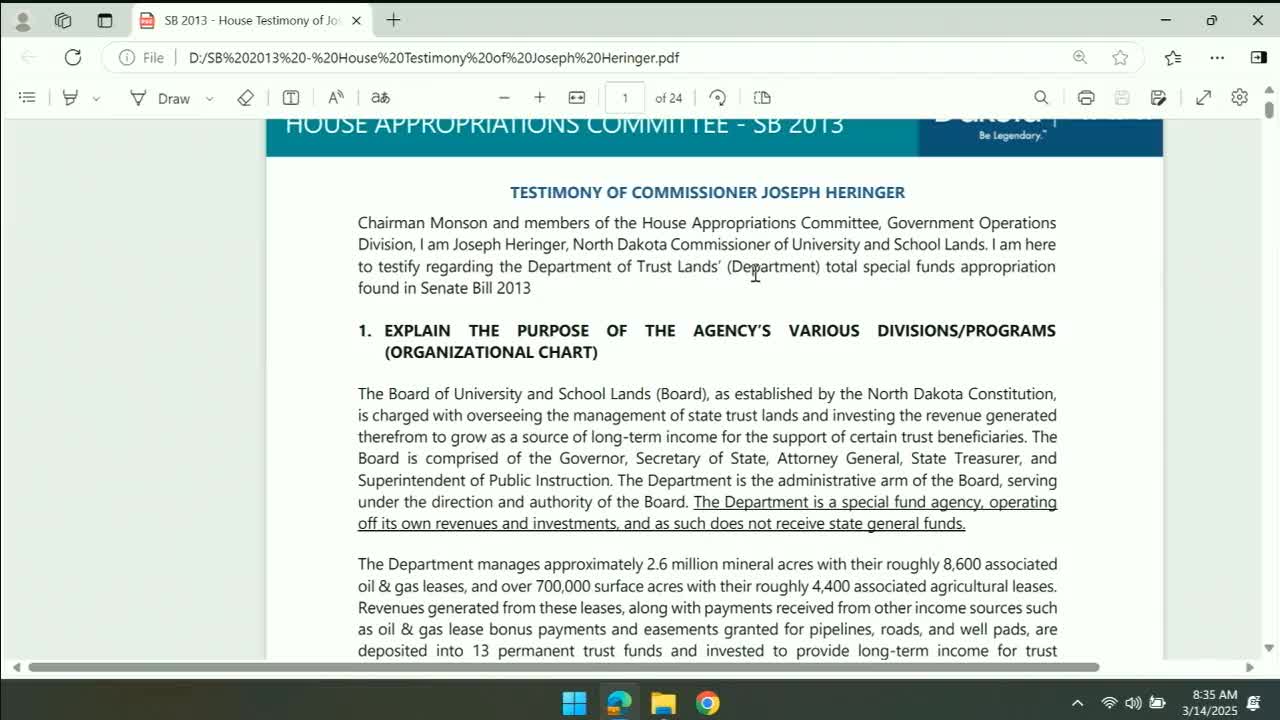
Joseph Herringer, commissioner of the Board of University and School Lands, presented Senate Bill 2013 to the House Appropriations Committee’s Government Operations Division and outlined the department's $7 billion investment program, proposed staffing and pay changes, and a compensation study that recommends equity adjustments.
Joseph Herringer, commissioner of the Board of University and School Lands and the Department of Trust Lands, presented Senate Bill 2013 to the House Appropriations Committee’s Government Operations Division and described the department’s revenue sources, proposed staffing changes and a compensation study intended to address turnover.
Herringer said the department is “a special funds agency, so we don't affect the general fund at all,” and told members the department manages roughly $7 billion in invested assets in the Common Schools Trust Fund and related permanent funds.
The presentation said the Common Schools Trust Fund balance was about $7 billion at the end of fiscal 2024, and that the department projects $585 million in distributions to beneficiaries in the 2025–27 biennium, a 17% increase over the previous biennium. Herringer described the department’s revenue mix — royalties, lease bonuses, right‑of‑way fees and investment returns — and noted the Strategic Investment and Improvements Fund (SIF) produced more than $200 million in revenue in the last fiscal year.
Herringer and Adam Ottison, director of revenue compliance, outlined investment performance and staffing. Herringer reported the department had a 9.42% return for fiscal 2024 and that calendar‑year returns were about 8.83% for 2023 and 10.11% (preliminary) for 2024. He said the agency employs 33 full‑time equivalent staff and has seen roughly 45% turnover since 2021, which the department attributes primarily to pay competition with private sector and out‑of‑state employers.
Ottison reviewed a CBIZ compensation study the land board commissioned. “CBIZ performed a thorough evaluation. They interviewed every employee,” Ottison said, summarizing the firm’s work. The report recommends equity adjustments for a subset of staff and identified 12 positions the consultant judged most at risk of turnover. The department requested $675,000 in biennial equity adjustments (with additional benefits funding to be calculated by legislative counsel) and presented a lower, $231,000 option limited to the highest‑risk positions.
Herringer also requested two new FTEs: one “diversified revenues officer” to pursue non‑mineral revenue opportunities (carbon projects, wind/solar, rare earths and similar) and an internal auditor/compliance FTE for the unclaimed property program to improve audits of regional and local holders. He told the committee the diversified‑revenues post would be funded from trust‑land revenues if approved, and predicted the auditor position would recover multiple millions in additional unclaimed property collections annually if implemented.
Committee members asked for additional supporting materials. Representatives requested calendar‑year return tables, a multi‑decade projection of Common Schools Trust Fund impacts if House Concurrent Resolution 3035 (a proposed constitutional amendment to use trust funds for specified school construction projects) passed, and a clearer expected return on investment for the requested unclaimed‑property auditor. Herringer said staff had already prepared longer‑term projections and offered to provide the detailed spreadsheets and the CBIZ study to the committee record.
At a February 27 land board meeting referenced in testimony, the land board voted 3–1 to oppose moving the unclaimed property program to the State Treasurer’s office; Herringer told the committee land board members framed the issue, in effect, as “if it isn't broken, why are we looking to fix it?” Treasurer office staff had sought a transfer during the executive budget process, and the committee asked staff to provide the Treasurer’s requested costs so members could compare duplicate line items between budgets.
No formal committee vote on SB2013 or the department’s staffing and pay requests was recorded during the hearing; the presentation and Q&A were continued for further documentation and follow‑up scheduled for a subsequent hearing.
The committee also discussed policy implications of HCR 3035 (a constitutional amendment under consideration) and Herringer’s testimony that a $300 million annual distribution for 10 years (the measure’s sponsor’s proposal) would remove roughly $3 billion of trust principal over a decade and could reduce long‑term fund growth and future distributions. Herringer said department projections showed a multi‑billion‑dollar cumulative reduction in distributions and ending balance over a 30‑year horizon under the sponsor’s assumptions, and he offered to present the department’s spreadsheet to the committee.
The hearing closed with the committee asking the department to return with the requested financial tables, the CBIZ report, more detailed projections on HCR 3035, and a projected return on investment for the unclaimed‑property auditor position. Herringer said staff would provide those materials before the next scheduled hearing.