Get Full Government Meeting Transcripts, Videos, & Alerts Forever!
Get email alerts on the Budget Corrections topic
No spam. Unsubscribe anytime.
DOCR central office requests $168.5 million budget, cites salary, operating and capital needs
Summary
The Department of Corrections and Rehabilitation’s central office budget request for the next biennium totals $168.5 million, officials told the Appropriations — Human Resources Section. The package includes 34 FTEs, a large capital ask and targeted equity funding.
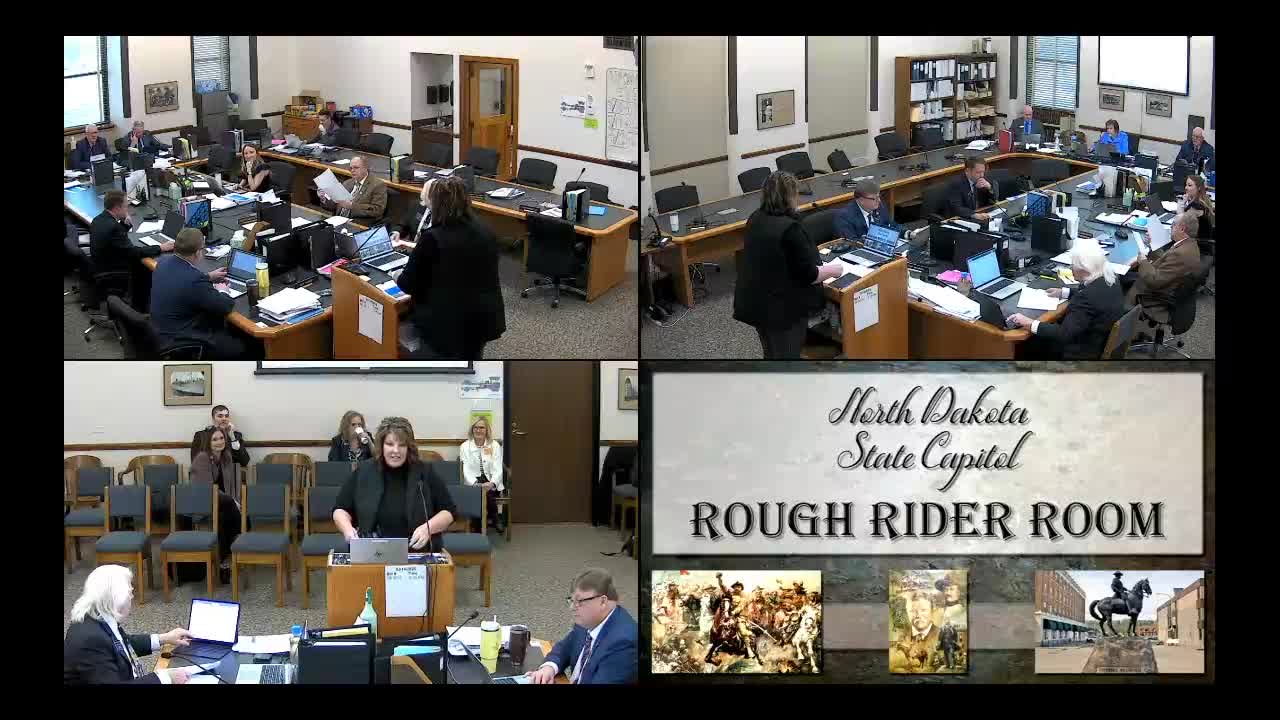
Chairman Nelson and members of the Appropriations — Human Resources Section heard Thursday that the Department of Corrections and Rehabilitation’s (DOCR) adult services central office is seeking $168,500,000 for the upcoming biennium, a $110 million increase from its base-level budget, officials said.
Michelle Zander, DOCR chief financial officer, told the committee the request covers administration, human resources, information technology, business analysts, fiscal operations (including grants and contracts), warehouse, training, medical and plant operations. The department asked for 34 new FTEs total; Zander said seven are tied to a temporary man camp request and 26 are for the Heart River Correctional Center (HRCC) project.
Zander summarized the dollar breakdown: about 20% of the executive recommendation is salary and benefits, 45% is operating expenses and 32% is capital. She said the department requested approximately $39.6 million for salaries and that the adult-side share of a target-equity request would be $5.7 million (88% of a departmentwide $6.5 million request). The packet lists operating expenses of roughly $75.2 million and capital requests of about $53.6 million, including land and buildings and project components tied to HRCC and other facility repairs.
Committee members asked for detail on large line items. Zander said 52% of operating costs support IT data processing, telephone and IT contracts, while 14% is building, grounds and maintenance costs. She acknowledged uncertainty in some estimates and promised to supply more detailed breakdowns (for example, the DOCR monthly ITD bill and the underlying utility assumptions) at a later hearing.
Zander also identified a number of decision packages included in the request: a target-equity package, a restoration package to recover one-time reductions, a man-camp proposal, and a request to restore temporary salaries. The packet shows requests for mechanical and program elements for HRCC (mechanical vestibules, food coolers, Roughrider building expansion, overnight visitation and outdoor space), and a $9.5 million line labeled “Excel repairs” that is allocated across adult and juvenile needs.
The DOCR said some one-time capital costs are tied to projects that will phase into the biennium. Committee members suggested the department tighten timing and staffing assumptions where possible. Zander agreed to revisit FTE counts and timing estimates before the next presentation.
Ending: Zander and DOCR staff left the committee with follow-up items including an itemized utility-cost spreadsheet, more detail on the IT monthly charges, and a clarified FTE/timing schedule for the man-camp and HRCC requests.