Get Full Government Meeting Transcripts, Videos, & Alerts Forever!
Get email alerts on the Facility Construction topic
No spam. Unsubscribe anytime.
Law-enforcement agencies seek state land and funding for shared Minot facility; cost estimates rise
Summary
A hearing on House Bill 1487 heard testimony that the state could transfer about 1.25 acres of DOT land east of Minot and that OMB would own and manage a new building to be leased to the Bureau of Criminal Investigation and the Highway Patrol.
A hearing on House Bill 1487 heard testimony that the state could transfer about 1.25 acres of North Dakota Department of Transportation (DOT) land on Minot’s east side and that the Office of Management and Budget (OMB) would own and manage a new building to be leased to the Bureau of Criminal Investigation (BCI) and the Highway Patrol.
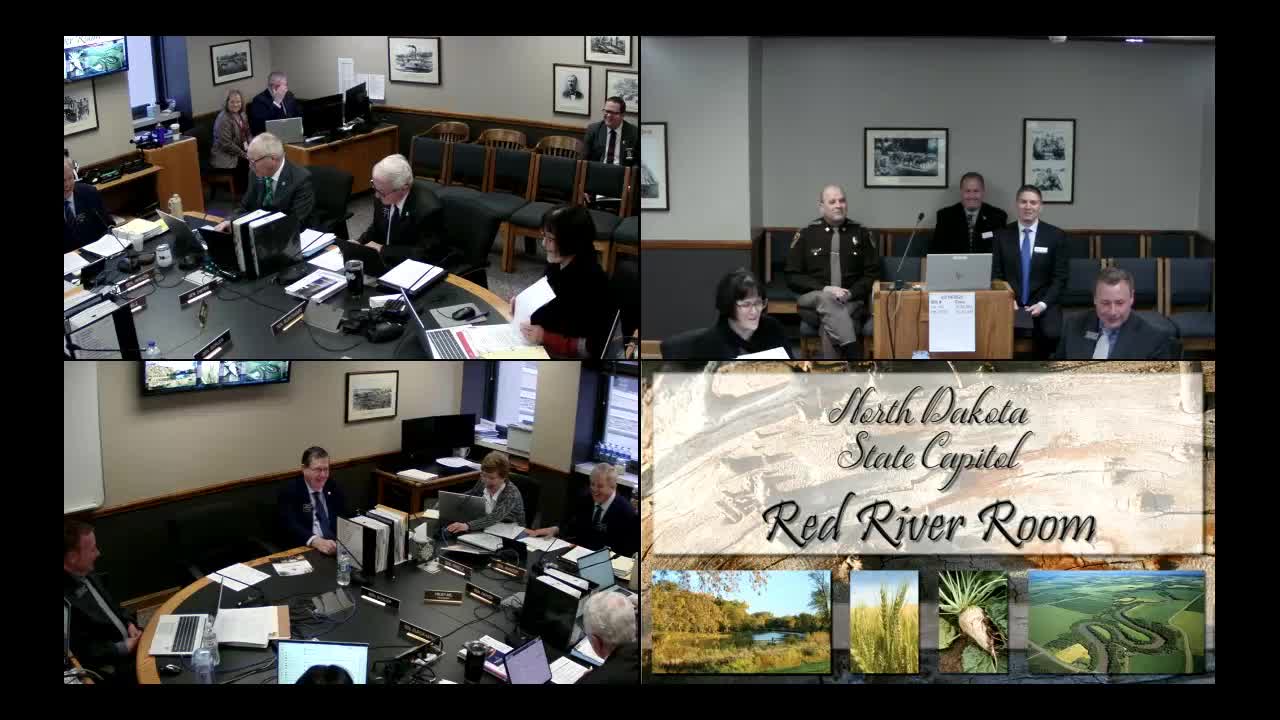
The bill, presented to the Appropriations – Government Operations Division by Patrick Leonard, Supervisor and Special Agent with the Bureau of Criminal Investigation, would authorize DOT to transfer the parcel and appropriate funds to construct a combined office and vehicle/shop facility. “The bill is very, short. It’s 2 paragraphs,” Leonard told the committee as he summarized the transfer and appropriation elements and why the agencies are pursuing a new site.
Leonard said the parcel contains a small weigh station structure but is otherwise open ground and that agencies working with OMB, DOT, Highway Patrol and the Attorney General’s office agreed DOT would donate the land if the Legislature appropriates construction funds. He said the current Job Service building that now houses the Minot field office is slated for sale and that the BCI’s Minot field office—currently 15 people in the joint workspace—cannot easily relocate on short notice because evidence rooms, a computer lab and secure storage are in the present location.
Why it matters: committee members and agency witnesses emphasized that state law enforcement needs secure evidence storage, lab and limited garage/shop space that typical downtown commercial leases lack, and the Job Service building sale could create an urgent need to relocate if notice is given by the property owner.
Costs, space and schedule
Witnesses described two paths and rough cost comparisons. Leonard said OMB’s early construction estimate was about $350 per square foot for a new build; the agencies worked toward a rough program of roughly 14,000 square feet to serve both BCI and the Highway Patrol, including shared training/conference space and garage stalls. That $350/sq ft estimate produced a $4.9 million figure in testimony; OMB testimony suggested $350 may be low and recommended $400 per square foot as a safer planning figure, which raises the appropriation estimate to roughly $5.6 million.
Brandon Solberg, Facilities Management Division Director for OMB, told the committee the $350 estimate did not include several predictable costs —utility connections, soils work, and architect and engineering fees (architect fees for a project that size could be “up to 8%,” he said). Solberg recommended planning at about $400 per square foot to allow room for architect fees and contingencies.
The committee also heard a renovation alternative: Leonard said remodeling the current Job Service building (about 17,000 sq ft, growing to ~19,000 sq ft with garage add-on) could cost about $4.3–$4.4 million but would require the agency to vacate for roughly a year while work proceeds.
Lease comparisons and operating costs
Leonard and OMB contrasted current government-to-government lease rates with commercial space. Leonard said BCI’s current internal lease rate runs about $11 per square foot; commercial options he reviewed started about $18 per square foot and could rise into the $20s after initial years. OMB noted local market rates that include common-area maintenance (CAM) charges are often closer to $18–$20 per square foot for competitive commercial space, and that moving to commercial space would materially increase long-term operating costs.
Who would occupy the facility
Leonard said the Minot office currently houses 15 people across multiple partners: six BCI agents, an attorney from the Attorney General’s Office, members of the Ward County Narcotics Task Force (including Minot Police Department and Ward County Sheriff’s Office officers), Internet Crimes Against Children task force agents and occasional federal partners. He said the agencies plan space for future growth and estimated planning for roughly 20 offices to provide breathing room for future hires. Adam Dvorak, Support Services Commander for the North Dakota Highway Patrol, testified that the patrol also faces lease uncertainty—their short-term lease ends June 30, 2025—and supports exploring the shared facility option.
Funding source and timing
Witnesses said DOT would transfer land at no cost; the appropriation request discussed in testimony originally appeared as $4.9 million and later was described as likely needing $5.6 million if the per-square-foot planning number is raised. Solberg said any unused appropriation would remain in the State Infrastructure Fund or be returned as required by state practice. Construction timelines were described as a year or more; witnesses said a summer 2025 start would be ideal if funds are approved but acknowledged construction-bid cycles can delay that schedule and the new building might not be ready until late 2026.
Committee response and next steps
Committee members asked detailed questions about space planning, how evidence and specialized ventilation needs would be handled, and how lease and operating costs would be split among partner agencies. Witnesses described how current task-force cost-sharing works (the narcotics task force contributes a share of lease costs) and that the exact OMB-managed lease split would be based on square footage and shared-space formulas.
The committee held the hearing and closed public testimony without a recorded final vote on the bill during the session recorded in the transcript. Several members flagged the appropriation amount and SIF limitations as items that would need resolution as the bill moves through the process.
Ending note
No formal committee vote on House Bill 1487 is recorded in the transcript excerpt. Agency witnesses asked the Legislature to act in time to avoid an urgent relocation if Job Service gives notice to vacate; OMB and agency staff recommended planning at the higher per‑square‑foot estimate to reduce the risk of future deficiency requests.