Get Full Government Meeting Transcripts, Videos, & Alerts Forever!
Get email alerts on the Campus Housing Workforce topic
No spam. Unsubscribe anytime.
Dakota College at Bottineau urges new residence hall, expanded TrainND presence and downtown allied‑health capacity
Summary
Dakota College at Bottineau told the appropriations committee it has record enrollment growth, new allied-health programs downtown, and urgent deferred‑maintenance needs for three aging dorms; the campus proposed a staged replacement residence-hall project and asked for TrainND outreach funding to expand workforce training in Minot.
Dakota College at Bottineau (DCB) told the Appropriations - Education and Environment Division that enrollment and program growth have increased demand for clinical and residence capacity even as the campus grapples with multi-million‑dollar deferred maintenance on three residence halls.
Campus Dean Carmen Symone described record head count and full‑time-equivalent growth (DCB reported a fall head count of about 1,206 and rising FTE) and highlighted new allied‑health programming downtown in Minot — including a dental‑assisting cohort and a planned dental‑hygiene program for fall 2025. Symone said the college is already leasing second‑floor space in Trinity Health’s Health Center West for nursing instruction but that the leased space is not a long‑term solution.
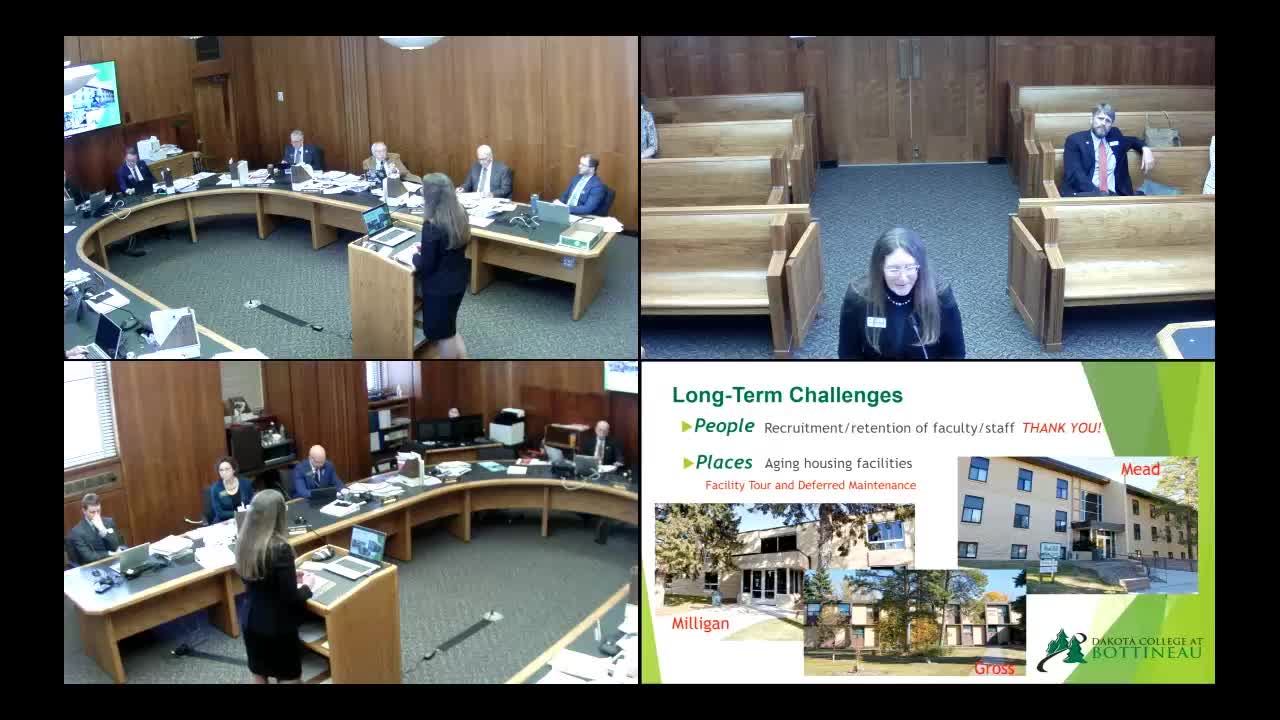
The most urgent local infrastructure issue Symone detailed was student housing. DCB operates three residence halls (Milligan, Gross and Mead) whose age and deferred maintenance have produced recurring plumbing, groundwater and structural issues. Symone provided a room‑by‑room description in testimony and cited February 2022 deferred‑maintenance estimates: roughly $1.7 million for Gross Hall, $2.9 million for Mead Hall and $2.2 million for Milligan (the testimony noted those are 2022 estimates and likely higher now). She said some facilities have asbestos ceilings, alkali‑damaged cinderblock, failing plumbing and sump‑pump dependencies.
DCB’s capital proposal described a staged plan to replace aging residence inventory with a new, modern hall on the Gross Hall footprint. Symone said the college would need to stage demolition and construction to preserve capacity during the work and estimated a project in the range discussed in testimony (a scaled, campus‑fit replacement) at roughly $30 million to replace the three existing halls over time; she said demolition of one hall without replacement would make the campus nonfunctional for residential students so sequencing is required.
Workforce and TrainND
Symone also urged the committee to consider expanding TrainND services into the Minot region (a “TrainND North Central” site) or to provide outreach funding; testimony described a $1.6 million statewide TrainND pilot request (about $400,000 per region) and DCB asked the committee to consider a smaller local allocation to establish TrainND capacity in Minot. She said TrainND-aligned workforce training would flow naturally into DCB’s CTE and allied‑health programs and that downtown DCB space could host noncredit workforce courses.
Other highlights
- DCB reported successful capital work completed earlier (Old Main renovation) and said auditors found prior control weaknesses that the campus has addressed with staff turnover and improved business-office support shared with Minot State.
- DCB requested $12.35 million jointly with Minot State for the regional health sciences campus (see separate article). Symone said the downtown location helps clinical partnerships and is already home to dental assisting and other short-term career programs.
What the committee asked and next steps
Legislators pressed for cost estimates, sequencing and bond/revenue options for housing and asked what revenue streams could support debt service. Symone said the campus relies on auxiliary revenues (housing, dining) and that revenue-bond approaches are constrained because campus-owned housing currently supports broader operating budgets; she described steps DCB is taking to increase dedicated revenue (a student dining fee and a modest roster fee for student-athletes) and said long-term replacement will require a mix of state support and local planning.
Ending
DCB asked the committee to prioritize housing and workforce outreach funding, and to consider the joint downtown health-sciences proposal. Symone said DCB will collaborate with system partners and TrainND if the legislature funds a regional expansion.