Get Full Government Meeting Transcripts, Videos, & Alerts Forever!
Get email alerts on the Public Safety Telecommunicators topic
No spam. Unsubscribe anytime.
Committee hears bill to define 9-1-1 telecommunicators as "first responders"
Summary
Senate Bill 2296 would add public safety telecommunicators to the statutory definition of first responders; supporters testified the change recognizes high training and trauma exposure and could enable access to mental-health and pension programs, while fiscal and pension effects require separate bills and notes.
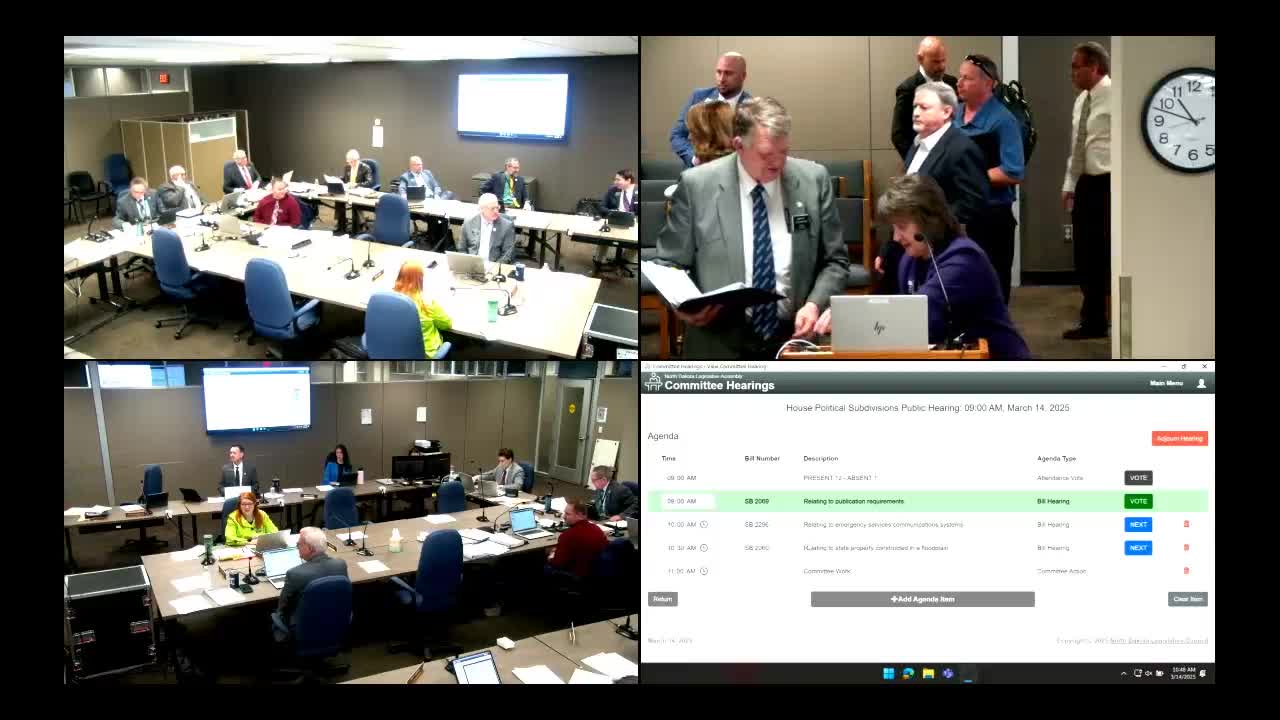
Senate Bill 2296, which would add public safety telecommunicators (9-1-1 operators/dispatchers) to the statutory definition of first responders, drew support from dispatch centers and public-safety officials at a House Political Subdivisions Committee hearing on March 6.
Senator Chuck Wallen, sponsor, told the committee the bill would list public safety telecommunicators among those defined as first responders under section 57-40.6-01 of the North Dakota Century Code, alongside firefighters, law enforcement and emergency medical personnel. "First responders provide urgent aid during an emergency," Wallen said, noting telecommunicators coordinate responses and provide life-saving instructions while field units travel to scenes.
Sarah Miller, Public Safety Telecommunications Director and president of the North Dakota 9-1-1 Association, described the day-to-day demands and trauma telecommunicators face. "The chain of public safety simply does not exist or begin without the public safety telecommunicator," she said. Supporters said the statutory change is primarily a recognition that could enable access to training, mental-health supports and make future pension participation (a separate bill) administratively simpler.
Darren Anderson of State Radio and Barnes County dispatch representatives said recognition would help recruitment and retention and noted existing mental-health supports coordinated with state law enforcement resources. Committee members asked about pension implications: several witnesses clarified that any change to retirement benefits would require separate legislation (House Bill 1419 was discussed during the hearing) and carry a fiscal note.
The committee did not record a final vote on SB 2296 during the hearing; members asked staff to check statutory cross-references and fiscal implications before further action.
Ending: Proponents framed the bill as recognition of telecommunicators' role and a first step toward ensuring parity in training and support; lawmakers requested additional fiscal and statutory analysis before advancing the measure.