Get Full Government Meeting Transcripts, Videos, & Alerts Forever!
Get email alerts on the Human Trafficking Commission topic
No spam. Unsubscribe anytime.
Senate committee hears HB 1308 to establish Human Trafficking Commission, expand training and reporting immunity
Summary
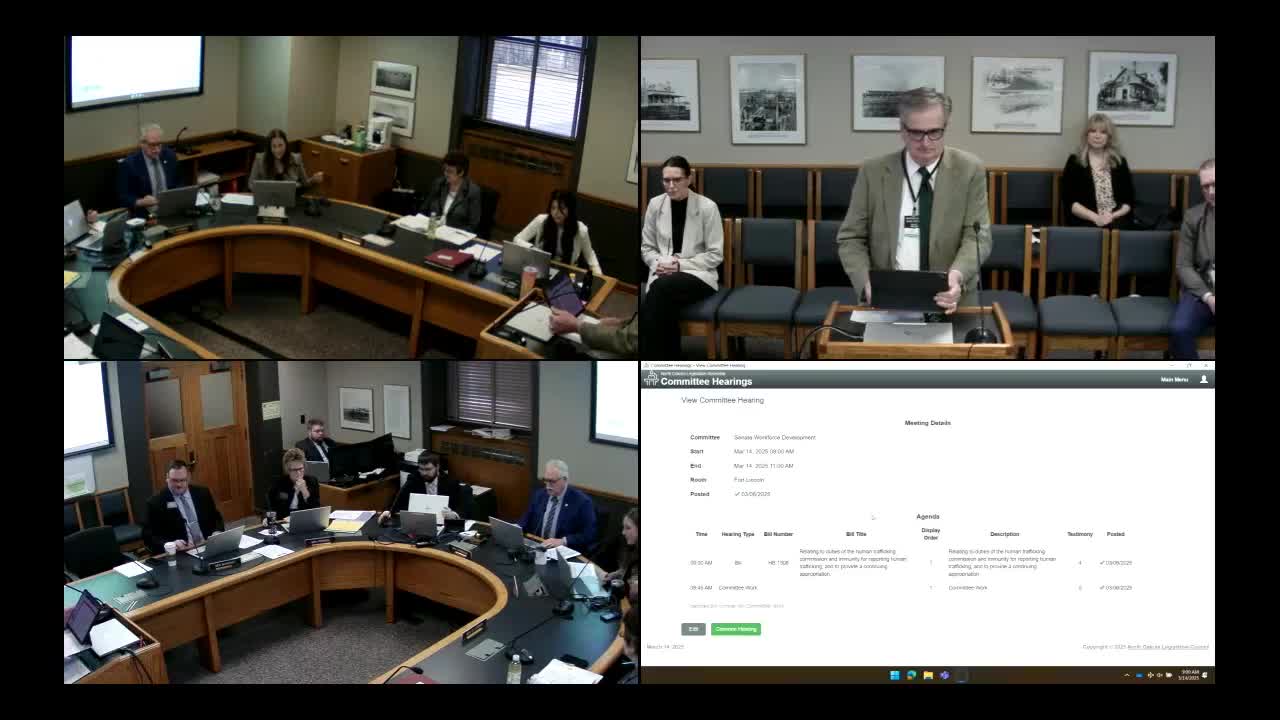
The Senate Workforce Development Committee held a hearing on House Bill 1308, a bill that would direct the attorney general to establish a Human Trafficking Commission, authorize certain regulated occupations and professions to accept human-trafficking training for continuing-education credit, and provide immunity for good-faith reporters.
The Senate Workforce Development Committee held a hearing on House Bill 1308, a bill that would direct the attorney general to establish a Human Trafficking Commission, authorize certain regulated occupations and professions to accept human-trafficking training for continuing-education credit, and provide immunity from civil liability for individuals who report suspected human trafficking in good faith. The committee took testimony but did not vote on the bill at the hearing.
Sponsor Representative Bernie Satrim of District 12 told the committee the measure’s aim is “more eyes, more educated eyes on the problem,” by adding human trafficking to continuing-education topics for regulated professionals so they can better identify and report trafficking. “If you’re a regulated individual, or occupation, that requires continuing education ... we’d like to have human trafficking be a topic for consideration,” Satrim said.
Supporters from nonprofits and faith groups described outreach, rescue and prevention work and urged the committee to pass the bill. Pastor Mark Irmin Trout, community engagement director for the God’s Child Project in Bismarck, described the organization’s anti-trafficking arm, ITemp (Institute for Trafficked, Exploited, and Missing Persons), and said the group has conducted trainings worldwide. “We cannot let up on the gas as we are making strides to combat human trafficking,” Trout said, asking the committee to “vote do pass.”
Jacob Thompson, a policy analyst with North Dakota Family Alliance Legislative Action, said permanently establishing the commission and expanding training across regulated professions would help identify victims. “This education has the potential to significantly change the lives of victims of human trafficking for the better in our state,” Thompson said.
Amy Boyd Bomi, program manager for Youthworks’ anti‑trafficking programs, urged training be calibrated to how trafficking appears in North Dakota. She said most local cases involve runaway or homeless youth exploited by people they know — including family members or people who use drugs — rather than the abduction scenarios shown in media. Boyd Bomi described a multidisciplinary response model and warned that school-based trainings must be paired with properly trained follow-up staff, because students who recognize their own experience as trafficking will need immediate, trauma‑informed support.
“The best way to combat human trafficking is with a multidisciplinary approach,” Boyd Bomi said, outlining the roles of law enforcement, prosecutors, children’s advocacy centers and nonprofits in investigations and survivor care. She told the committee that a prior administrative decision combined the attorney general’s commission with the North Dakota Human Trafficking Task Force, and that education already is part of the task force’s work.
David Tamasi, executive director of the North Dakota Catholic Conference, told the committee the conference supports language in HB 1308 requiring the attorney general to establish the commission and supporting training and immunity provisions. Tamasi said the bill changes the draft language from “may” to “shall” regarding establishment by the attorney general.
Committee members pressed witnesses on operational details. Senator Boushey asked whether age-appropriate school curriculum exists; Boyd Bomi said her organization and other local groups already provide youth‑specific curriculum but that scaling statewide could require additional staffing and funding. She estimated that broadly delivering prevention curriculum statewide could require roughly one full-time equivalent staff per quadrant of the state to do the work well, and also flagged secondary-trauma training and supports for trainers.
Witnesses and senators discussed related measures and study options. Witnesses referenced the state’s 2015 Uniform Act on Prevention of and Remedies for Human Trafficking and administrative reporting processes; committee members noted other bills and a proposed study resolution are also pending and suggested coordinating language or using an interim study to develop a more comprehensive legislative approach.
The committee closed the public hearing on HB 1308 without taking a vote. Senators discussed taking additional time to consider the commission's duties, funding and how the bill should interact with other proposals under consideration in the Legislature.