Get Full Government Meeting Transcripts, Videos, & Alerts Forever!
Get email alerts on the Higher Education Budget topic
No spam. Unsubscribe anytime.
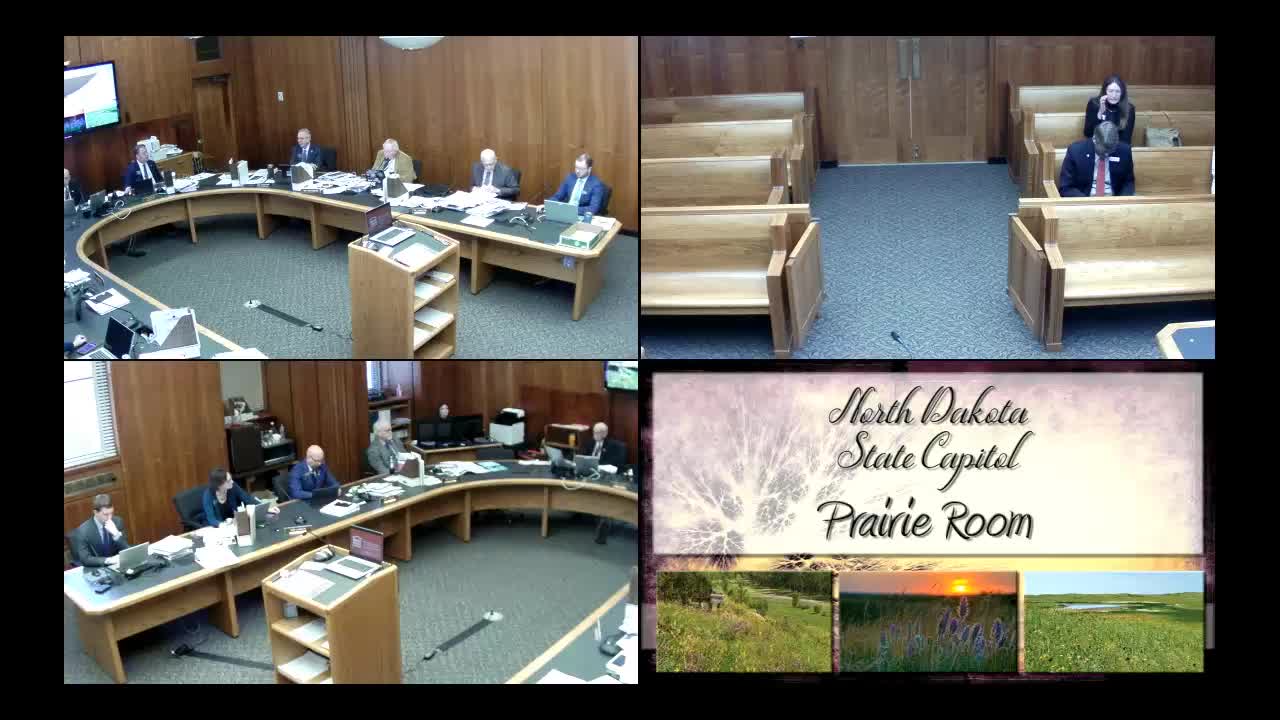
Minot State lays out enrollment gains, workforce programs and capital needs during SB2003 hearing
Summary
Minot State University officials told the Appropriations - Education and Environment Division that enrollment is stabilizing, nursing and cyber programs are growing, and the university seeks state funding for academic renovations and other capital needs included in Senate Bill 2003.
Minot State University officials told the Appropriations - Education and Environment Division on the hearing for Senate Bill 2003 that enrollment has edged up after COVID-related declines, key workforce programs are expanding and the campus is seeking state support for academic renovations and several capital projects.
President Shirley, Minot State University’s lead witness in the hearing, said the university’s spring enrollment is “just over 2,600” students and that enrollment is up for a third consecutive semester. He told the committee the institution’s largest majors are nursing (about 70 baccalaureate graduates annually), social work, management and elementary education, and he highlighted newer programs such as exercise science and rehabilitation, cybersecurity (a National Security Agency/Department of Homeland Security designated cyber defense center of academic excellence), entrepreneurship and a new data science major.
Shirley said the university has no recent audit findings in state auditor reports and credited the business office for financial controls. Krista Lambrecht, Minot State’s vice president for administration and finance, gave the committee a fiscal overview, saying fiscal 2024 operating revenue came mainly from grants and contracts, state appropriations, and tuition and fees and noting a funding-formula adjustment tied to enrollment changes.
Why it matters: Minot State described programs tied directly to regional workforce needs — especially nursing and health-related fields — and framed capital requests as aimed at maintaining and upgrading instruction and lab spaces that support those programs.
Most important details
- Nursing: Shirley said the nursing program graduates about 70 baccalaureate nurses per year and that Minot State has expanded partnerships (including guaranteed-admission pathways with regional community colleges) to grow capacity.
- Academic and capital requests in SB2003: Lambrecht summarized the university’s base budget request and Senate adjustments; the Senate version included a funding increase and a $8,100,132 one-time academic space renovation line intended for laboratory and teaching-space upgrades (no new square footage). Shirley also detailed three capital priorities the campus had asked the State Board to rank: the academic-space renovation (the one with legislative intent), a proposed regional health sciences campus (a joint Minot State–Dakota College at Bottineau request), and demolition work for an aging residence hall (Dakota Hall) that requires additional tunnel shoring work estimated at roughly $1.4 million in total to complete the demolition safely.
- NDCPD and new program funding: The Senate included $500,000 for an MSU-hosted program described in testimony as the MSU Advancing Students Towards Education and Employment Program (through the North Dakota Center for Persons with Disabilities). Shirley said the program serves students with developmental disabilities and is spreading to other campuses.
- Challenge grant and foundation fundraising: Shirley said Minot State recently concluded a multiyear capital campaign that raised about $55 million; he credited the state challenge-grant program for enabling growth in endowed scholarships.
- Student modalities and outcomes: Shirley presented data showing a substantial shift to hybrid and online modalities since 2019; he also said the six-year bachelor’s completion rate (IPEDS measure for first-time, full-time freshmen) is roughly mid-40 percent and that first-year (freshman-to-sophomore) retention has remained near 70 percent over the last eight years.
What the committee asked and what followed
Committee members questioned Shirley and Lambrecht about when Career and Technical Education (CTE) programs would return to the committee, the status of the IT rate and funding-formula adjustments, and how the campus is preparing for a planned influx of personnel tied to changes at Minot Air Force Base. Shirley said the university is “starting to think through” the long-term implications of increased base personnel but has not yet adopted specific ramp-up plans for 2025.
Ending
Minot State officials told the committee they would return for a deeper dive on larger capital requests. The university presented its operating request, noted the Senate adjustments, and asked the committee to consider full funding for academic renovation priorities and the jointly proposed health-sciences initiative.