Get Full Government Meeting Transcripts, Videos, & Alerts Forever!
Get email alerts on the Wildlife Funding topic
No spam. Unsubscribe anytime.
Game and Fish fee increase debated; committee delays action to gather more detail
Summary
Senators heard extensive testimony on House Bill 1470, which would raise multiple hunting, fishing and outfitter fees to shore up the Game and Fish fund; the committee requested more information and postponed action.
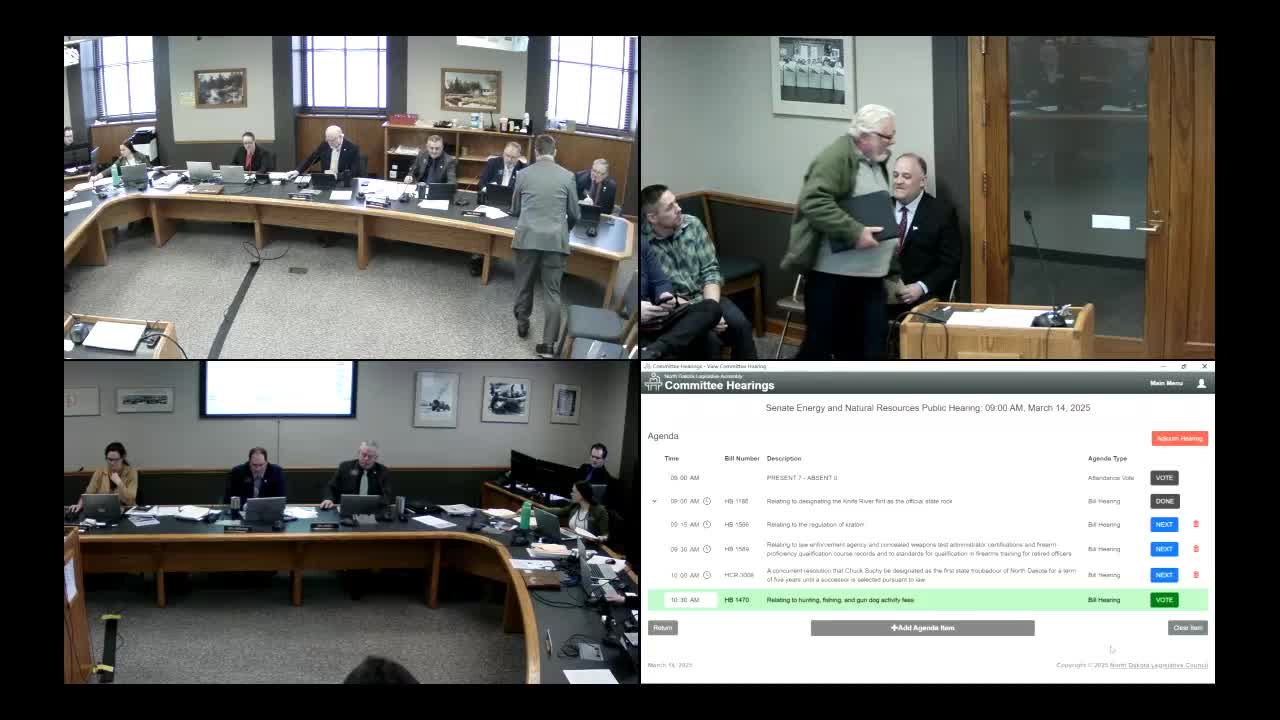
The Senate Energy and Natural Resources Committee heard detailed testimony on House Bill 1470, a package of license and fee adjustments proposed to address projected declines in the Game and Fish special fund, but did not vote and asked department staff for further information.
Representative Glenn Bosch introduced the bill and said department projections indicated the Game and Fish Fund could fall below the statutory reserve requirement of $15 million by the end of the 2025–27 biennium if revenue is not adjusted. He noted the last license-fee change occurred in 2013 and that the proposed increases aim to preserve department programs including habitat and access work.
Supporters including the North Dakota Wildlife Federation and Backcountry Hunters and Anglers urged a due-pass recommendation, saying the department needs predictable revenue to expand habitat and access programs. John Bradley of the Wildlife Federation said fee increases would enable the department to lead habitat partnerships and leverage state and federal dollars. Brock Wall of Backcountry Hunters and Anglers emphasized recent habitat losses and rising costs of access and landowner agreements.
The department explained its funding mix (approximately 46% from federal excise taxes and the rest from license sales) and reiterated the legal requirement to maintain a $15 million ending balance. Director Jeb Williams also acknowledged that some low-use licenses in statute were being removed and that the agency had provided a draft amendment to correct a clerical inconsistency in the bill.
Committee members pressed for more detail on fee calculations, fiscal projections and administrative implications. Director Williams asked for time to review the amendment and consult internally; the committee agreed to delay action to a later date to allow staff follow-up.