Get Full Government Meeting Transcripts, Videos, & Alerts Forever!
Get email alerts on the State And Local Government topic
No spam. Unsubscribe anytime.
Lawmakers debate scope of proposed interim study on state employee pay
Summary
Representatives and agency officials told the State and Local Government Committee that an interim legislative study of state employee compensation should examine total rewards, prevailing wages on state projects and whether to use consultant support; no committee vote was recorded.
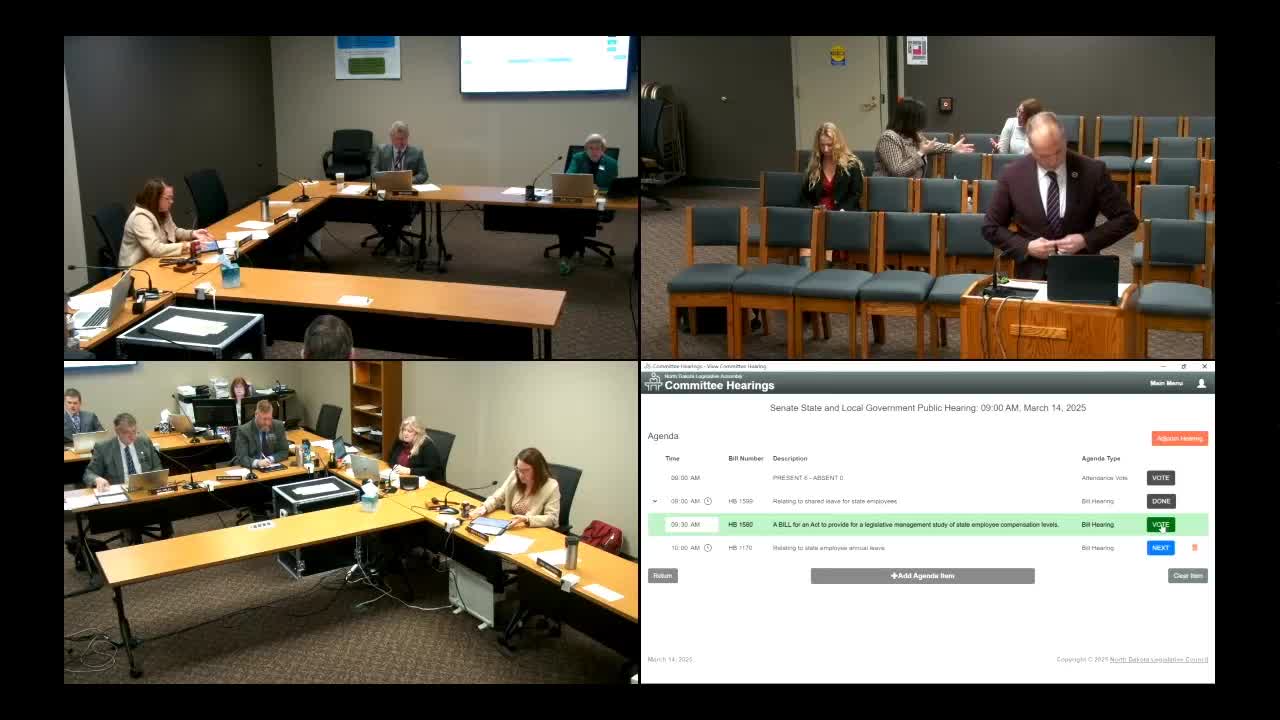
The State and Local Government Committee heard testimony on House Bill 1580, a bill to direct the interim legislative management to consider a study of state employee compensation levels, including comparisons with private-sector pay, the use of equity funding and bonuses to retain staff, and prevailing wage considerations for state projects.
Representative Steve Vetter told the committee the measure is intended to assemble existing agency data into a package for legislators. “Where do we rank comparison to private sector jobs?” Vetter asked, saying the study would gather agency pay-history data and consider whether targeted incentives are needed for specialized roles such as investment managers, legislative counsel and attorneys.
Discussion in committee focused on the study’s scope and methodology. Senator Lee and other members noted the value of examining the full “total rewards” package — pay, retirement and health benefits — rather than wages alone. Molly Harrington, the state’s chief people officer and director of Human Resource Management Services (HRMS) at the Office of Management and Budget, recommended a total-rewards approach and said the last full in-depth review was more than a decade ago. Harrington also warned that recent and proposed changes — including a move from defined benefit to defined contribution retirement structures and proposed health-plan changes referenced in the hearing record — alter the context and make a comprehensive review timely.
Committee members debated whether a third-party consultant would be necessary. Senator Lee said a consultant could be appropriate given the workload and technical complexity; Representative Vetter said agency data might be sufficient and noted the state treasurer supported the study on the House side. No formal motion or committee vote on HB 1580 was recorded in the hearing minutes; the bill would only become a formal study if selected by legislative management.
Committee members and staff discussed possible additions to the study language — including a broader review of pay-grade classifications, health-care benefit options and the impact of moving from a grandfathered to a non-grandfathered health plan — and how final wording might change depending on concurrent action on health-plan legislation.