Get Full Government Meeting Transcripts, Videos, & Alerts Forever!
Get email alerts on the State And Local Government topic
No spam. Unsubscribe anytime.
Committee advances technical cleanup to shared-leave law after brief hearing
Summary
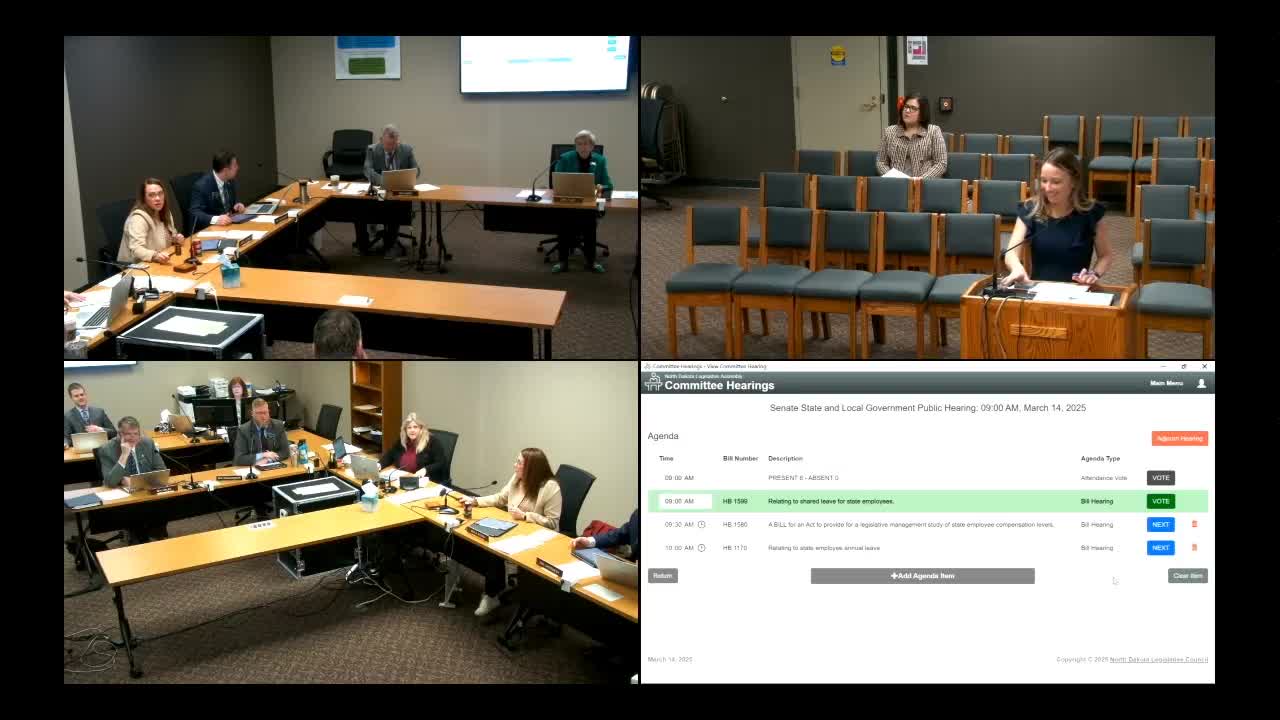
The State and Local Government Committee gave a unanimous do-pass recommendation to House Bill 1599, a technical cleanup to the state shared-leave program that removes duplicated language and withdraws a prior attempt to single out pregnancy as a covered condition.
The State and Local Government Committee voted 6-0 to give a do-pass recommendation to House Bill 1599, a technical cleanup to the state shared-leave program that removes duplicated text and an earlier attempt to single out pregnancy as a covered condition.
Representative Emily O’Brien, who introduced the bill in the House, told the committee the current hearing reflects a cleanup of duplicative language. “This really is just a technical correction,” Representative O’Brien said. She explained the bill removes language that would have singled out pregnancy and strikes duplicate lines that were added in error, and said a physician would still be able to verify qualifying conditions under the shared-leave program.
The cleanup replaces text on page 1 and page 2 of the bill to remove duplicated phrasing and the previously proposed insertion identifying pregnancy as a covered condition. O’Brien said the version before the committee is the corrected draft and does not change the program’s substantive process beyond eliminating duplicate text and the singled-out condition.
After testimony closed with no opposition, Senator Lee moved a do-pass recommendation; Senator Wallen seconded. The clerk’s roll call recorded aye votes from Chair Roars, Vice Chair Castaneda, Senators Barta, Brownberger, Lee and Wallen, yielding a 6-0 do-pass recommendation. Committee members asked for a volunteer to carry the bill to the floor; no carrier was announced during the hearing record.
The committee’s action is a committee-level recommendation only; the bill will still require a floor vote and any subsequent amendments before final enactment.