Get Full Government Meeting Transcripts, Videos, & Alerts Forever!
Get email alerts on the Kratom Regulation topic
No spam. Unsubscribe anytime.
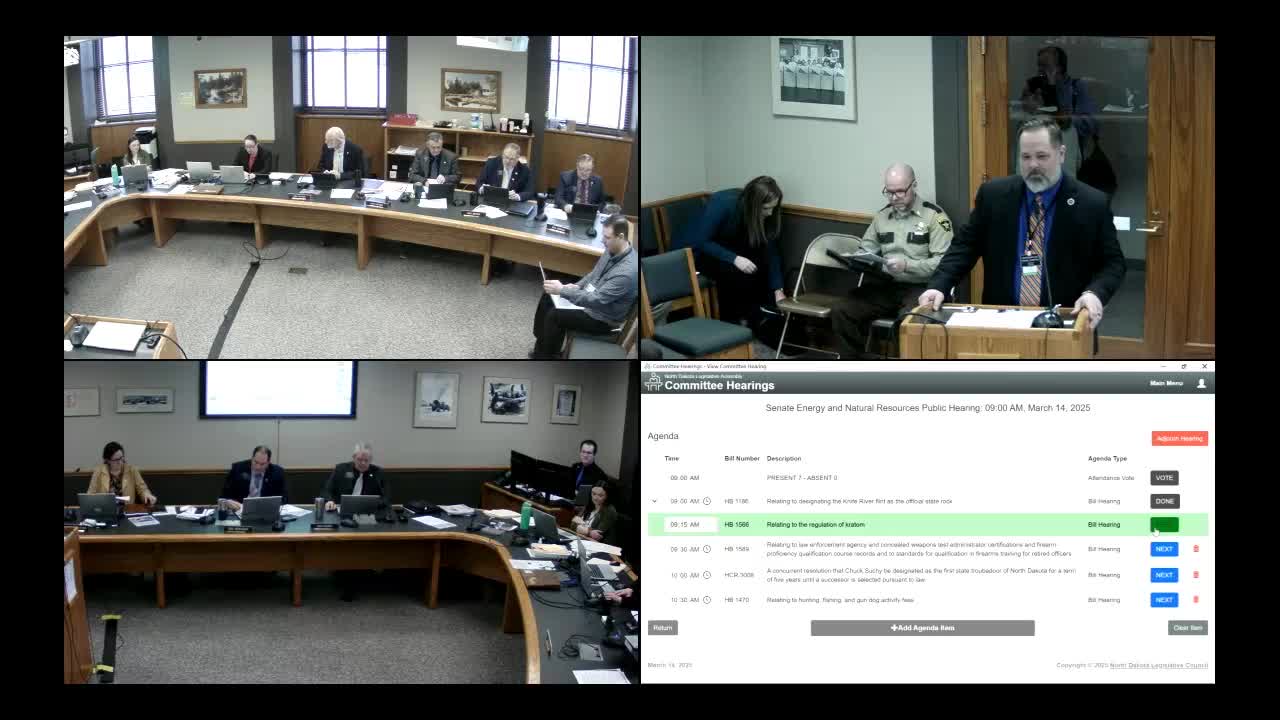
Committee hears competing views on kratom; bill left in study form as stakeholders seek regulatory approach
Summary
Lawmakers heard extensive testimony from users, industry groups and state health officials about kratom and left House Bill 1566 in study form to allow further work on an appropriate regulatory framework.
The Senate Energy and Natural Resources Committee heard hours of testimony on House Bill 1566, a proposal to create a regulatory framework for kratom products in North Dakota, but did not advance the bill; lawmakers left it in study form to allow further review and stakeholder work.
Sponsor testimony said the impetus for the bill came after a bill to schedule kratom as a controlled substance produced mixed evidence in another committee. Representative Dan Johnson (District 24) told senators that consumers, parts of the industry and some law enforcement have asked for regulation so users can know whether they are buying “pure, unadulterated stuff.” He also cited concern about a fiscal note attached to an earlier regulatory version that estimated eight full-time employees would be required to enforce the scheme.
Industry representatives urged regulation rather than prohibition. Scott Meske of the American Kratom Association said the industry wants “guardrails” to protect consumers and to prevent bad actors from selling adulterated products. Kurt Bramble, a former Utah state senator who helped draft Utah’s Kratom Consumer Protection Act, described the policy as a model that requires laboratory certificates of analysis, prohibits synthetics and sets labeling standards.
Opponents and neutral agency witnesses emphasized the complexity and fiscal impact of a regulatory scheme. Allison Hicks, assistant attorney general and general counsel for the public health division of the Department of Health and Human Services, said the department was neutral on the study but had opposed the prior regulatory bill because it had not been developed with the regulator and because the fiscal note reflected substantial administrative costs. Hicks recommended time for a careful, multistakeholder design process.
Representatives of the Global Kratom Coalition and the American Kratom Association asked the committee to amend the study into an enforceable Consumer Protection style bill; others urged study so North Dakota could draw on models from other states. Committee members stressed the need to “get it right” and allow the attorney general and agency staff time to review enforcement options and fiscal implications. The committee closed the hearing without action, leaving the matter in study form for further work.