Get Full Government Meeting Transcripts, Videos, & Alerts Forever!
Get email alerts on the State Symbols topic
No spam. Unsubscribe anytime.
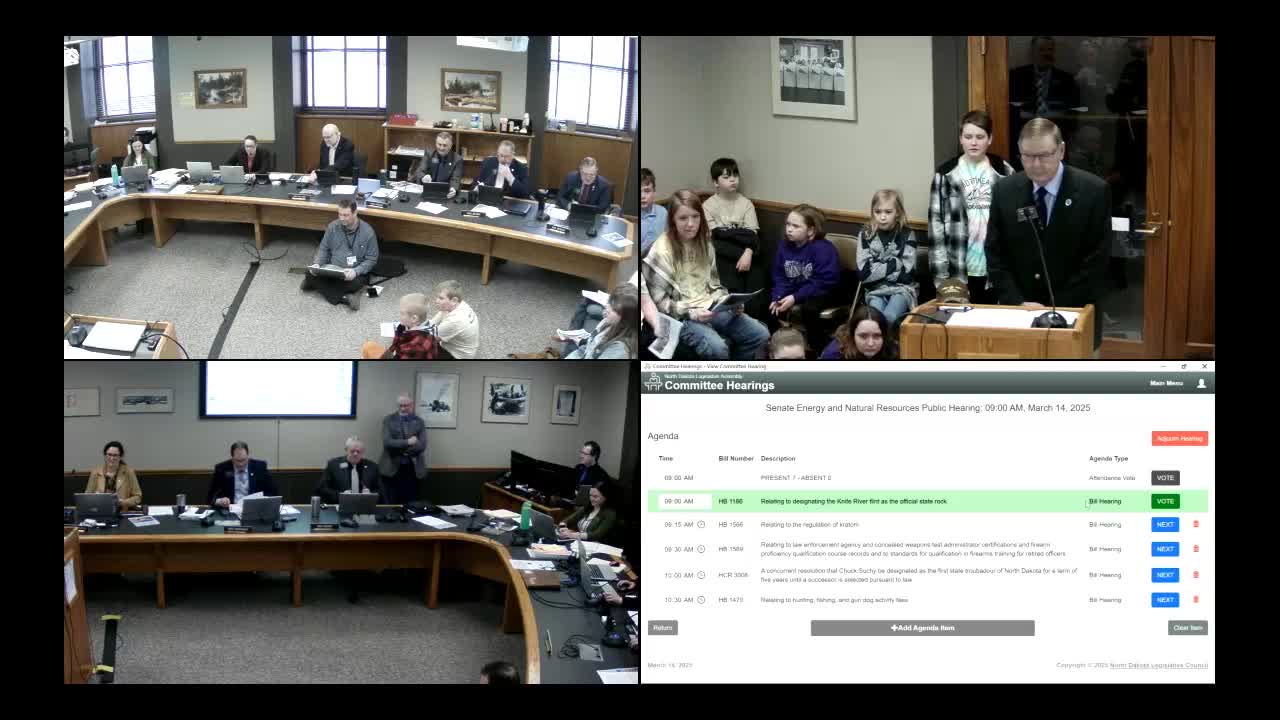
Senate committee advances bill to name Knife River Flint North Dakota’s official state rock after students testify
Summary
The Senate Energy and Natural Resources Committee voted 7-0 to give House Bill 1186 a “do pass” recommendation after students, educators and geologists described Knife River Flint’s geological and cultural importance.
The Senate Energy and Natural Resources Committee voted unanimously to give House Bill 1186 a “do pass” recommendation after hearing testimony about Knife River Flint’s geological and historical significance.
The bill, introduced as House Bill 1186, would designate Knife River Flint as North Dakota’s official state rock. Committee members heard a mix of student-led testimony, educational context from Dakota College at Bottineau staff and historical perspective from the state geologist.
Michelle Cawley, a natural resources and geology instructor at Dakota College at Bottineau, told the committee the bill grew out of a student civics project. “We had a school wide vote for the K–12,” she said, and the students researched several candidate rocks before 56% of voters chose Knife River Flint. Several Botineau Rockhound club members described properties of the material: third grader Anna Sand said Knife River Flint is “a hard sharp rock” useful for tools and making sparks; fourth grader Kaylana said Knife River Flint “is unique” and “is only found in North Dakota.”
State geologist Ed Murphy described the rock’s archaeological importance and the Lynch Quarry near Dunn Center. Murphy said artifacts made from Knife River Flint have been found across North America and that the Lynch Quarry has been recognized at the national level, noting it was made a national historic landmark in 02/2011.
After the testimony, Senator Beard moved a do-pass recommendation; Senator Van Oosting seconded. The clerk recorded 7 ayes, 0 nays. Committee leadership assigned Senator Van Oosting to carry the bill to the Senate floor.
The hearing record includes student vote totals and references to local quarries; sponsors and supporters emphasized the bill’s educational and civic-engagement value in addition to the rock’s cultural and archaeological history. The committee did not receive any opposition testimony during the hearing.