Get Full Government Meeting Transcripts, Videos, & Alerts Forever!
Get email alerts on the Labor And Industry topic
No spam. Unsubscribe anytime.
Labor & Industry director Joel Sachs defends agency focus on safety, claims management and modernization
Summary
Joel Sachs, director of the Department of Labor & Industry, told the Senate committee his agency’s priorities include worker and public safety, workers’ compensation outcomes, customer experience and technology modernization; senators asked about caseloads and rate pressure.
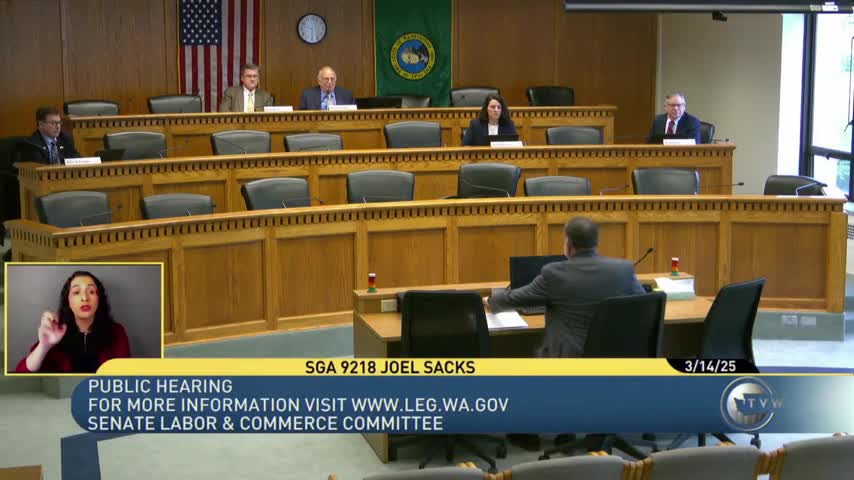
Joel Sachs, nominated for reappointment as director of the Department of Labor & Industry, testified before the Senate Labor & Commerce Committee about the agency’s priorities and operational challenges.
Sachs said the department focuses on five goals: public and worker safety, workers’ compensation outcomes, customer experience, enforcement balance, and cultivating staff to deliver services. On workers’ compensation he emphasized the objective of helping injured workers heal and return to work and said caseloads per claims manager in Washington are higher than in some comparison states, which can slow outcomes.
Senators pressed Sachs on rate increases and what the agency can do to relieve pressure on employer rates. Sachs said the department aims for steady, predictable rate changes and compares rate-setting to wage inflation; he described strategies to manage costs by increasing reserves, investing in early-return-to-work programs such as vocational counseling and the stay‑at‑work program, and by improving administrative efficiency. He also identified three major challenges going forward: reducing caseloads for claims managers, investing in technological infrastructure, and supporting injured workers who need retraining to return to the workforce.
Sachs told senators the department is pursuing technology modernization and earlier vocational engagement as tools to improve outcomes and control cost growth. The nominee was sworn under Senate Rule 69 and took questions from several committee members; the committee did not record a confirmation vote at the hearing.