Get Full Government Meeting Transcripts, Videos, & Alerts Forever!
Get email alerts on the Adu Self Certification topic
No spam. Unsubscribe anytime.
Bill would let cities run architect‑led self‑certification for detached ADUs; audits and penalties required
Summary
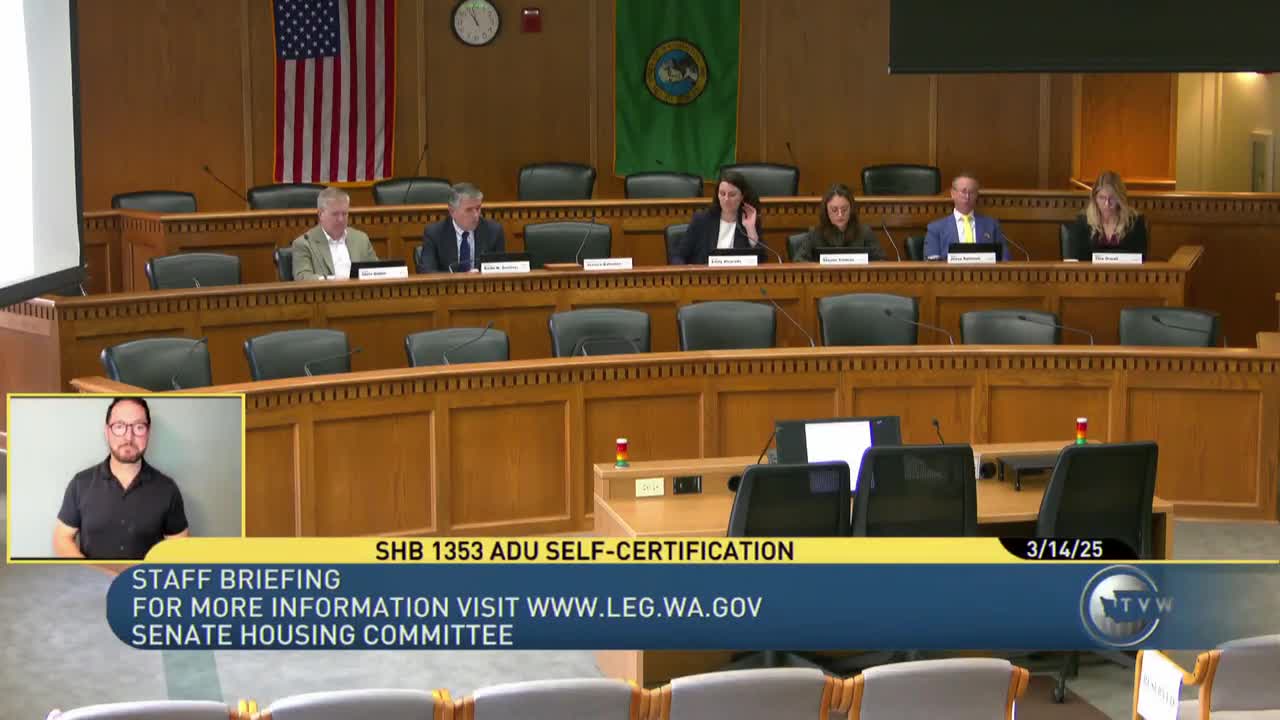
A bill creating an opt‑in self‑certification program for detached accessory dwelling unit permit applications, certified by registered architects and subject to audits and penalties, was presented to the Senate Housing Committee on March 14.
A substitute House bill to authorize local self‑certification programs for detached accessory dwelling units was debated in the Senate Housing Committee on March 14.
Staff explained the bill permits cities to operate an opt‑in program under which registered architects may self‑certify that a detached ADU application complies with applicable requirements. Cities would adopt program rules, random audit protocols and minimum professional‑liability insurance requirements. The bill requires random audits such that at least 20% of applications or five applications, whichever is fewer, are audited annually and establishes penalties: an architect who fails an audit is temporarily barred from the program for at least one year and may be permanently barred after repeated failures.
Representative Alex Rammell, sponsor of the House version, said the pilot focuses narrowly on detached ADUs and is intended to speed permit timelines in jurisdictions that choose to opt in. "The goal here is that that can accelerate how quickly the permit can be approved and we can get to construction," Rammell said, while noting projects remain subject to inspections after construction.
Senator Gaynor asked whether the bill’s attestations and penalties distinguish between inadvertent errors and knowing misrepresentations. Staff replied that failed audits trigger program suspensions and noted program rules would be set by each city; senators requested clarifying language on the consequences for knowingly false attestations and the process for appeals or discipline.
The bill requires cities operating programs to report penalties to Commerce and allows Commerce to maintain a database of architects subject to penalties. Cities with existing self‑certification programs as of July 26, 2025 may continue operating under prior rules. Commerce would receive program reports and summarize outcomes to the Legislature by December 31, 2028.
Ending: Sponsors described the bill as a narrowly tailored, opt‑in pilot for detached ADUs; committee members asked staff and sponsors to clarify language distinguishing inadvertent errors from intentional false attestations and to ensure audit and discipline procedures were clear.