Get Full Government Meeting Transcripts, Videos, & Alerts Forever!
Get email alerts on the Housing Court topic
No spam. Unsubscribe anytime.
Bill to let superior courts appoint housing‑court commissioners advances to hearing; sponsors cite surge in eviction filings
Summary
A bill authorizing superior courts to appoint housing court commissioners was discussed. Supporters said the commissioners could help clear an expanded unlawful‑detainer caseload; courts and associations noted training and fiscal implications.
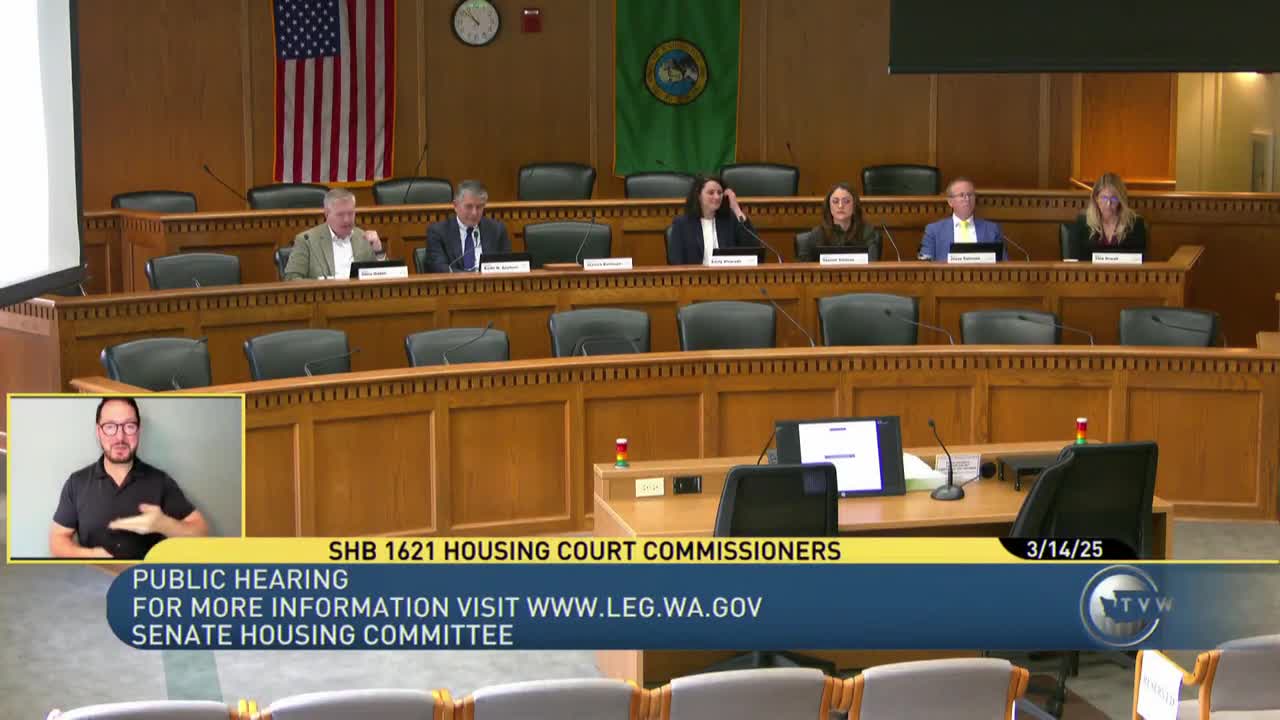
The Senate Housing Committee held a public hearing on a bill that would allow superior courts to appoint housing court commissioners to assist with unlawful detainer (eviction) dockets.
Committee staff described the statutory background: the Washington State Constitution authorizes superior courts to appoint commissioners, and the legislature has previously authorized specialized commissioners with limited powers. The substitute bill would authorize courts in every county to appoint one or more attorneys as full‑ or part‑time housing court commissioners, with appointments requiring consent of the county legislative authority and a majority vote of county superior court judges.
Representative Nicole Macri, sponsor of the House version, said the bill responds to a historic rate of eviction filings. "As of the end of 2024, we had over 23,000 eviction filings," she said, and argued courts are overwhelmed, particularly on matters of nonpayment of rent.
Judge Sean O’Donnell of the King County Superior Court and the Superior Court Judges Association testified in favor. He said some courts’ pending unlawful‑detainer caseloads have climbed substantially (he contrasted a 2019 average pending caseload of about 480 unlawful detainer cases in King County with a pending caseload of over 2,200). The judges’ association offered to help with judicial education; sponsors acknowledged the bill includes training requirements that could affect fiscal notes.
Housing providers also testified in support, saying the bill could speed resolution of issues that affect entire multifamily communities. The substitute carried an emergency clause in the House version, and staff noted the administrative office of the courts had raised possible training costs tied to that clause.
Ending: Proponents urged the committee to support the bill to provide courts relief; staff and sponsors indicated they would work with the administrative office of the courts on training language and any potential fiscal effects.