Get Full Government Meeting Transcripts, Videos, & Alerts Forever!
Get email alerts on the Building Conversion topic
No spam. Unsubscribe anytime.
Committee considers easing rules for converting existing buildings to housing, including energy‑code carve‑outs
Summary
A bill that would limit local permitting and state energy code triggers for conversions of existing buildings to residential units drew testimony from the bill sponsor and industry representatives, who argued the changes lower barriers to converting underused space into homes.
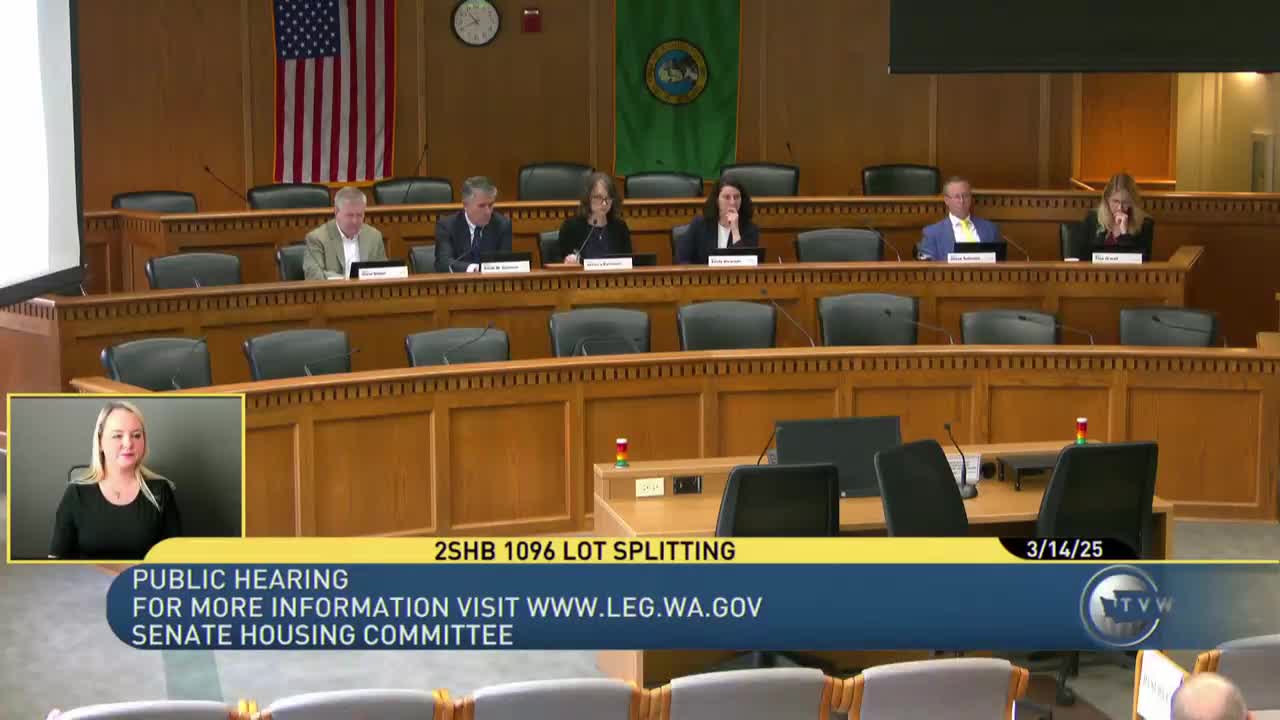
A substitute House bill to modify local regulation of conversions of existing buildings to residential use was presented to the Senate Housing Committee on March 14.
Staff summarized the bill as adjusting local land‑use regulations and the state building code to make it easier to convert underutilized commercial and other buildings into housing. The staff briefing said cities must amend land‑use regulations within specified timelines and that the bill would prohibit some local requirements (for example, change‑of‑use permits in certain circumstances) and exempt some conversions from the current state energy code under limited conditions.
Representative Amy Walen, the bill’s prime sponsor, told the committee the measure builds on prior work to make conversions feasible. "This is not a giant piece of policy, but I think it's an important one," she said, adding that long permit timelines, financing barriers and uncertainty block conversions of underused buildings into housing. Walen said the bill is intended to allow modest reorganization of building envelopes and limited new units without triggering full, building‑wide energy code upgrades that can make conversions infeasible.
The staff briefing described technical thresholds that, if met, exempt a portion of added residential floor area from current state energy code requirements — for example, when the added residential space is under a stated square‑foot threshold or a percentage of total building square footage and when a building owner documents projected energy‑use intensity at or below the applicable target.
Senators asked whether cities could still require local permits in zones that are not strictly residential. Staff said the bill prevents cities from requiring change‑of‑use permits for conversions to residential purposes in the specified contexts but that staff would follow up on questions about specific zones.
Supporters from multifamily owners testified the bill would streamline conversions of underused amenity or retail space into housing. An asset manager for a national REIT described converting storage or amenity space into studio and one‑bedroom homes in California and said the bill would let owners bring units online without replacing central building systems solely because of a limited conversion.
Staff noted the bill sets city compliance deadlines (cities must comply by June 30, 2026) and that the fiscal note indicates indeterminate but nonzero local impacts. The hearing was suspended for further review and potential amendments.
Ending: Sponsors asked the committee to advance the bill to ease reuse of buildings for housing; staff and local governments will follow up on zoning and permitting specifics.