Get Full Government Meeting Transcripts, Videos, & Alerts Forever!
Get email alerts on the Land Use Subdivisions topic
No spam. Unsubscribe anytime.
Committee hears bill to standardize unit‑lot subdivision rules to expand homeownership for middle housing
Summary
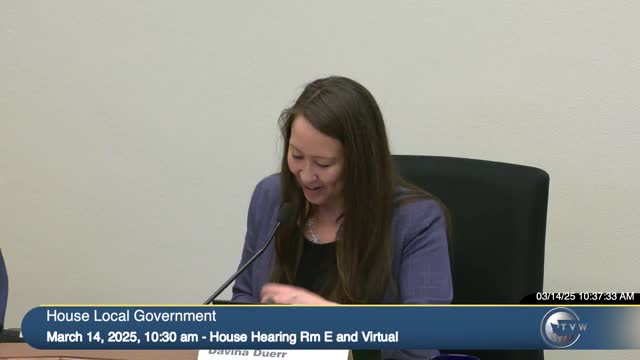
Senator Liz Lovett, sponsor and chair of the interim work group on land use, and Elizabeth Allison, staff to the Local Government Committee, opened the hearing on engrossed Senate Bill 5,559, which would set statewide baselines for unit‑lot subdivision procedures inside counties planning under the Growth Management Act.
Senator Liz Lovett, sponsor and chair of the interim work group on land use, and Elizabeth Allison, staff to the Local Government Committee, opened the hearing on engrossed Senate Bill 5,559, which would set statewide baselines for unit‑lot subdivision procedures inside counties planning under the Growth Management Act.
The bill would require cities and towns located in counties subject to the Growth Management Act to adopt procedures for unit‑lot subdivisions and, at minimum, require prominent informational notes on recorded plats stating that specified requirements have been met. The text in the staff briefing says the procedures must: limit public pre‑decision meetings or hearings, allow only administrative design review, require clear and objective design and development standards, be logically integrated with underlying application review, and be subject to statutory time limits unless a project‑specific extension is agreed.
"We want people to be able to have fee‑simple opportunities to own the dirt under their home," Senator Liz Lovett, Fortieth Legislative District, told the committee, framing the bill as a tool for middle housing and homeownership. Elizabeth Allison, committee staff, briefed the committee on existing subdivision terms and said the bill clarifies how unit‑lot subdivisions relate to short plats and other subdivision types.
Supporters from the homebuilding and housing sectors said the bill fills a statutory gap left by earlier requirements that only asked jurisdictions to adopt procedures for unit‑lot subdivisions without providing guidance. "For those jurisdictions who have adopted procedures, the intention is that they won't have to do anything differently; for those who haven't, the hope is this provides a helpful framework," Riley Benge, Washington Realtors, told the committee. Ryan Donahue, chief advocacy officer for Habitat for Humanity Seattle‑King‑Kittitas Counties, said procedural clarity reduces cost and delay and cited a Burien project that faced nearly $1 million in extra costs because of subdivision issues.
Representatives of the Master Builders Association and the Building Industry Association urged support as a practical tool to allow ownership of underlying lots in townhome and attached housing projects. Scott Hazelgrove of the Master Builders Association said unit‑lot subdivision lets owners "own the dirt" without changing what is built on a site.
Cities and local government groups generally supported the bill's goals but asked for clarifications. Carl Schrader of the Association of Washington Cities said definitions (for example, "parent lot") should be reconciled with related legislation, and several cities (Tacoma, Redmond, Kent) asked for explicit exemptions or language clarifying when shoreline hearings would still be required. Scott Bajukian and Chris Collier of the American Planning Association Washington chapter recommended aligning bill language with the Department of Commerce model code and harmonizing definitions across pending bills.
Committee staff and witnesses identified key deadlines and limits stated in the bill: cities and towns required to submit their next comprehensive plan in the 2027 update cycle must incorporate the procedures in that update cycle; other jurisdictions must implement the procedures within two years of the bill's effective date. Staff also noted that the bill does not prohibit cities and counties from applying public health, safety, building code, and environmental permitting requirements to projects subject to a unit‑lot subdivision process, nor does it require local governments to authorize development where other laws or ordinances restrict it.
Several witnesses urged technical edits to reduce ambiguity—particularly to clarify definitions, required plat notes, and how unit‑lot subdivisions interact with other instruments such as lot splits. Several testifiers recommended that the Department of Commerce's recently published factsheet and model language be used to harmonize the statutory definitions. Cities requested more time for Commerce guidance in one instance; other witnesses suggested spelling out where hearings are still required, such as for shoreline substantial development permits.
The committee took public testimony from builders, planners, housing advocates and city staff, and then closed the public hearing on SB 5,559 before opening a hearing on the parking bill. No formal committee vote on SB 5,559 was recorded in the transcript.
Why it matters: The change aims to expand fee‑simple ownership opportunities in townhouses, cottage housing and attached middle‑housing types by standardizing a subdivision tool that local governments may use differently today. Proponents say clearer, uniform state baseline rules reduce transaction costs and legal ambiguity; local officials want precise definitions and process safeguards to reflect local variations and shorelines.
What comes next: The bill will return to the committee process for any amendments addressing technical questions raised by cities and trade groups. Several witnesses offered to provide drafting suggestions and model code language to the sponsor and committee staff.